GMB Management: Run Google Business Profiles Like a Pro
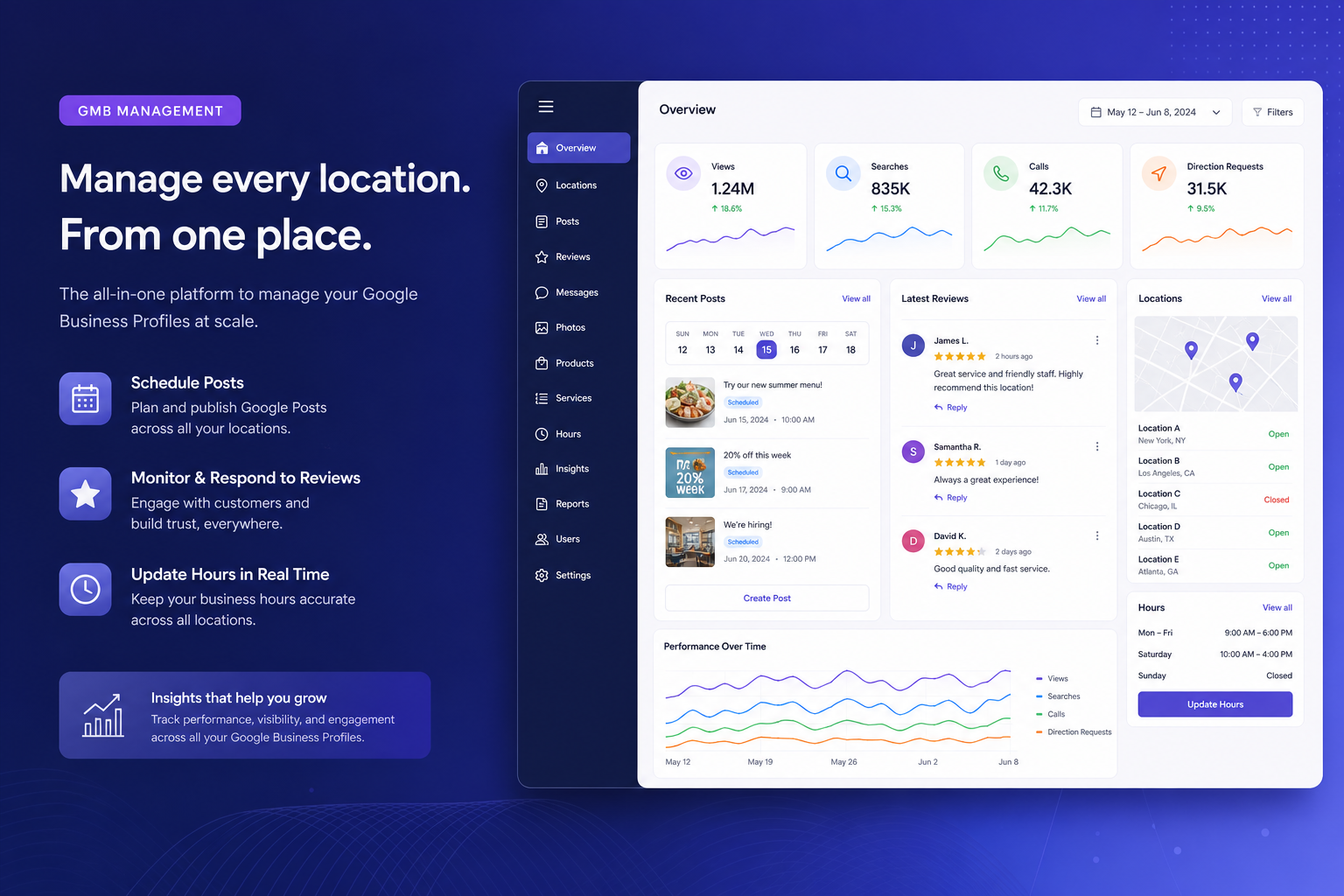
GMB management is the operating system behind a healthy Google Business Profile: who can edit, what gets updated, how reviews are handled, and how performance is reported. Whether you manage one storefront or a hundred, professional processes prevent ranking surprises, brand damage, and access chaos. This guide shows how to run Google Business Profiles like a disciplined local marketing channel.

Management vs Optimization: You Need Both
Optimization improves the quality of the listing. Management keeps that quality stable over time. Hours change, staff turn over, photos age, spam posts appear, and competitors evolve. Without management, last quarter’s optimization quietly decays.
A professional GMB management program covers access control, content calendar, review operations, issue escalation, compliance checks, and reporting. It also defines what local managers may change versus what requires central approval—especially for name, category, and website fields that can trigger policy or brand problems.
Agencies should present management as an ongoing service with clear deliverables, not vague “we monitor your GMB” language. Owners deserve a rhythm they can see: weekly tasks completed, monthly insights reviewed, quarterly strategy adjustments based on Maps performance.
Publish an internal service catalog for GMB management: what is included weekly, what is monthly, what requires change requests, and what is out of scope. Ambiguous retainers create missed expectations even when the team is busy inside Google Business Profile.
Publish an internal service catalog for GMB management: what is included weekly, what is monthly, what requires change requests, and what is out of scope. Ambiguous retainers create missed expectations even when the team is busy inside Google Business Profile. Put that catalog in onboarding so new marketers inherit the same boundaries.
Access Control and Security First
Start every management engagement with a People and access audit. Remove unknown users. Ensure the Owner is a company-controlled account. Grant managers least privilege. Require 2-Step Verification. Document offboarding steps so employees and vendors lose access the day relationships end.
Shared passwords are a liability. Use proper Google roles and, where needed, an agency dashboard that syncs data without circulating Owner credentials. Hijacks and revenge edits are management failures as much as security failures.
Keep an evidence vault: licenses, storefront photos, brand guidelines, and approved NAP records. When verification, recovery, or suspension issues arise, organized management records shorten resolution dramatically.
Build escalation paths for negative reviews that mention safety, legal threats, discrimination, or regulated claims. Not every reply should be handled with the same template, and management quality includes knowing when to pause and involve counsel or operations leaders.
Build escalation paths for negative reviews that mention safety, legal threats, discrimination, or regulated claims. Not every reply should be handled with the same template, and management quality includes knowing when to pause and involve counsel or operations leaders. Document those escalations so replies stay consistent under pressure.
- Audit People and access monthly for multi-user profiles.
- Store owner recovery contacts in a secure company system.
- Prohibit unsupervised category or name changes at local level.
- Log material profile edits with date, user, and reason.
Content, Photos, and Review Operations
Create a simple publishing calendar for Google Posts: offers, seasonal hours, hiring notes, community updates, and service highlights. Quality beats volume. Each post should help a customer decide or take action. Archive expired offers so the profile does not look neglected or misleading.
Photo management needs standards: resolution, branding, privacy, and authenticity. Refresh exteriors when landscaping or signage changes. Add project photos regularly for service businesses. Remove outdated interiors that no longer match reality.
Review operations deserve a queue. Assign response SLAs—especially for negative reviews. Use tone guidelines, escalation paths for legal or safety issues, and a feedback loop into operations. Ethical review generation belongs in management too: train staff to ask at the right moment without violating Google policies.
Maintain a change calendar for holidays, renovations, temporary closures, and campaign launches so hours, posts, and website banners stay synchronized. Inconsistent channels make even a well-ranked Maps listing feel unreliable.
Maintain a change calendar for holidays, renovations, temporary closures, and campaign launches so hours, posts, and website banners stay synchronized. Inconsistent channels make even a well-ranked Maps listing feel unreliable. Share the calendar with website and ads owners before campaigns go live.
Multi-Location and Agency Workflows
At scale, spreadsheets alone break. You need a source of truth for NAP, categories, URLs, and local contacts; bulk-safe update processes; and exception queues for locations that fail validation. Roll out changes in cohorts so you can detect problems early.
Franchise and enterprise brands should separate corporate standards from local flair. Local teams can contribute photos and posts within templates, while core identity fields stay protected. This balance preserves authenticity without inviting policy-risky improvisation.
Reporting must match audiences. Location managers need task lists. Regional leads need exception heatmaps. Executives need portfolio trends. GBP Local Ranker can support audits and rank tracking across locations so management meetings focus on decisions, not manual data pulls.
Review tooling quarterly: Insights exports, audit scores, rank grids, and task trackers should reduce manual copying, not create parallel truths. GBP Local Ranker can sit in that stack as the audit and visibility layer while your CRM or helpdesk owns customer follow-up.
Review tooling quarterly: Insights exports, audit scores, rank grids, and task trackers should reduce manual copying, not create parallel truths. GBP Local Ranker can sit in that stack as the audit and visibility layer while your CRM or helpdesk owns customer follow-up. Retire tools that create conflicting NAP records.
QA, Compliance, and Reporting Cadence
Build a QA checklist for every managed profile: name accuracy, categories, services, hours, phone tests, website clicks, post freshness, review response rate, and photo recency. Score locations and prioritize the worst offenders first.
Compliance is part of management. Watch for keyword stuffing, inaccurate attributes, restricted claims, and spammy posting behavior. If a vendor suggests black-hat ranking tricks, decline. Management quality includes protecting eligibility on Google Maps.
Report monthly with three layers: what changed, what performance did, and what is next. Include Insights highlights and local visibility notes for priority keywords. Transparent reporting builds renewals and internal buy-in for continued investment.
For multi-location brands, run exception-based management. Score locations, fix the bottom quartile first, and celebrate playbooks that raise the median—not only the hero branch that already performs well.
A 90-Day GMB Management Playbook
Days 1–30: access audit, baseline field snapshot, critical fixes, review response catch-up, and first content calendar. Establish SLAs and the source-of-truth NAP record. Run an initial completeness audit so everyone agrees on the starting point.
Days 31–60: steady posting and photo cadence, citation cleanup for major inconsistencies, landing page alignment checks, and the first comparable rank or visibility review. Train local staff on what they can and cannot edit.
Days 61–90: optimize based on data—adjust services language, improve underperforming location pages, refine review ask timing, and formalize quarterly compliance reviews. By day 90, management should feel like a reliable system rather than reactive firefighting.
Close every month with a short retrospective: what broke, what was prevented, and which process should change. Professional GMB management improves through iteration the same way any operations function does.
GMB management RACI (simplified)
| Task | Owner | Manager | Agency |
|---|---|---|---|
| People & access changes | A/R | C | C |
| Weekly posts & photos | A | R | R (if contracted) |
| Review replies | A | R | C/R |
| Category changes | A | C | R (proposed) |
| Monthly reporting | A | C | R |
Weekly GMB management checklist
| Task | Frequency | Done when |
|---|---|---|
| Respond to new reviews | Daily / weekly | No unanswered reviews older than SLA |
| Publish or schedule a post | Weekly | Live post with clear CTA |
| Verify hours & special hours | Weekly | Matches real operations |
| Upload fresh authentic photos | Weekly / biweekly | Recent work or premises shown |
| Scan for unauthorized edits | Weekly | Critical fields match source of truth |
Managed vs neglected Google Business Profile
| Area | Neglected | Professionally managed |
|---|---|---|
| Access | Unknown users linger | Monthly access audits |
| Content | Months without posts | Calendar-driven updates |
| Reviews | Slow or no replies | SLA-based responses |
| Accuracy | Stale hours and services | QA scoring and fixes |
| Measurement | No reporting cadence | Monthly Insights + visibility review |
FAQ
What is included in professional GMB management?
Typically access control, profile accuracy maintenance, posts and photos, review response workflows, compliance checks, and performance reporting for Google Business Profile listings.
How is GMB management different from GMB optimization?
Optimization improves the listing’s quality and setup. Management keeps it accurate, active, secure, and measured over time. Most businesses need both.
How often should a Google Business Profile be updated?
Review replies should be prompt and ongoing. Posts and photos often work well on a weekly cadence. Full field audits are commonly monthly, with deeper compliance reviews quarterly.
Can one person manage multiple locations?
Yes with the right checklists and tools, but quality drops if there is no source of truth, QA scoring, or clear local escalation paths. Scale requires process.
Should local managers have Owner access?
Usually no. Prefer Manager roles with limited scope. Keep Owner on a secured company-controlled account to reduce hijack and accidental damage risk.
What KPIs should GMB management report?
Common KPIs include calls, direction requests, website clicks, review response time, rating trends, post cadence completion, and local visibility for priority keywords.
Do I need an agency to manage my GBP?
Not always. Single-location owners can self-manage with discipline. Agencies add the most value for multi-location portfolios, busy operators, or teams that need consistent reporting.
How do we prevent spam edits on our listing?
Control access tightly, monitor critical fields, respond quickly to unexpected changes, and maintain documentation for reclaim or support if sabotage occurs.
Can GMB management include review generation?
Ethical request workflows yes—after real customer experiences. Buying fake reviews or manipulative gating schemes is not acceptable management practice.
How can GBP Local Ranker support GMB management?
It helps teams audit profiles and track Maps rankings across locations, making management reporting more concrete and easier to act on.
Related GMB guides
- GMB Optimization
- Local SEO
- GMB Verification
- GMB Recovery
- GMB Weekly Posts Management
- GMB Review Management