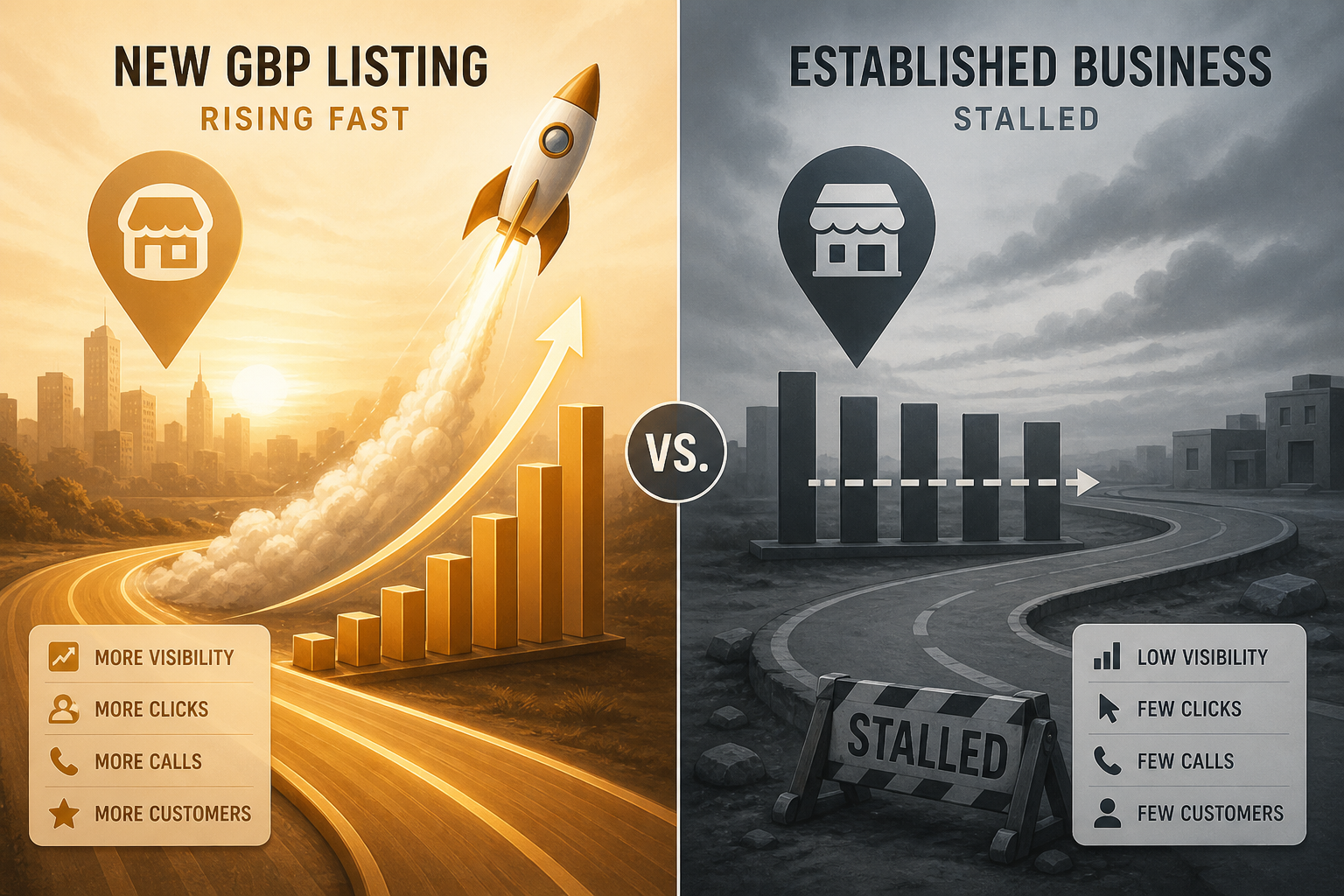
It is one of the most common complaints in local SEO forums: a business that opened six weeks ago is sitting in the top three of the Map Pack, while a business that has operated for eight years is stuck in position seven. Owners assume Google secretly rewards new listings, and some agencies repeat that theory without evidence because it is easier to sell than "your profile has been neglected."
There is no documented, official "new listing boost" in how Google ranks Business Profiles. What actually happens is a set of ordinary, explainable factors stacking in the new listing's favor at the same moment they are quietly working against the older one. Once you see the mechanics, the pattern stops feeling mysterious and starts feeling fixable.

The Pattern Owners Keep Noticing
A new competitor opens nearby, claims their listing, and within a month or two shows up ahead of businesses that have served the neighborhood for years. It genuinely looks like Google is favoring novelty. But look closer at what the new business typically did in that window: chose an accurate primary category from scratch based on current search behavior, filled every field Google offered because the onboarding flow nudged them to, and asked every early customer for a review because review generation was baked into their opening-week routine.
Meanwhile, the established business is often running on a profile set up years ago by someone who no longer works there, with a category chosen for how the business described itself in 2019, photos that have not changed since a phone upgrade three phones ago, and a review request process that quietly stopped after the person who owned it left.
What New Businesses Are Doing Right—Usually by Accident
New listings tend to launch with categories that match how customers search today, not how the business owner phrased their trade a decade ago. They also frequently benefit from a genuine early-review honeymoon: friends, family, and first customers leave enthusiastic, timely reviews in a tight window, which produces a burst of velocity and recency that older profiles rarely maintain unless they run a deliberate ongoing system.
A fresh profile also has no accumulated baggage. No duplicate listing fighting it for authority, no outdated address from a previous location, no attribute left unchecked from years ago, and no history of a suspension or reinstatement muddying its record. Google is simply evaluating a clean, complete, accurately categorized listing against one that carries small inconsistencies most owners never audit.
| Reason | Mechanism | Fix for established businesses |
|---|---|---|
| Accurate current-day category | Chosen fresh against today's search behavior | Re-audit primary/secondary categories against real queries |
| Review honeymoon burst | Friends and early customers review quickly | Restart a deliberate, ongoing request habit |
| Complete onboarding fields | Google's setup flow nudges full completion | Audit every field for gaps and staleness |
| No accumulated baggage | No duplicates, drift, or suspension history | Clean up duplicates and old address records |
| Fresh, current photos | New owners photograph the space as it is now | Add new real photos monthly, retire stale ones |
Why Established Profiles Quietly Fall Behind
Neglect is rarely dramatic; it accumulates one skipped month at a time. Staff turnover means the person who used to reply to reviews left eighteen months ago and nobody replaced that habit. A rebrand or menu change never made it into the services list. A competitor opened two blocks closer and nobody noticed the distance math shifted. None of these individually looks like a crisis, but together they explain a multi-position drop that feels sudden from the outside.
There is also a subtler effect: engagement decay. A profile that used to get regular clicks, calls, and direction requests can see that activity taper off as loyal customers stop needing to search for a business they already know how to reach, while new customers increasingly discover the newer, fresher-looking competitor instead. Lower engagement on an older listing is not a penalty Google applies on purpose—it is a real drop in the signals that used to support its prominence.
How to Reclaim Your Position as an Established Business
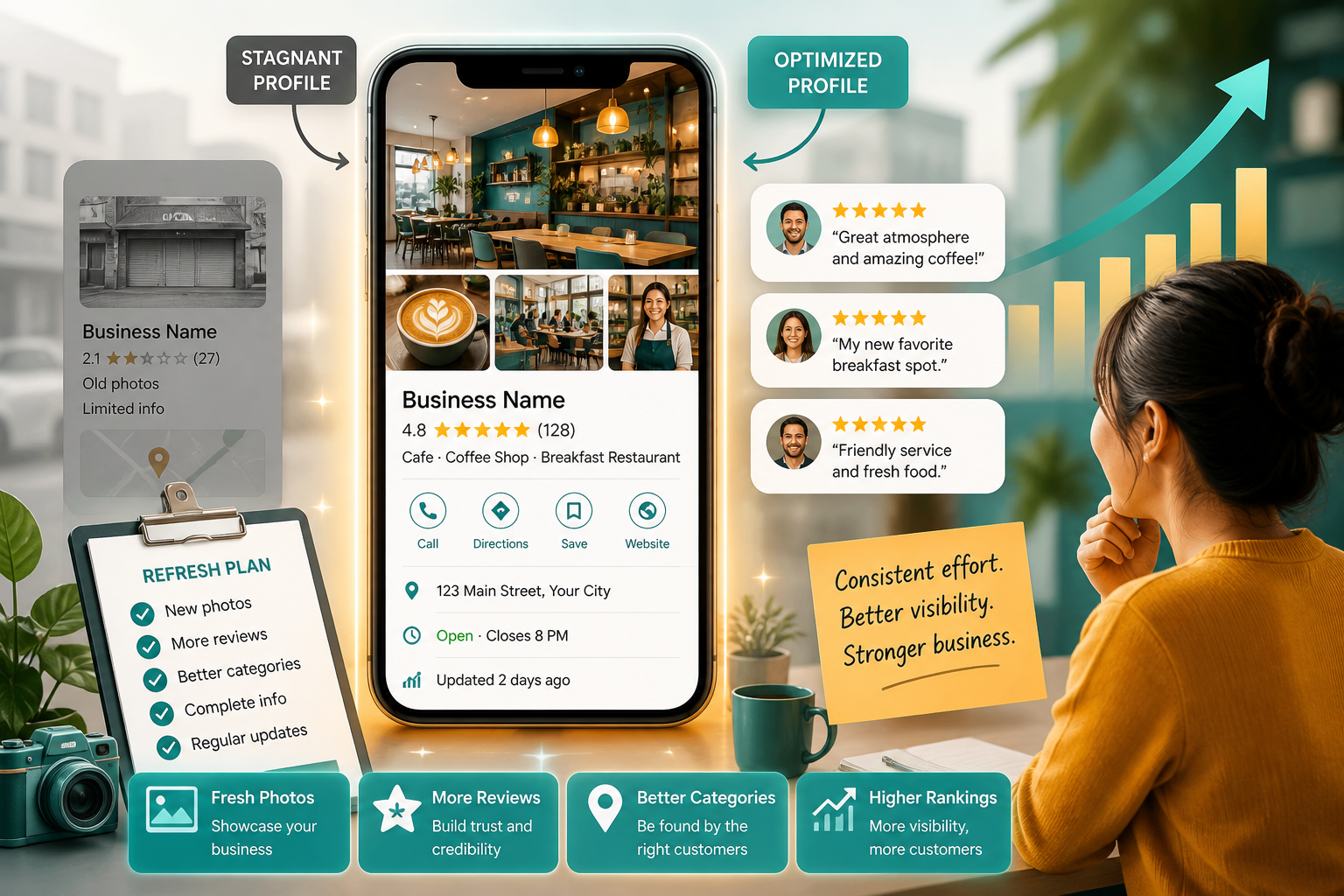
Start with a full audit rather than a single quick fix. Recheck your primary and secondary categories against how customers search today, not how the business described itself when the profile was created. Confirm the address pin is still exact, especially if you moved counters, entrances, or parking since the listing was set up. Search for duplicate or outdated listings tied to old addresses or previous phone numbers and get them merged or removed—duplicates split your authority instead of building it.
Then rebuild the habits that decayed. Put review requests back into your actual workflow instead of hoping customers remember on their own. Refresh photos on a monthly cadence so the listing looks like it belongs to a business operating today, not one frozen in an earlier year. Rewrite the description and services list in current language, and reconnect the profile to updated local landing pages on your site—our GMB optimization guide and local SEO playbook both walk through this in more depth.
Finally, measure the comeback properly. A single search from your own office will not show you what changed; track a neighborhood grid with a tool like GBP Local Ranker so you can see whether the fixes are closing the gap block by block, not just in one spot-check search. Recovery from years of drift is usually measured in weeks to a couple of months, not days, so give the rebuilt habits time to compound before judging results.
| Timeframe | Focus area | Expected early signal |
|---|---|---|
| Week 1–2 | Category, NAP, pin accuracy audit | No visible rank change yet—this is groundwork |
| Week 3–4 | Restart review request habit | First new reviews arriving, velocity building |
| Week 4–6 | Photo refresh and duplicate cleanup | Improved click-through in the pack |
| Week 6–10 | Sustained review and engagement growth | Grid rank beginning to close the gap |
| Week 10+ | Ongoing maintenance rhythm | Position stabilizing at improved level |
Franchise and Rebrand Scenarios Deserve Special Care
The dynamic covered so far assumes a single independent business slowly losing ground to a fresh competitor. Franchises and rebrands add another layer: a location that rebrands or changes ownership sometimes ends up creating a genuinely new listing rather than updating the existing one, unintentionally throwing away years of accumulated reviews and history in the process. Before any rebrand, confirm with Google and your franchise support team whether the existing profile can be updated in place rather than replaced, since preserving that history is almost always worth more than a clean slate.
If a genuinely new listing is unavoidable—following a full change of ownership, for instance—treat the transition like launching a new business rather than assuming old momentum will carry over. Apply the same clean-setup advantages that new listings naturally enjoy: accurate categories chosen fresh, a complete profile from day one, and a deliberate, immediate review request habit rather than hoping legacy customers rediscover you on their own.
What a Realistic Timeline for Recovery Looks Like
Owners frequently expect a category correction or a photo refresh to change their position within days, and when it does not, they conclude the fix did not work and abandon it. In reality, most of these signals take several weeks to fully register, and reviews in particular need sustained velocity over one to two months before their effect on prominence becomes clearly visible in a rank grid.
A realistic sequence looks like this: category and NAP corrections can show early relevance effects within one to three weeks, a restarted review habit typically needs four to eight weeks of consistent requests before velocity and recency meaningfully shift, and photo and engagement improvements tend to compound gradually rather than producing a single visible jump. Set expectations accordingly, both for yourself and for any client you are managing this recovery for, so nobody panics and reverses course halfway through a plan that was actually working.
It also helps to document a clear before-and-after baseline the day you start the recovery work—screenshot your grid rank, note your current review count and rating, and save your existing photos and category settings. That baseline turns an abstract sense of "things feel better" into a concrete comparison a few months later, which matters enormously when you need to justify continued investment in profile management to a business partner or a client.
Final Takeaway
New Google Business Profiles are not secretly favored by an algorithm switch—they are simply starting clean, complete, and accurately categorized while collecting an early burst of genuine reviews. Established businesses lose ground the same ordinary way: neglect accumulates quietly until it shows up as a rank drop. The fix is not a trick either. Audit the foundation, rebuild the habits, and measure with a real grid instead of a single search, and an established business can absolutely out-compete a newcomer that has nothing but freshness on its side.
Frequently Asked Questions
Does Google actually give new Business Profiles a temporary ranking boost?
There is no documented official boost. What looks like a boost is usually a clean category, a complete profile, and an early burst of genuine reviews all landing at once.
How long does the "new listing" advantage typically last?
It fades naturally within a few months once the review honeymoon slows and the listing needs the same ongoing management as any other profile to keep its momentum.
Can an old, neglected listing really catch up to a new competitor?
Yes, in most cases. Category corrections, cleaned-up duplicates, a restarted review habit, and fresh photos regularly close the gap within one to three months.
Should I close and reopen a new listing to get the same benefit?
No. Closing and reopening risks losing your review history and can trigger verification and trust issues. Fix the existing listing instead of starting over.
Is it worth checking for duplicate listings if my business has never moved?
Yes. Duplicates can appear from old aggregator data, previous owners, or franchise setup mistakes even without a physical move, and they quietly split authority.
Do new listings get more forgiving spam enforcement?
No, if anything newer listings can face more verification scrutiny. Their apparent advantage comes from accuracy and freshness, not lighter enforcement.
What is the fastest single fix for a declining established profile?
Restarting a consistent review request habit usually produces the quickest visible movement, since recency and velocity respond faster than category or citation changes.