Watching where you rank is only half the competitive picture — understanding how your competitors are actually performing, and why, is what turns a rank tracking habit into a genuine strategic advantage. Too many businesses check their own position obsessively while never systematically looking at what the businesses actually beating them are doing differently, which means they miss the real, actionable insight sitting one search away.
This guide covers how to monitor competitor rankings on Google Maps properly — not through guesswork or the occasional manual search, but through a repeatable process that reveals patterns you can actually act on. It pairs naturally with our overview of tools for tracking GBP rankings, but the focus here is specifically on the competitive analysis workflow rather than tool selection alone.
Why Manual Spot-Checks Give You a Distorted Picture
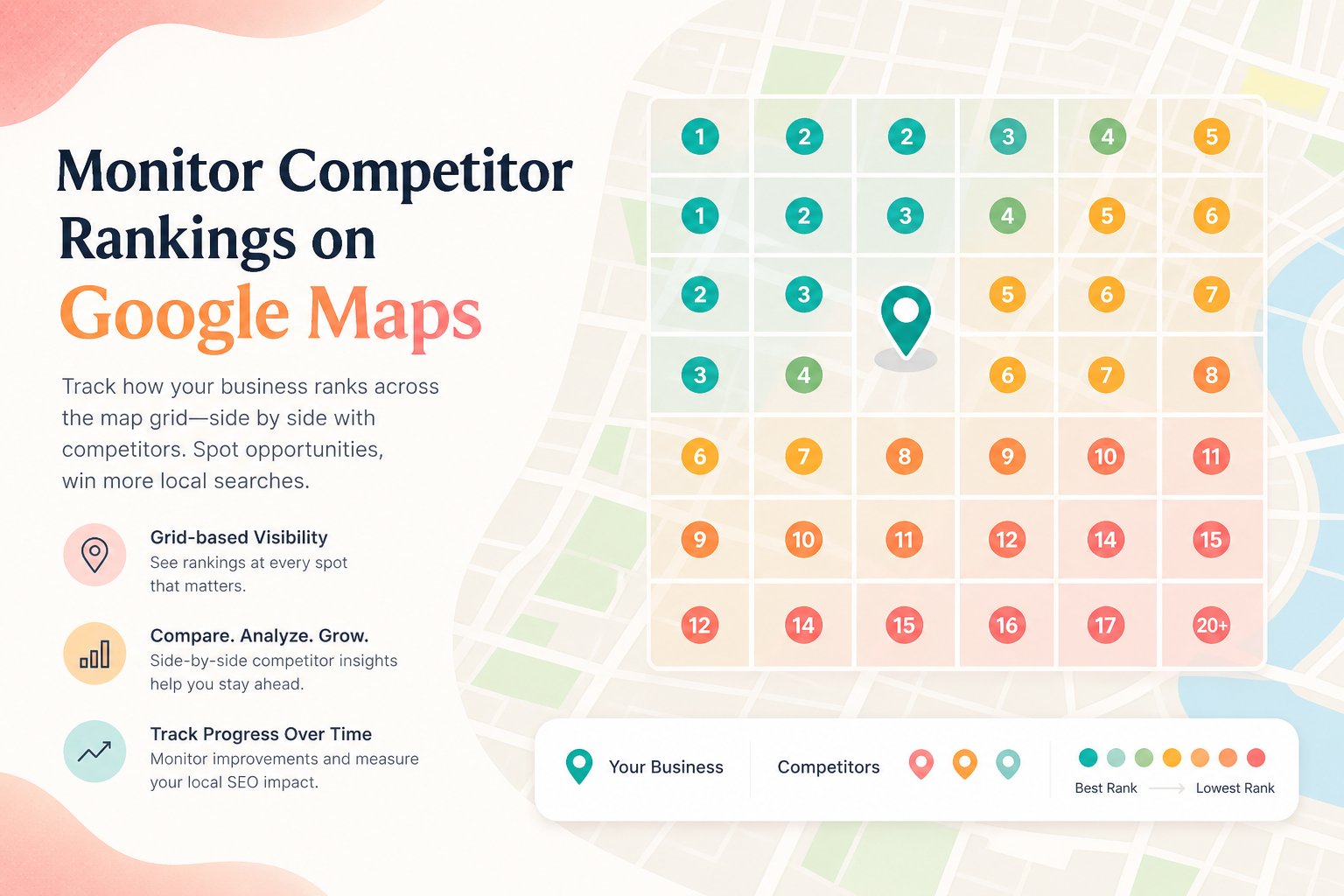
Searching your competitor's name and glancing at where they appear tells you almost nothing reliable, because a single search from a single location is heavily influenced by exactly where that search happens to be performed from, your own search history, and Google's personalization layer. A competitor might appear to dominate from your office chair while actually being far weaker across the broader service area, or vice versa, and building a competitive strategy on that distorted picture leads to wasted effort chasing a lead that does not really exist.
Grid tracking solves this for competitors too
The same grid-based tracking approach used to understand your own visibility applies directly to competitor analysis: checking a competitor's ranking from a spread of points across your shared service area reveals where they genuinely dominate versus where they are actually vulnerable, which is far more useful than a single anecdotal search ever could be.
Building a Repeatable Competitor Monitoring Routine
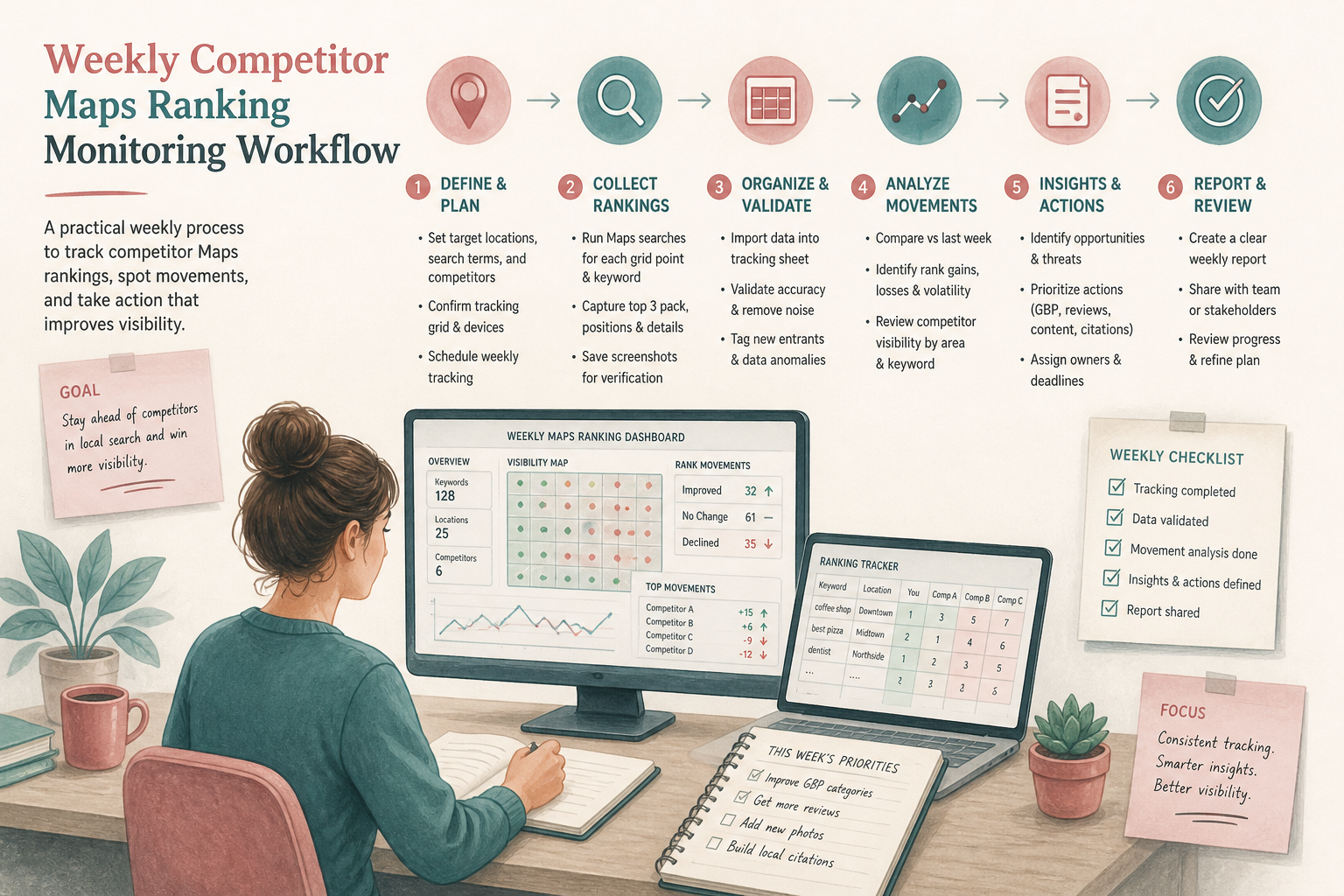
Start by identifying your three to five genuine competitors — the businesses that actually show up consistently for the searches that matter to you, not simply the largest or most well-known names in your industry, which may not even compete for the same customers. Track their rank position across the same grid points you use for your own listing, on a consistent schedule, ideally weekly or biweekly, so you can spot real movement rather than reacting to noise from a single snapshot.
Beyond raw position, pay attention to what changes alongside a competitor's rank shift: a sudden jump in review count, a new set of photos, a category change you can sometimes infer from shifts in what searches they start appearing for, or a flurry of new posts. Rank movement without an obvious cause is common and often just reflects normal algorithmic fluctuation, but rank movement that coincides with a visible change on their profile is a genuine signal worth learning from.
Seasonal fluctuation deserves a mention here too, since many categories genuinely see rank volatility tied to demand cycles rather than anything either business actually did. A landscaping company or a tax preparation service, for example, may see competitors' visibility shift meaningfully between peak and off-season simply because search volume and review velocity both change with demand. Comparing your monitoring data against the same period a year earlier, once you have enough history, helps separate a genuine competitive shift from an entirely normal seasonal pattern.
| Signal | What it might indicate | How to check it |
|---|---|---|
| Review count and recency | An active review request system | Compare review counts month over month |
| Photo activity | Recent investment in profile freshness | Check photo upload dates if visible |
| Posting frequency | An active content and promotion habit | Scroll their profile updates section |
| Category or services changes | A repositioning that may explain new search visibility | Note their current category periodically |
Tools That Make Systematic Monitoring Practical
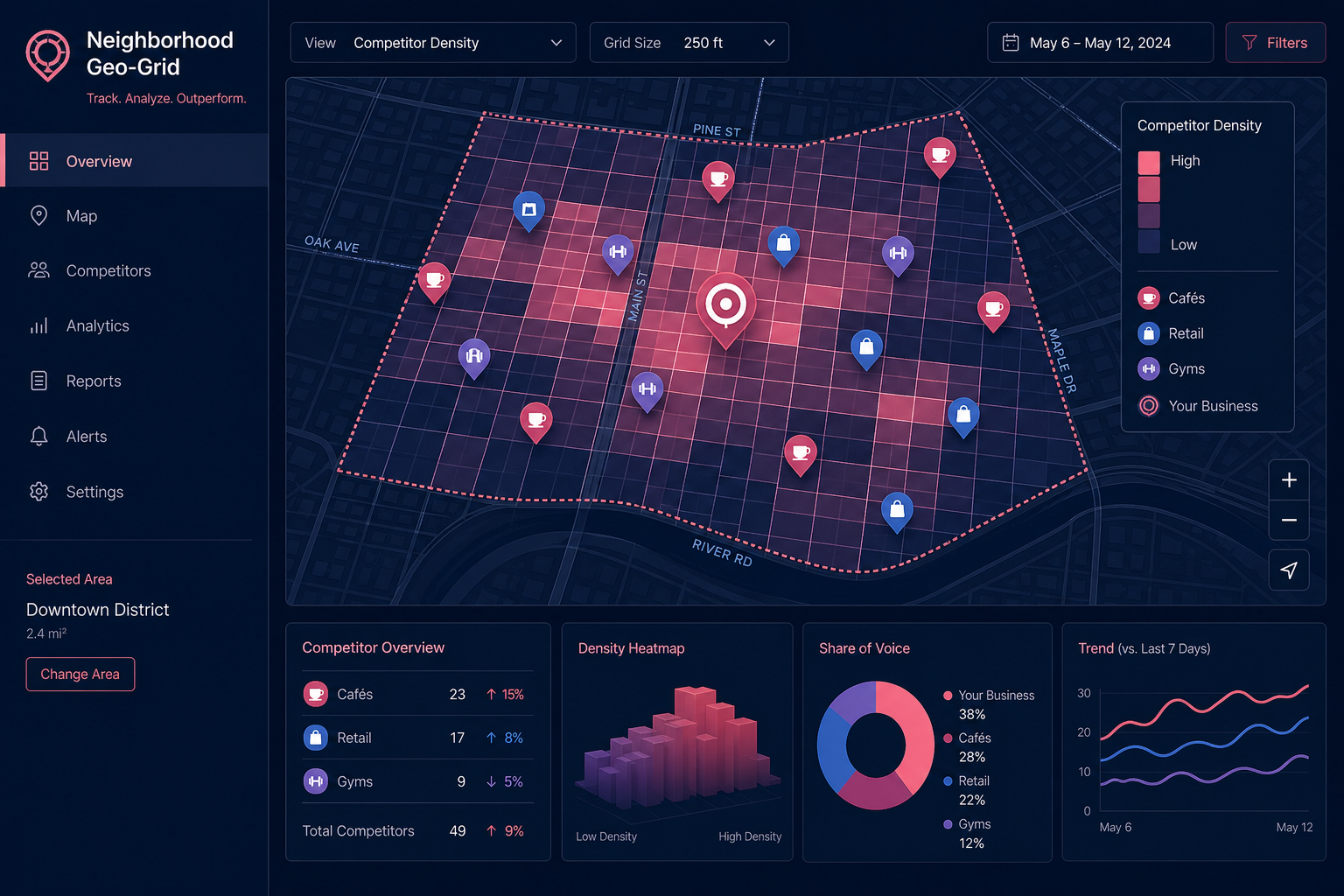
Doing this entirely by hand does not scale past a competitor or two, which is exactly why dedicated rank tracking tools exist. Our roundup of tools for tracking GBP rankings and separate list of free local rank tracking tools cover the options across different budgets, from manual free methods suitable for a single competitor to dedicated grid-tracking platforms like GBP Local Ranker built specifically for ongoing, multi-competitor monitoring at scale.
Whichever tool you choose, the value comes from consistency rather than the specific platform. A tool checked once and then forgotten provides almost no more insight than a manual search, while even a modest free tool used on a genuine weekly schedule builds a real dataset over a few months that reveals patterns a single snapshot never could.
Turning Competitor Data Into Actual Decisions
Monitoring only creates value once it changes what you actually do. If a competitor consistently outranks you specifically in one part of your service area, examine whether their proximity, review density, or category specificity in that area explains it, and consider whether a location page or more targeted review requests from customers in that zone would help close the gap. If a competitor's rank spiked shortly after a visible burst of new reviews, that is a reasonably strong signal that a similar review push on your own profile is worth prioritizing.
Avoid copying tactics blindly without local context
Not every competitor tactic that appears to work will translate directly to your business — a competitor with an established address in a dense commercial area benefits from proximity advantages a service-area business simply cannot replicate. Use competitor monitoring to identify plausible hypotheses worth testing, not as a rigid playbook to copy wholesale regardless of whether your underlying situation actually matches theirs.
Where Competitor Monitoring Crosses a Line
Monitoring a competitor's public ranking data and profile activity is entirely legitimate and something every serious local business should do. Using that information to file false spam reports against a legitimate competitor, leave fake negative reviews, or attempt to have their listing suspended through bad-faith complaints is not — and beyond being dishonest, it frequently backfires, since Google's systems are specifically designed to detect and penalize this kind of coordinated abuse.
The line is simple in practice: observing what is publicly visible and learning from it is fair competition, while attempting to interfere with a competitor's listing rather than improving your own is not. Businesses that spend energy trying to suppress competitors rather than strengthening their own profile tend to see worse long-term outcomes anyway, since that energy is directed at something outside their control instead of the fundamentals they can actually influence.
Reporting genuine violations is different from competitive sabotage
If a competitor's listing is genuinely fraudulent — a fake address, a duplicate listing, or clearly fabricated reviews — reporting it through Google's legitimate channels is appropriate and does not fall into the same category as bad-faith competitive sabotage. The distinction is honesty: reporting a real, verifiable violation is fundamentally different from filing a report you know to be false simply to gain a competitive advantage.
Keep this same ethical standard in mind when interpreting what you observe. A competitor's rank movement is data to learn from, not evidence of wrongdoing unless you have genuine reason to believe otherwise, and treating every competitive shift as suspicious rather than simply competitive tends to waste energy that would be better spent improving your own listing.
Document your baseline before you start comparing
Before drawing conclusions from competitor data, establish your own baseline rank position across the same grid points over two or three checks, since a single starting snapshot can be misleading if it happens to catch either you or a competitor during an unusual fluctuation. A short baseline period makes any later comparison meaningfully more reliable.
How Often You Should Actually Check
Weekly monitoring is reasonable for a competitive market where rankings shift frequently, while biweekly or monthly checks are usually sufficient for less volatile categories or smaller service areas. Checking daily rarely reveals anything actionable beyond ordinary algorithmic noise and mostly just creates anxiety over fluctuations that resolve themselves within days. Match your monitoring frequency to how competitive and fast-moving your specific market actually is, rather than defaulting to the most frequent option available.
| Market type | Recommended check frequency |
|---|---|
| A highly competitive urban market | Weekly |
| Moderate competition in a mid-size city | Biweekly |
| Low competition or a niche category | Monthly |
| A rural or single-competitor market | Monthly or as needed |
Final Takeaway
Competitor monitoring is most valuable when it is systematic, grid-based, and tied to specific decisions rather than an occasional anxious search to see who is winning this week. Build a simple, consistent routine using the tools covered in our broader rank tracking guides, focus on genuine competitors rather than the biggest names in your industry, and let real patterns — not single snapshots — guide where you invest your next round of effort.
Frequently Asked Questions
How many competitors should I actually monitor?
Three to five genuine competitors that consistently compete for the same searches is usually enough; monitoring too many dilutes your attention without adding much useful insight.
Is grid tracking necessary for competitor monitoring, or is a single search enough?
A single search gives a distorted, location-biased picture; grid tracking across your shared service area gives a far more reliable view of where a competitor genuinely dominates.
How often should I check competitor rankings?
Weekly is reasonable in competitive markets, while biweekly or monthly is usually sufficient for less volatile categories, with daily checks rarely adding useful insight.
Can I monitor competitor rankings for free?
Yes, manual grid-style searches or a handful of free tools can work for monitoring one or two competitors, though it becomes impractical at scale without a dedicated tool.
Should I copy a tactic that seems to be working for a competitor?
Only after considering whether your situation genuinely matches theirs; a tactic tied to their specific address, category, or review history may not translate directly to your business.
What is the most useful signal to track alongside rank position?
Review count and recency tend to be the most consistently informative signal, since review activity often correlates directly with visible rank movement.
Does monitoring competitors help more than focusing on my own profile?
It is a complement, not a replacement; monitoring reveals what to prioritize, but the underlying work of improving your own profile still has to happen.