Free local rank tracking tools are a genuinely useful starting point, especially for a solo operator or small business not ready to invest in a paid platform. The honest catch is that "free" almost always means limited — fewer keywords, fewer grid points, manual searching, or a capped number of checks per month. Understanding those limits upfront helps you use free tools effectively instead of being surprised when they cannot answer the question you actually need answered.
This guide covers the genuinely useful free options available in 2026, what each one is actually good for, where they fall short, and when it makes sense to graduate to a paid grid-tracking tool like GBP Local Ranker — discussed fairly, without pretending free tools are useless or that paid tools are magic.
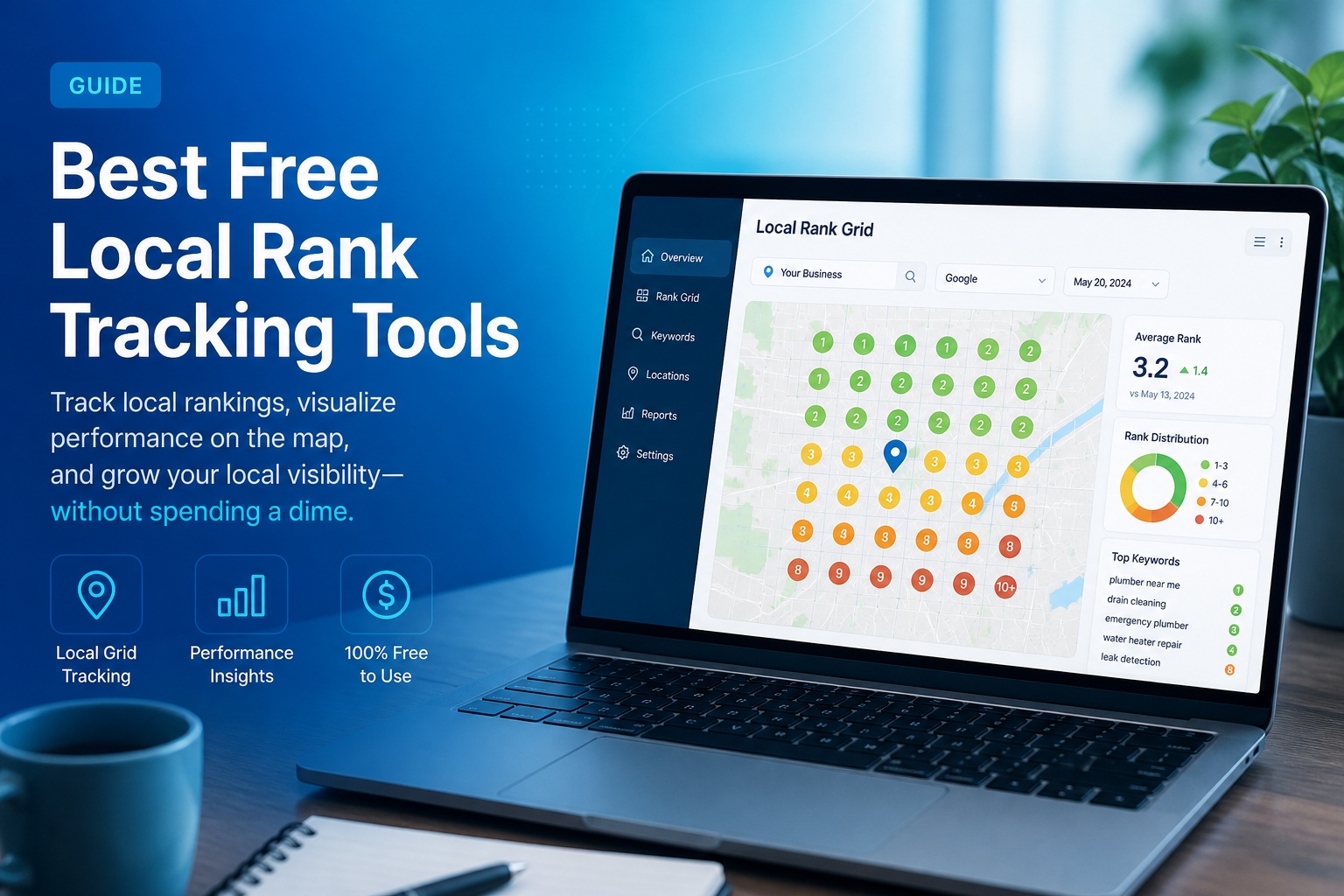
What Free Rank Tracking Tools Can Actually Do Well
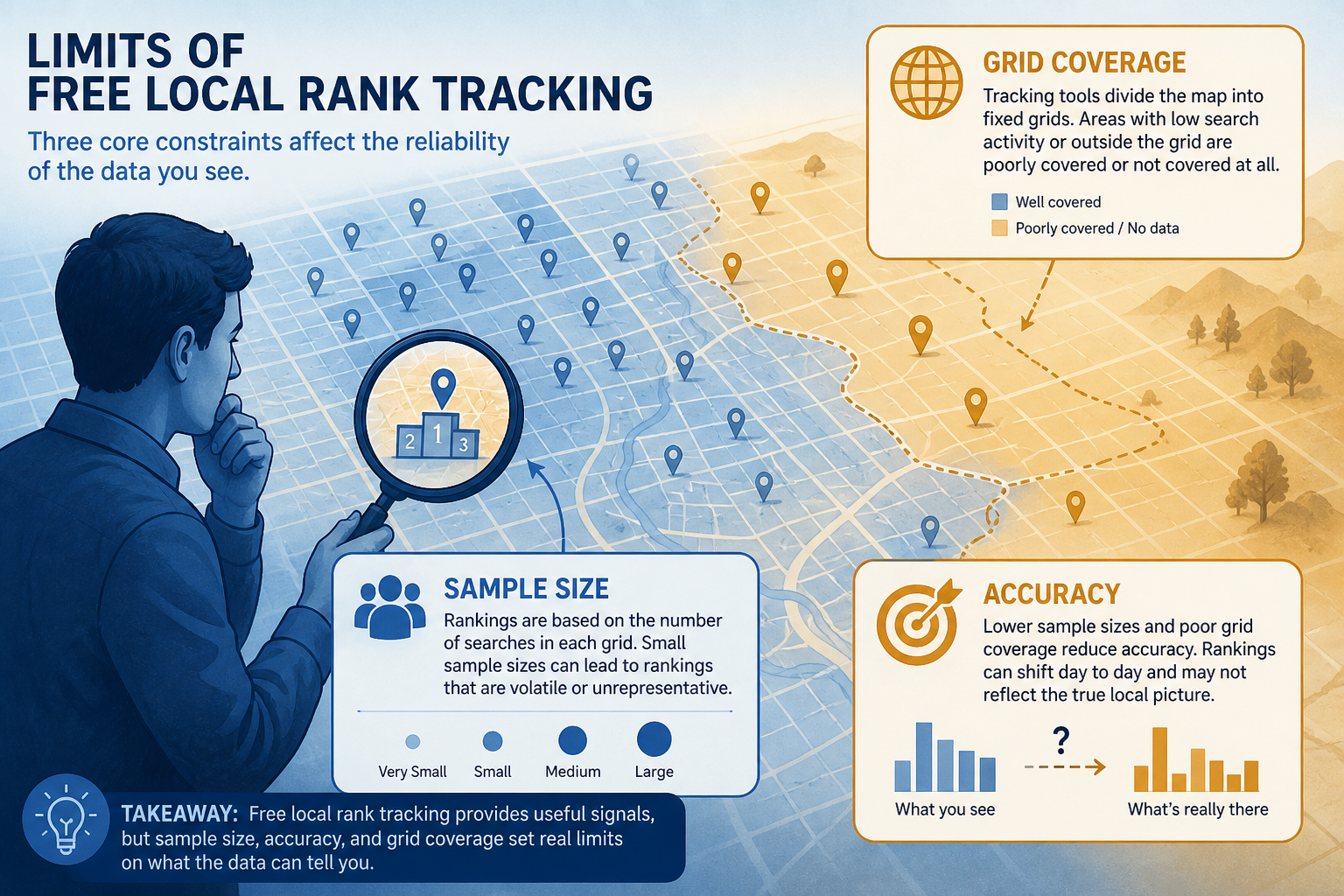
Manual incognito searching from different devices or locations remains the simplest free method: search your target keyword in an incognito browser window, ideally from a phone with location services matching different parts of your service area, and record what you see. It costs nothing but time, and it gives an honest, if narrow, snapshot of how you appear for one keyword from one specific point at one specific moment.
Google Search Console, while not a Maps-specific rank tracker, provides genuinely useful free data on which queries actually bring traffic to your website, which indirectly informs which local keywords matter most to prioritize. Combined with GBP Insights — also free — showing calls, direction requests, and search views, you can build a reasonably informed picture of performance without spending anything, even without a dedicated grid tool.
| Method | What it shows | Biggest limitation |
|---|---|---|
| Manual incognito search | Snapshot rank for one keyword, one location, one moment | No historical tracking, easy to get inconsistent readings |
| Google Search Console | Search queries and impressions for your website | Not Maps-specific, no direct 3-pack position data |
| GBP Insights (built-in) | Calls, direction requests, search views over time | No competitor comparison, no keyword-level rank position |
| Free tier of paid rank trackers | Limited keyword/location tracking with some automation | Capped checks, often missing historical trend data |
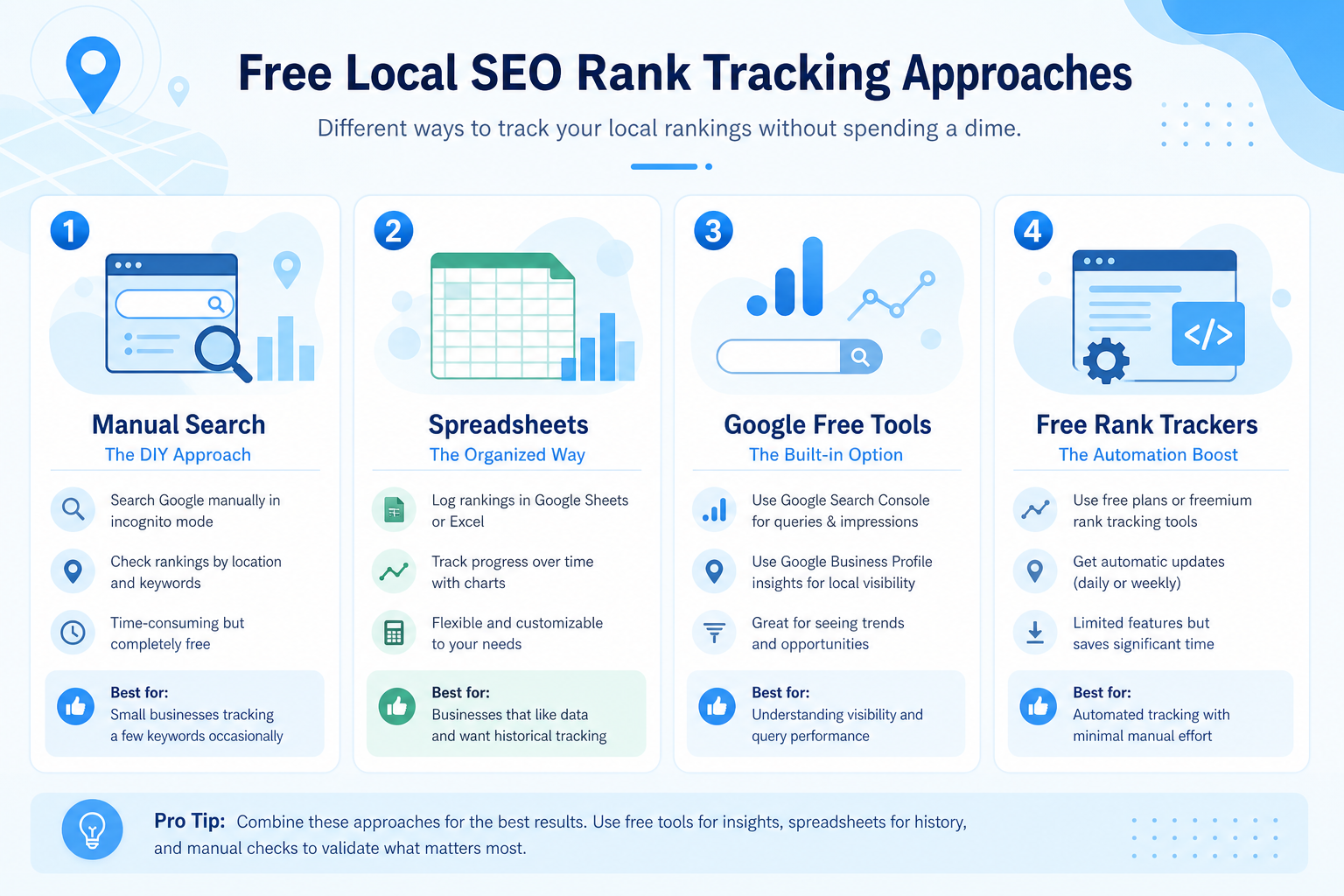
The Honest Limits of Free Tools
No real grid tracking
The core weakness of manual and most free methods is the absence of a proper geographic grid — checking your rank from multiple simulated points across your actual service area rather than one search from one spot. Local rank genuinely varies by exact location, and a single search from your office can look dramatically different from a search three neighborhoods away, which free manual checking cannot capture at scale.
No historical trend data
Without a saved history of past rank checks, it is difficult to tell whether a change genuinely reflects your recent optimization work or simply normal day-to-day fluctuation. Free tools that do not store history force you to rely on memory or your own manual spreadsheet, which most people eventually abandon.
Time cost adds up quickly
Manually checking even five keywords across five locations weekly takes real time that a small business owner or a busy agency managing multiple clients rarely has to spare consistently, which is often the real reason free methods get abandoned within a few weeks despite costing nothing financially.
When Free Tools Are Genuinely Enough
If you manage a single business with a small, tight service area and only need to track one or two priority keywords occasionally, a disciplined manual incognito routine combined with GBP Insights can honestly be sufficient, especially in the early stages before investing in paid tools makes financial sense. The key word is disciplined — a routine you actually maintain matters more than the sophistication of the tool behind it.
Free tools also work well as a sanity check even for businesses using paid tracking, since manually verifying a surprising rank reading from time to time helps confirm the automated tool is behaving as expected. Our full rank tracking tools comparison covers the broader landscape including paid options in more depth.
| Consideration | Free approach | Paid grid tool approach |
|---|---|---|
| Cost | Free, but real time cost | Monthly subscription, saves significant time |
| Grid coverage | Usually one point at a time, manual | Multiple simulated points automatically |
| Historical trends | Manual spreadsheet if maintained | Automatic, saved over time |
| Best fit | Single business, small area, limited keywords | Multiple keywords, competitive markets, agencies with clients |
Making the Switch to Paid Tracking When It Makes Sense
The signal that it is time to consider a paid tool is usually not a specific date but a specific pain point: you are spending more time manually checking ranks than the subscription would cost in your own hourly value, you are managing more than one location or client, or you keep making decisions based on inconsistent single-point searches that later turn out to be misleading. A grid-based tool like GBP Local Ranker is designed specifically to solve the grid-coverage and historical-trend gaps that free methods cannot realistically close.
That said, switching to a paid tool does not replace the fundamentals — categories, reviews, service-area accuracy — that actually drive ranking. A rank tracker, free or paid, only measures the outcome; it does not create it. Use whichever tool fits your current stage honestly, and do not assume a paid subscription alone will move your rank without the underlying profile work behind it.
Building a Simple Free Tracking Routine That Actually Sticks
Pick a fixed day and a short, repeatable checklist
Free tracking routines usually fail not because the method is flawed but because they get forgotten within a few weeks. Choosing a fixed day — the first Monday of the month, for example — and a short checklist of three to five keywords and locations makes the habit far more likely to survive past the first month of enthusiasm.
Keep a simple spreadsheet instead of trusting memory
Even a basic spreadsheet with date, keyword, location, and observed position turns scattered manual checks into a usable trend line over a few months. Without this record, it is nearly impossible to tell whether a specific change genuinely helped, since human memory of exact past rank positions is notoriously unreliable.
Pair manual checks with the free Insights data you already have
Manual rank snapshots become far more meaningful when viewed alongside GBP Insights trends for calls and direction requests over the same period. A rank check that shows little movement but Insights that show rising calls still represents genuine progress worth recognizing, rather than a wasted effort.
Free Tools for Related Local SEO Tasks Worth Knowing About
Free citation consistency checkers
Several free tools let you search your business name across major directories to spot inconsistent NAP details, which indirectly supports rankings even though they are not rank trackers themselves. Running this check periodically catches drift that can quietly undermine the prominence signals a rank tracker eventually reports on.
Free Google Business Profile audit checklists
Structured free checklists, including a thorough optimization checklist covering categories, attributes, and description completeness, help confirm profile completeness without any paid software, complementing whatever rank tracking method you choose by ensuring the underlying profile is actually worth tracking in the first place.
Free review monitoring alerts
Many platforms offer free email or app notifications the moment a new review posts, which helps you respond quickly and also catch a sudden negative review cluster early. Pairing review alerts with your rank tracking routine gives a more complete, still-free picture of overall profile health.
Combining a citation checker, a profile audit checklist, and a review alert system costs nothing beyond the time to set them up, and together they cover far more ground than rank position alone. None of these free options replace the judgment of actually reading your own reviews and profile data critically. Alerts, checklists, and citation tools surface information, but interpreting what that information means for your specific market and next action still requires the same disciplined thinking this entire guide has emphasized — free tools remove friction from data collection, not from decision-making.
Whichever combination of free tools you settle on, revisit the setup every few months rather than assuming it will keep working unattended forever. Tools get discontinued, free tiers get trimmed, and your own tracking needs change as your business grows, so treat the toolkit itself as something worth a periodic check rather than a one-time decision you never reconsider.
Final Takeaway
Free local rank tracking tools are genuinely useful for small, simple setups and disciplined manual routines, but they come with real limits around grid coverage, historical data, and time cost that eventually become the bottleneck for growing businesses or agencies managing multiple clients. Use free methods honestly for what they are good at, and consider a paid grid tool once the time cost or the need for reliable, multi-point data outgrows what manual checking can provide.
Frequently Asked Questions
Are free rank tracking tools accurate enough for a small business?
For a single business with a small service area and a handful of priority keywords, disciplined manual tracking combined with free GBP Insights is often accurate enough for practical decisions.
Why does my rank look different when I search from home versus my office?
Local rank varies genuinely by physical location and by whether you are logged in, using incognito mode, or have location history enabled, all of which affect what results you see.
Is Google Search Console useful for tracking Map Pack rankings?
Not directly, since it reports website search performance rather than Map Pack position specifically, but it provides useful supporting data about which local queries drive real traffic.
How many keywords should I track for free before it becomes worth paying?
There is no fixed number, but once manual tracking starts consuming more time weekly than a paid tool's subscription cost would represent in your own hourly value, it is worth reconsidering.
Can I combine free and paid tracking tools?
Yes, many businesses and agencies use a paid grid tool as the primary source while occasionally cross-checking specific results manually as a sanity check.
Does a paid rank tracker guarantee better rankings?
No, a rank tracker only measures your position; it does not directly cause ranking improvement. The underlying profile work — categories, reviews, accuracy — is what actually drives rank.
What is the biggest mistake people make with free rank tracking?
Relying on a single search from one location and treating it as representative of the whole service area, which often produces a misleading and inconsistent picture of actual performance.