A sudden ranking drop is one of the most stressful moments in managing a Google Business Profile. Yesterday you were solidly in the 3-pack for your main keyword; today you are nowhere to be found, or sitting at position seven where position two used to be. The instinct is to assume Google changed the algorithm overnight, but in the overwhelming majority of cases, the real cause is something specific, findable, and often fixable — an edit, a review pattern, a competitor move, or a policy flag.
This guide walks through the most common causes of sudden GBP ranking drops in 2026, in the order you should actually check them, along with realistic recovery timelines. The goal is not to promise you will be back at position one by tomorrow — sometimes recovery takes weeks — but to stop the guessing and give you a clear, evidence-based diagnostic process.

Step One: Rule Out a Suspension or Policy Flag First
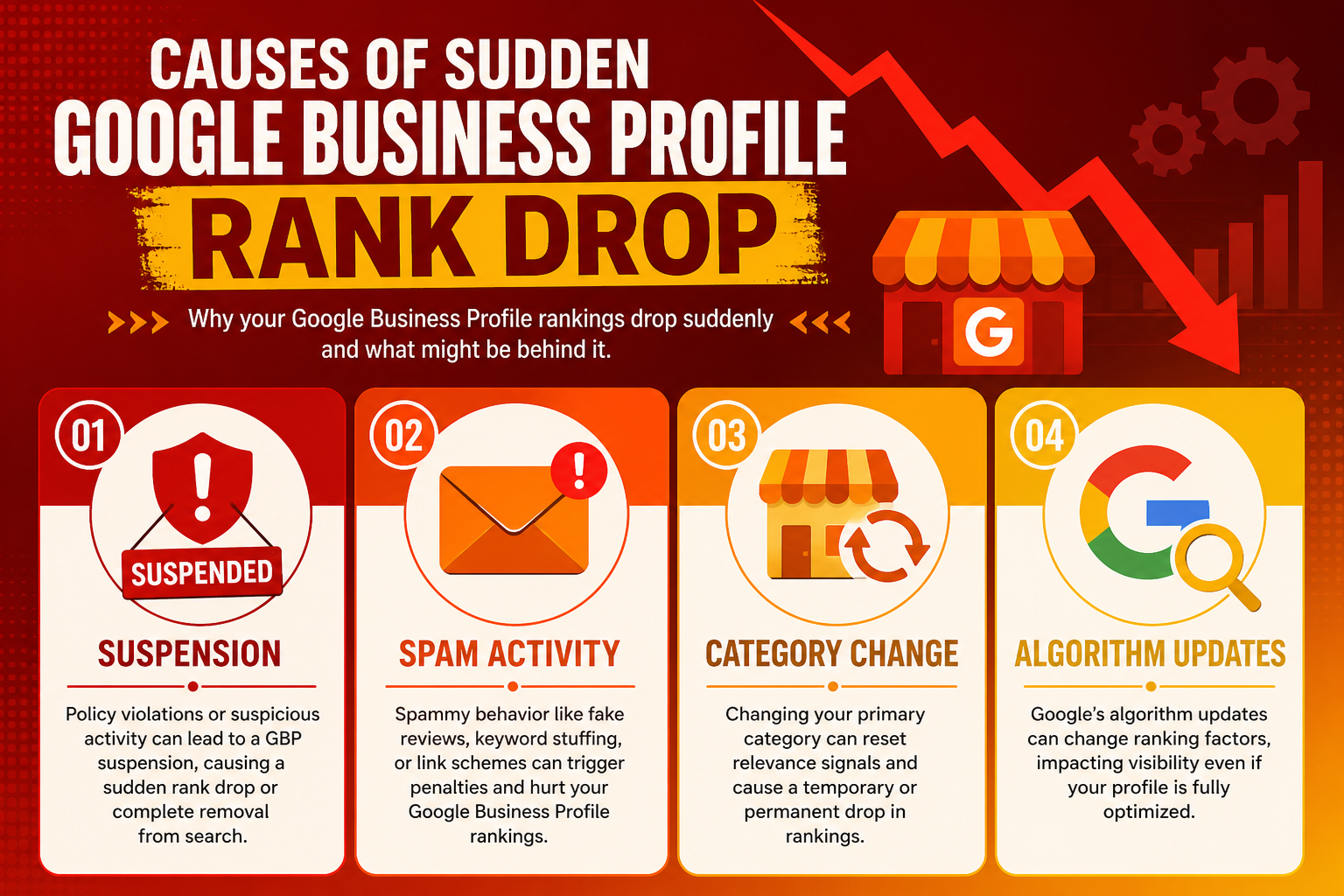
Before investigating anything subtle, check whether your listing shows any visible warning, whether it still appears at all when you search your exact business name, and whether you can still log into your Business Profile dashboard normally. A full or partial suspension looks like a dramatic ranking drop but is actually a different problem with a different fix — usually an appeal or a correction to whatever triggered the flag, most often a recent address edit, a name change that added unearned keywords, or a wave of user reports.
If the listing is intact and simply ranking lower rather than missing, move on to the more common, less dramatic causes below. Confusing a genuine algorithmic or competitive drop with a suspension wastes time on the wrong fix, so this check always comes first, and our ranking factors guide is a useful reference for what Google is actually evaluating once suspension is ruled out.
| Check first | What it tells you | If yes, do this |
|---|---|---|
| Does the listing still appear for your exact business name? | Rules in or out a suspension | If missing entirely, start the reinstatement process immediately |
| Was anything edited in the last 14 days? | Recent edits can trigger review or reset trust signals | Review the edit history, revert anything unnecessary |
| Did review volume or rating change sharply? | A spam attack or a genuine service issue can shift prominence fast | Audit recent reviews, report clear fakes, respond to real complaints |
| Did a competitor make a visible change? | Sometimes it is not you dropping, it is them improving | Run a side-by-side gap audit |
The Most Common Real Causes of a Sudden Drop
A recent profile edit reset trust signals
Editing your business name, primary category, or address — especially multiple fields at once — can trigger Google to re-evaluate the listing, sometimes causing a temporary visibility dip while the review completes. This is usually recoverable within one to three weeks if the edit was legitimate and accurate.
A cluster of negative or fake reviews
A sudden run of one-star reviews, whether genuine or a coordinated attack, can shift your average rating and review-quality signal quickly. Report anything that violates policy — reviews from people with no evidence of being a customer, competitor-driven attacks, or clearly fabricated complaints — while also responding calmly to any legitimate criticism.
A nearby competitor made a real improvement
Sometimes the drop is not really about you. A competitor who fixed their category, launched a review campaign, or verified a more accurate address can push you down without your profile changing at all. This is where a side-by-side audit becomes essential to understand what actually shifted.
Duplicate or conflicting listings appeared
A new, possibly unauthorized duplicate listing — from an old employee, a directory sync error, or a former business partner — can split your reviews, confuse Google about which listing is authoritative, and drag down visibility for both. Search your business name broadly to check for duplicates you may not know exist.
Seasonal and Algorithm-Wide Shifts (The Less Common Cause)
Genuine, broad algorithm updates do happen, but they are far less common than owners assume, and they almost always affect an entire category or region rather than a single listing in isolation. If you notice competitors in your niche also mentioning shifts around the same date, or trade forums discussing a specific update, that points toward a wider change rather than something specific to your profile.
Seasonal demand shifts can also look like ranking drops when they are really search-volume changes — a landscaping business searched heavily in spring may simply see less absolute traffic in winter even at the same rank. Before assuming the worst, check whether total search volume for your keywords dropped industry-wide, and pair that with our broader optimization guide to confirm your fundamentals are still solid.
| Cause | Typical recovery window | What speeds it up |
|---|---|---|
| Minor edit triggered a review | 1-3 weeks | Nothing to do but wait; avoid further edits |
| Fake or attack reviews | 2-6 weeks | Prompt reporting plus steady genuine review requests |
| Competitor improvement | Ongoing until you close the gap | Targeted fixes based on a side-by-side audit |
| Duplicate listing conflict | 2-4 weeks after merge/removal | Report the duplicate and request a merge quickly |
| Full suspension | Days to months | Accurate reinstatement appeal, honest documentation |
How to Investigate Without Guessing
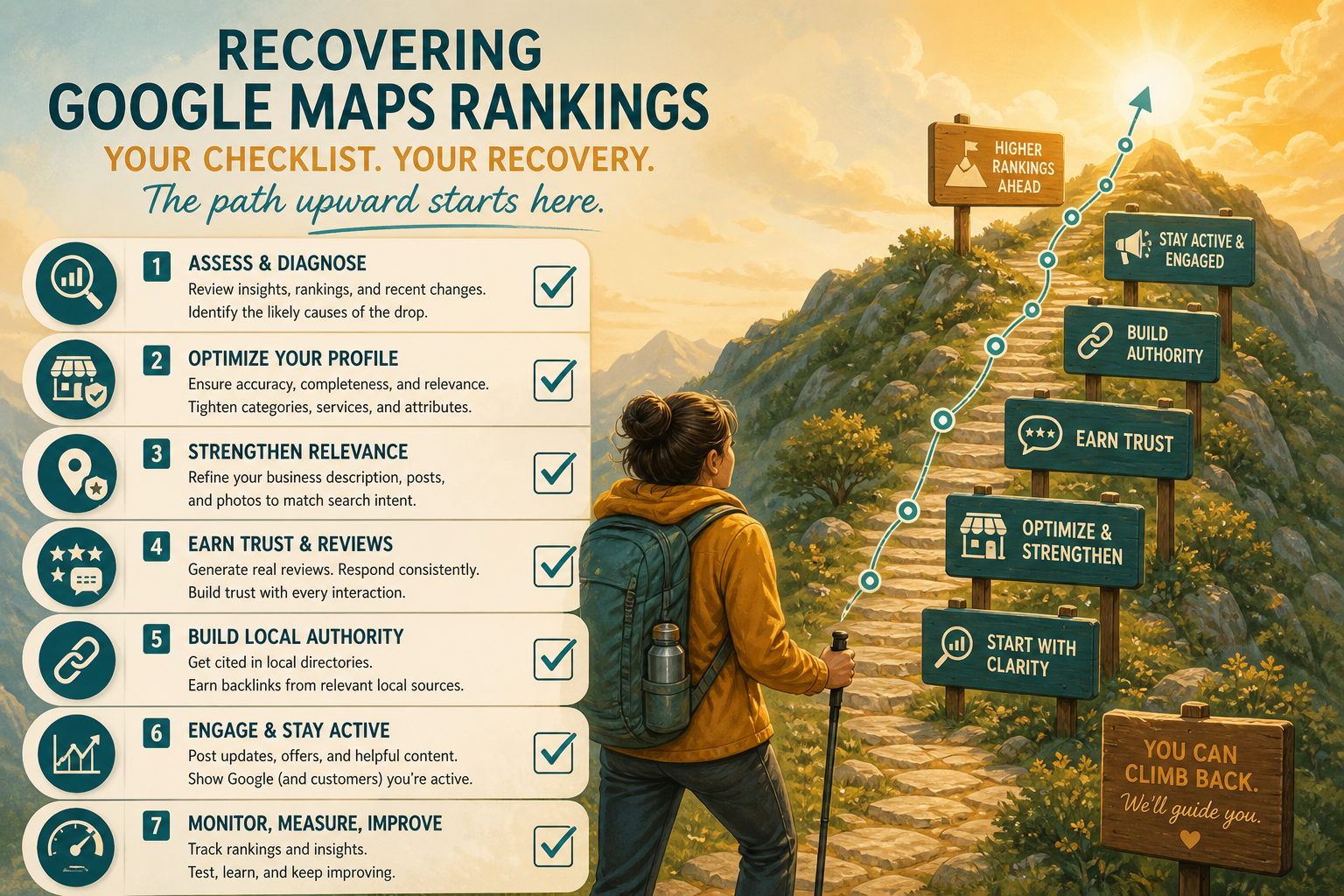
Pull your GBP Insights for the last 90 days and look at calls, direction requests, and search views rather than only rank position. A drop in rank alongside stable Insights sometimes means the query set you are tracking shifted more than your actual visibility. If you track rank with a proper grid tool rather than a single search from your office, you can also confirm whether the drop is uniform across your service area or concentrated in specific neighborhoods, which points toward a proximity or service-area issue rather than a content one.
Document everything you find with dates — the review pattern, the edit history, the competitor change — because this record is exactly what you need if you eventually have to file a reinstatement appeal or explain the situation to a client. Guessing at causes wastes weeks; a dated, evidence-based log turns a stressful mystery into a solvable checklist.
Preventing the Next Sudden Drop
Change one field at a time when editing a live listing
Batching several significant edits together — a new category, a new phone number, and a description rewrite in the same session — makes it far harder to isolate the cause if a drop follows. Spacing out meaningful edits and watching Insights between them protects you from exactly the kind of confusing, multi-cause drop this guide is meant to help you avoid.
Keep a lightweight monthly log of your profile state
A simple monthly note of your review count, rating, rank position for key terms, and any recent edits gives you a baseline to compare against the moment something looks off. Without this record, every drop investigation starts from scratch; with it, you can often spot the likely cause within minutes by comparing the current state to last month's snapshot.
Set up alerts for new reviews so attacks are caught early
Many review platforms and third-party tools can notify you the moment a new review posts. Catching a coordinated negative review attack within hours rather than weeks gives you a much better chance of reporting policy violations quickly and responding to legitimate complaints before they compound into a larger prominence problem.
Working With Google Support When Self-Diagnosis Is Not Enough
Know what support can and cannot fix
Google support can help with genuine suspensions, verification problems, and clear policy misapplications, but they generally cannot explain or reverse a normal competitive ranking shift, since that reflects the relative strength of every business in the area rather than a single fixable error. Understanding this distinction saves time and frustration when deciding whether a support ticket is the right next step.
Prepare a clear, evidence-based case before reaching out
Support requests move faster and get better outcomes when they include specific dates, screenshots, and a concise explanation of what changed and when, rather than a general complaint that rankings dropped. Treat the diagnostic log recommended earlier in this guide as the foundation for any support conversation you eventually need to have.
Set realistic expectations for response time
Response times vary and can take days to weeks depending on the nature of the issue and current support volume. Continue operating the business and maintaining normal review and posting habits while waiting, since a support ticket in progress is not a reason to pause the fundamentals that influence recovery regardless of the outcome.
Final Takeaway
A sudden Google Business Profile ranking drop almost always has a specific, findable cause — a recent edit, a review pattern, a competitor move, or occasionally a genuine policy issue. Work through the diagnostic order methodically, rule out suspension first, and resist the urge to make several panicked changes at once, since that often adds a new problem on top of the original one. Most drops recover within weeks once the actual cause is addressed rather than guessed at.
Frequently Asked Questions
How long does it take to recover from a sudden GBP ranking drop?
It depends heavily on the cause. Minor edit-triggered dips often recover in one to three weeks, while suspension-related drops can take considerably longer depending on the appeal process.
Can a single negative review cause a big ranking drop?
One review rarely causes a dramatic drop on its own, but a sudden cluster of negative or fake reviews arriving close together can meaningfully affect both rating and prominence signals.
Did Google just change the algorithm, or is it something I did?
Broad algorithm shifts are less common than assumed and usually affect entire categories or regions at once. Check whether competitors in your niche are also affected before assuming a personal cause.
Should I edit my profile again to try to fix a ranking drop?
Not immediately. Making multiple rapid edits while investigating can trigger further review and complicate diagnosis. Identify the likely cause first, then make one deliberate, accurate correction.
How do I know if my listing was suspended versus just ranking lower?
Search your exact business name directly. If the listing does not appear at all, or your dashboard shows a warning, that points to suspension rather than a normal ranking fluctuation.
Can a competitor's actions really cause my ranking to drop without me changing anything?
Yes. Local ranking is relative, so a competitor improving their categories, reviews, or accuracy can push you down even if your own profile has not changed at all.
What should I document if I plan to file a reinstatement or support request?
Keep dated records of recent edits, review patterns, screenshots of the listing before and after the drop, and any correspondence with Google, since this evidence speeds up support review.