Consistent Business Information Matters is one of the highest-leverage local search topics in 2026. NAP consistency — keeping your business name, address, and phone number identical everywhere they appear online — is one of the least exciting topics in local SEO, and it shows in how often it gets skipped. There is no dramatic before-and-after screenshot to share, no single dramatic fix, just a quiet, compounding source of friction that can persist for years without anyone tracing a ranking plateau back to it.
That does not make it any less real. Inconsistent business information still confuses the systems that try to match your listings across the web, and it still frustrates customers who call an old number or drive to an address you moved away from two years ago. This guide covers why it still matters in 2026, where inconsistencies most commonly hide, and how to fix them without paying for an expensive citation-building service you probably do not need.

What NAP Consistency Actually Means in 2026
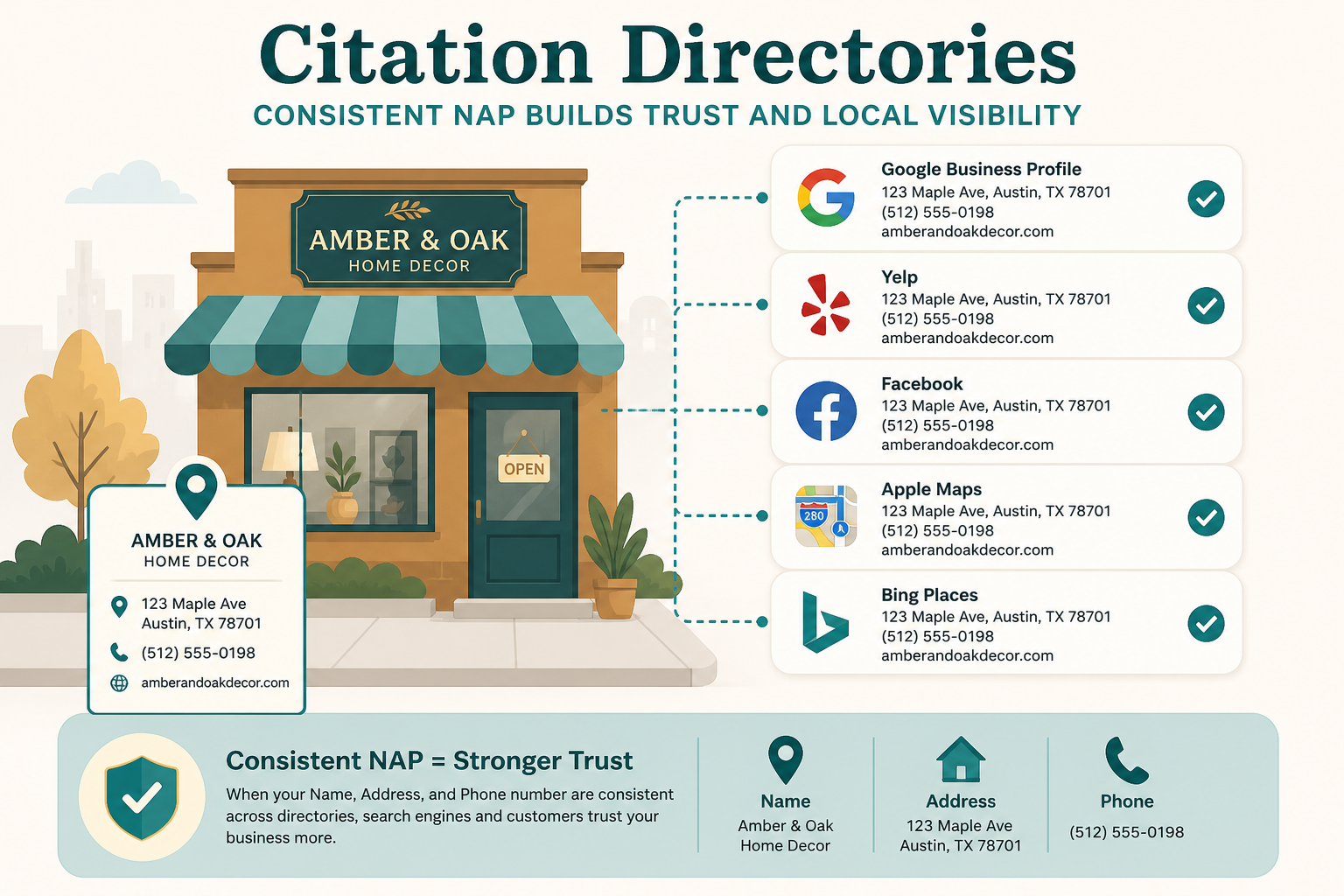
NAP consistency means your business name, address, and phone number appear identically — or at least functionally identically — everywhere your business is listed: your Google Business Profile, your website, directories, social profiles, and any third-party mentions you control. "Identically" does not require obsessive character-for-character matching down to abbreviation style, but it does mean avoiding genuinely conflicting information, like two different phone numbers or two different suite numbers for the same location appearing across different platforms.
The goal is removing ambiguity, not achieving perfect formatting uniformity. A directory listing "Suite 200" while your Google Business Profile says "Ste. 200" is a stylistic difference, not a real inconsistency. A directory still showing your old phone number three years after you switched carriers is a real, functionally damaging inconsistency that actively misroutes customers.
| Example | Type | Does it need fixing? |
|---|---|---|
| "St." vs "Street" across two listings | Stylistic formatting difference | Low priority, nice to standardize eventually |
| Old phone number still live on a directory | Genuine, functionally damaging inconsistency | Fix immediately |
| Previous business address still showing after a move | Genuine, functionally damaging inconsistency | Fix immediately |
| "Inc." included on one listing, omitted on another | Stylistic formatting difference | Low priority |
How Inconsistent NAP Quietly Hurts Rankings
It confuses the systems trying to confirm you are a real, stable business
Search engines cross-reference business information across multiple sources partly to build confidence that a listing represents a genuine, stable business rather than a fly-by-night or duplicate entry. When your name, address, or phone number conflicts across sources, that cross-referencing produces uncertainty instead of confidence, and uncertainty tends to work against a listing rather than for it, particularly in competitive local categories where trust signals carry real weight.
It directly costs you customers, which indirectly costs you rankings
A customer who calls a disconnected number or drives to an address you left two years ago does not usually try again — they call the next result instead. Beyond the immediate lost business, that customer never becomes a review, a repeat visit, or a referral, all of which feed the prominence signals that influence future rankings. The damage from bad NAP data compounds quietly through lost opportunities that never show up as an obvious ranking drop.
Where NAP Inconsistencies Usually Hide
The most damaging inconsistencies rarely live on your main website or Google Business Profile, since those get checked most often. They hide in smaller, less-visited directories that were set up years ago and never revisited: an old chamber of commerce listing, a niche industry directory signed up for once during a promotion, or a data aggregator that syndicated an old address to dozens of smaller sites before you ever noticed the original mistake.
| Source | Why it gets missed | How to find it |
|---|---|---|
| Old data aggregator syndication | Set up once years ago, rarely revisited | Search your old address or old phone number directly |
| Niche industry directories | Signed up for a promotion, then forgotten | Search your business name plus "directory" |
| Abandoned social profiles | Created early on, never updated after a move | Check every platform your team has ever used |
| Old press mentions or guest posts | Content is static and rarely gets corrected | Search your business name alongside your old address |
How to Audit and Fix NAP Across the Web
Start by searching your business name directly in quotes alongside your old address or old phone number if you have ever moved or changed numbers — this surfaces stale listings far faster than trying to manually check every possible directory. For remaining spot checks, focus on the handful of major directories relevant to your industry and location rather than trying to audit hundreds of obscure sites with negligible traffic or authority.
When you find an inconsistency, correct it directly wherever you can claim or edit the listing yourself, and use each platform's official correction or removal process where you cannot. Avoid paying for expensive, all-in-one citation cleanup services before trying the direct approach yourself; most small and mid-sized businesses have far fewer meaningfully damaging inconsistencies than the marketing around those services implies, and the highest-impact fixes are usually the address change covered in our guide on whether adding an address improves GBP rankings combined with your core Google Business Profile itself.

NAP Consistency for Service-Area and Multi-Location Businesses
Service-area businesses face a different, subtler risk
If you are a service-area business that hides its address on Google Business Profile, that same hidden address may still be sitting publicly on older directories from before you switched your privacy setting, or before you fully understood the guideline. This creates a specific kind of inconsistency — not conflicting data, but conflicting visibility — that can look unusual to systems comparing your public footprint. Audit older directories specifically for a leftover public address if you have ever changed your visibility setting on Google.
Multi-location businesses multiply the maintenance burden
Every additional location means every directory listing, every citation, and every mention needs to be checked and corrected independently, since a single template fix rarely propagates automatically across locations on third-party platforms. Businesses with several branches benefit from a simple shared tracking sheet listing every known citation per location, updated whenever any single location's information changes, so the burden of checking dozens of listings across multiple branches does not fall on memory alone.
Building a Maintenance Habit, Not a One-Time Fix
NAP consistency degrades naturally over time, especially after any move, rebrand, or phone system change, because updating every third-party listing rarely happens automatically. Build a habit of running the same direct search check after any change to your core business information, and set a reminder to repeat a lighter version of the audit annually even without a specific trigger, since directories occasionally change data on their own or resurface old cached information without any action on your part.
What About Website Schema and Structured Data?
Beyond directories, your own website often carries structured data — LocalBusiness schema markup — that explicitly declares your name, address, and phone number in a machine-readable format. If this markup was set up once during a site build and never revisited, it is a common place for a stale address or old phone number to persist quietly, invisible to a normal visual check of the page since it does not render on screen. A quick look at your site's structured data during any NAP audit closes a gap that a purely visual review would miss entirely.
If your website was built on a platform you do not control directly, ask whoever manages it to confirm the schema markup was updated at the same time as any visible address or phone number change. This single technical detail is easy to forget precisely because it does not show up anywhere a normal visitor would ever look, which is exactly why it tends to linger incorrectly for years once it slips through the cracks.
Final Takeaway
NAP consistency will never be the most exciting part of local SEO, and fixing it will not produce a dramatic ranking jump you can point to with confidence. What it does is remove a quiet source of friction that costs you customers and trust signals in ways that rarely announce themselves clearly. Pair it with the fundamentals covered in our 2026 local SEO strategy guide and the rest of your local SEO foundation, and it becomes one less thing quietly working against everything else you are building. Set the reminder, run the check, and move on to the parts of local SEO that are actually more interesting to work on. It is not glamorous work, but it is reliable work, and reliability is exactly what this particular part of local SEO rewards.
Frequently Asked Questions
Does NAP consistency still matter as much as it did five years ago?
It matters somewhat less as a direct ranking factor than it once did, but it still affects trust signals and, more importantly, directly affects whether customers can actually reach you.
How many directories should I actually check and fix?
Focus on major platforms and any directory relevant to your specific industry or region rather than trying to audit hundreds of low-traffic sites with negligible real impact.
Do I need to pay for a citation-building or cleanup service?
Most small businesses can handle the highest-impact fixes themselves through direct search and correction. Paid services can save time but are rarely strictly necessary.
What should I do first after moving to a new address?
Update your Google Business Profile and website immediately, then run a direct search for your old address in quotes to find and correct the highest-impact remaining mentions.
Do minor formatting differences like "St." versus "Street" actually hurt rankings?
Modern matching systems are generally tolerant of minor stylistic differences. Focus your effort on genuine conflicts in the actual data rather than achieving perfect formatting uniformity.
How often should I recheck NAP consistency if nothing has changed?
An annual check is reasonable even without a specific trigger like a move or phone change, since directories occasionally surface outdated cached information on their own.
Can inconsistent NAP data get my listing suspended?
It is unlikely to directly cause a suspension on its own, but it can contribute to broader trust concerns if it appears alongside other more serious profile inaccuracies.