Reviews are the most talked-about, most misunderstood part of Google Business Profile strategy. Owners hear conflicting advice constantly: some say review count is everything, others say only the star rating matters, and a few still believe buying reviews is a viable shortcut. The truth in 2026 is more nuanced than any of those claims, and understanding the nuance is what separates sustainable review growth from a strategy that eventually gets a listing suspended.
This guide separates what reviews actually influence—ranking, trust, and conversion are three distinct outcomes—covers the metrics that genuinely matter, walks through ethical generation tactics that work, and explains how to handle negative reviews without damaging either your reputation or your standing with Google.
What Reviews Actually Influence: Rank vs Trust vs Conversion
Reviews support prominence, one of the three core ranking pillars, but they are not the only input and rarely override a wrong category or a significant distance disadvantage on their own. Where reviews have their clearest, most measurable impact is conversion: a customer comparing three similar businesses in the pack overwhelmingly favors the one with more recent, detailed, positive reviews, independent of exact rank position. Trust operates alongside both—strong reviews build the kind of reputation that supports prominence over months while also directly persuading the person reading them right now.
The Metrics That Matter: Volume, Velocity, Recency, Rating and Replies
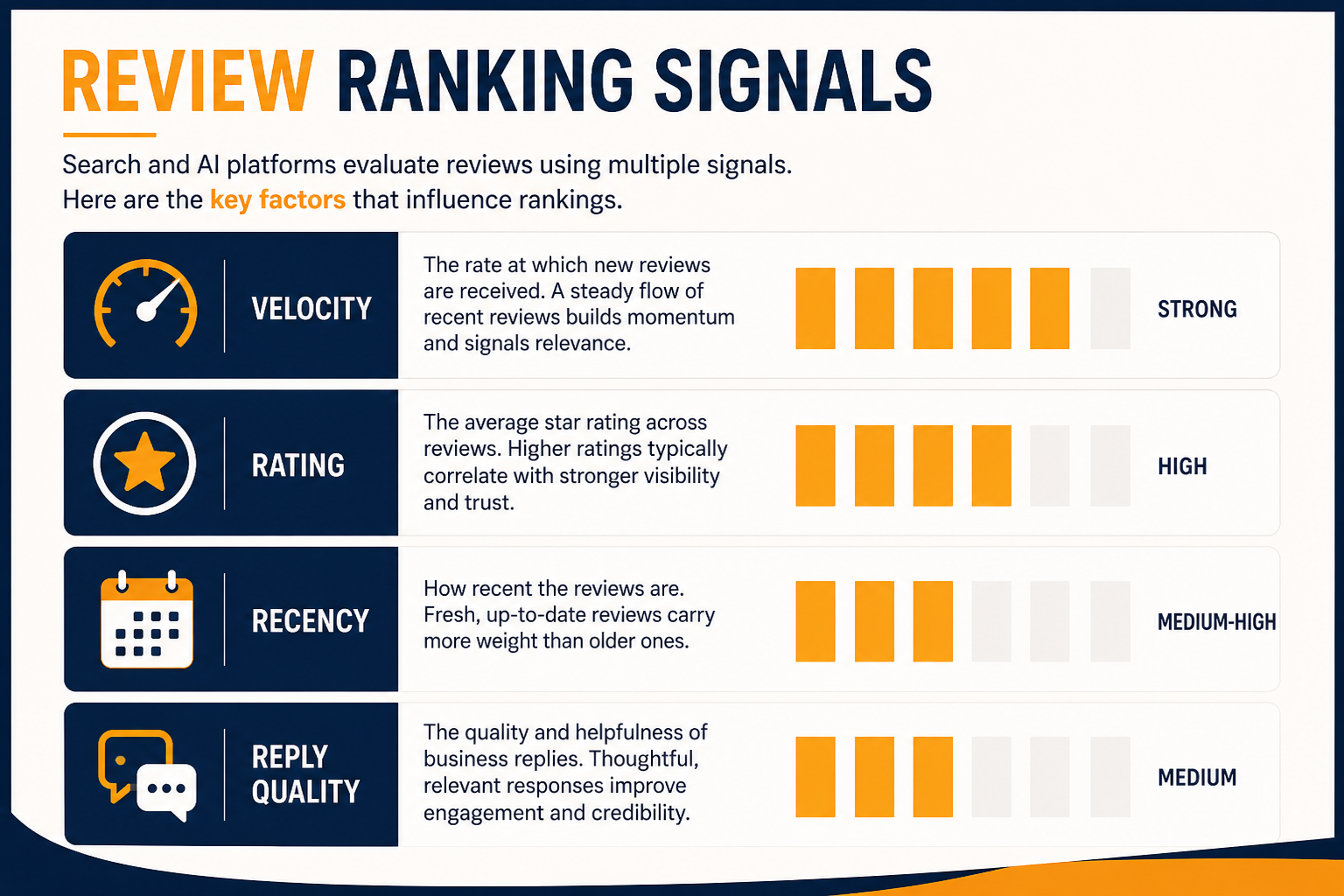
Total review volume matters less on its own than most owners assume; a profile with three hundred reviews frozen since two years ago can lose to a competitor with sixty reviews arriving steadily this year. Velocity—the pace of new reviews arriving—and recency—how fresh the most recent reviews are—both signal an actively trusted, currently operating business. Average rating matters, but a 4.6 with detailed, specific reviews often outperforms a suspiciously perfect 5.0 with generic, repetitive-sounding text. Reply quality and speed round out the picture, showing both Google and customers that the business is actively managed.
| Metric | What it signals | Practical target |
|---|---|---|
| Review velocity | Ongoing trust and activity | Steady flow, not one-off bursts |
| Recency | Currently operating and relevant | New reviews within the last few weeks |
| Average rating | Overall satisfaction level | 4.3 to 4.8 with genuine, varied reviews |
| Reply rate and speed | Active management | Reply within 48 hours, always |
| Total volume | Baseline credibility | Steady growth over time, not a fixed number |
Ethical Review Generation That Actually Works
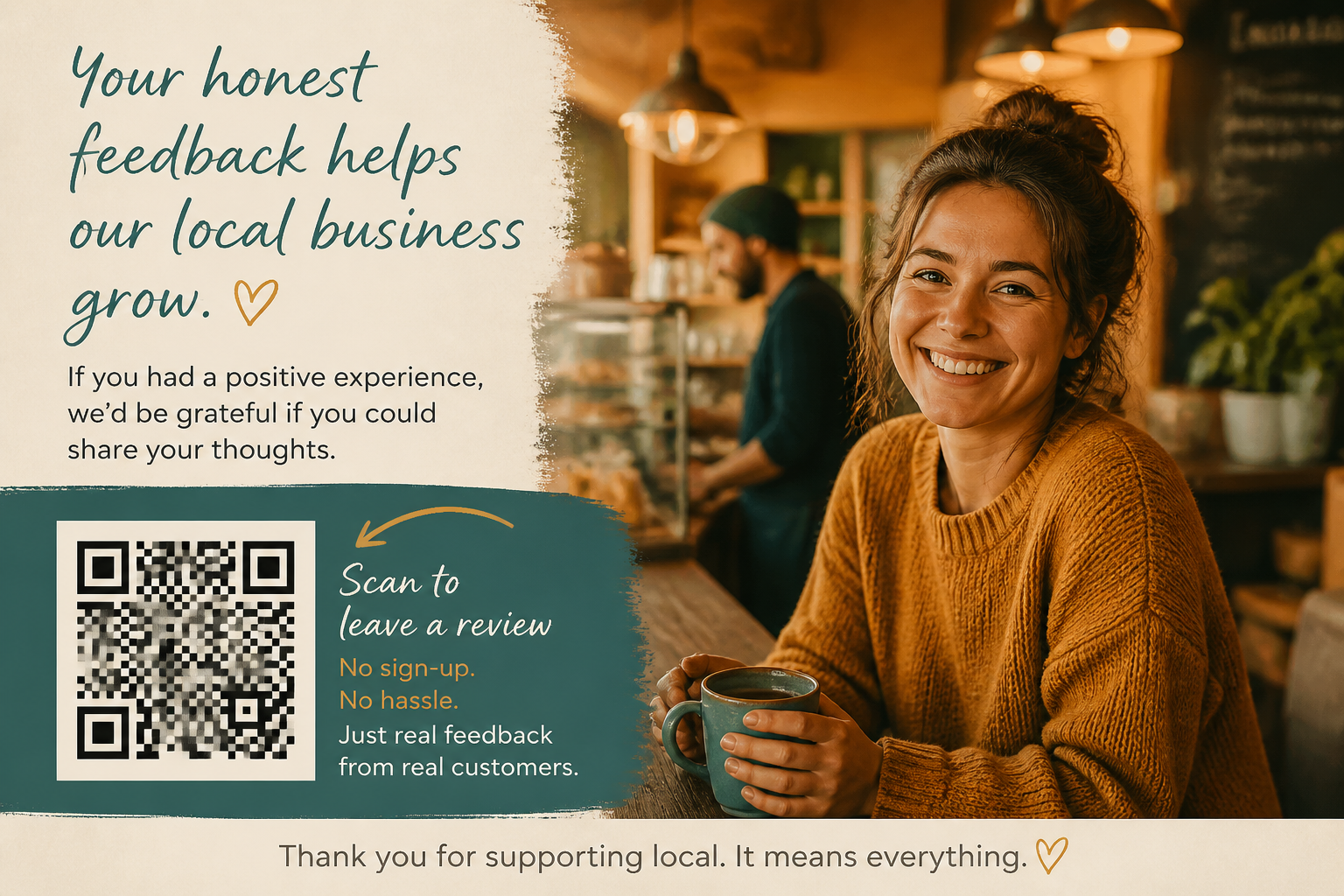
The most reliable review growth comes from building the request into your actual service delivery, not from a separate marketing campaign bolted on afterward. Ask at the natural high point of the customer relationship—right after a successful job, at checkout, or in a same-day follow-up message—and make the process as short as possible with a direct link or QR code. Train frontline staff with a brief, natural script instead of a scripted pitch that feels transactional.
What Does Not Work—and Can Get You Suspended
Buying reviews, running review-gating schemes that filter unhappy customers away from leaving public feedback, or offering discounts explicitly in exchange for five-star wording all violate Google's policies and carry real suspension risk. A suspension during your busiest season can erase months of accumulated visibility overnight, which makes these shortcuts a poor trade even setting aside the ethical problem.
| Tactic | Policy status | Outcome if used |
|---|---|---|
| Asking every customer for honest feedback | Safe | Sustainable, steady growth |
| QR code or link at point of service | Safe | Higher response rate, no policy risk |
| Buying reviews from third parties | Violation | Suspension risk, fake velocity spikes flagged |
| Review-gating unhappy customers away | Violation | Policy risk and misleading rating inflation |
| Paying for five-star wording specifically | Violation | Suspension risk, damages genuine trust |
Why Review Diversity Matters More Than a Perfect Average
A profile with only enthusiastic, near-identical five-star reviews can actually raise a subtle red flag for careful searchers, who increasingly recognize that real customer experiences are rarely uniformly perfect. A handful of honest four-star reviews describing a minor issue that was handled well often builds more credibility than an unbroken wall of five stars, because it signals that the reviews are genuine rather than curated or filtered.
This does not mean you should want negative experiences—obviously you should not—but it does mean you should not panic or attempt to suppress an occasional honest three or four-star review that reflects a real, minor shortcoming. Respond to it thoughtfully, show that you take feedback seriously, and let the overall pattern of mostly strong, varied, detailed reviews do the persuading rather than chasing an artificial, suspiciously perfect score.
Handling Negative Reviews Without Hurting Rankings or Trust
Reply calmly, acknowledge the specific concern, and offer a real path to resolution, whether that is a refund, a redo, or an invitation to discuss the issue directly offline. Never argue publicly or accuse a reviewer of lying, even when you suspect the review is unfair—prospective customers judge your reply more than the original complaint itself. If a review clearly violates Google's policies, such as containing hate speech or being posted by someone who was never actually a customer, flag it through Google's official reporting tools rather than trying to argue it away in the reply.
Building a Review Culture, Not Just a Review Tactic
The businesses that sustain strong review growth for years, rather than for a single burst, tend to treat asking for feedback as part of their genuine service culture rather than a marketing task assigned to one person. When every team member understands why reviews matter and feels comfortable asking naturally, the request stops feeling like an awkward script and starts feeling like a normal part of finishing a job well.
This cultural shift also produces better review content, not just more of it. A team that genuinely cares about the ask tends to time it at moments when the customer is actually satisfied, rather than firing off an automated request regardless of how the interaction went. That timing difference shows up directly in review quality—specific, detailed, positive reviews versus generic one-line ratings that provide less trust value to future readers.
What to Do When You Suspect Competitor Fake Reviews
Discovering that a competitor appears to be using fake or purchased reviews is frustrating, and the temptation to respond in kind is understandable but counterproductive. Document the suspicious pattern—unusually rapid review bursts, generic repetitive language, reviewer profiles with no other activity—and report it through Google's official tools rather than attempting to argue about it publicly or retaliating with fake reviews of your own, which only compounds the underlying problem across the platform.
Focus your energy on your own genuine review growth instead of monitoring a competitor's activity too closely. Google's spam detection systems have improved significantly over the past several years, and manipulated review patterns are increasingly likely to be caught and penalized without your direct intervention. Your time is almost always better spent strengthening your own profile than building a case against someone else's.
Measuring Review Impact Over Time
Track review count, average rating, velocity, and reply rate together in a simple monthly log rather than checking the star rating alone. Pair that with grid-based rank tracking through GBP Local Ranker so you can see whether steady review growth is correlating with improved neighborhood visibility over a period of months, not days. Our GMB optimization guide and local SEO playbook both cover how review management fits into the broader weekly operating rhythm.
A Final Reminder About Patience
Review-driven prominence is one of the slower-moving levers in local SEO, and expecting a dramatic rank change within a couple of weeks of restarting a request habit sets you up for disappointment even when the underlying work is genuinely correct. Give a consistent review system at least six to eight weeks before drawing conclusions, and judge it by the combination of review growth, conversion metrics, and gradual rank trends together rather than any single number checked too early.
Businesses that stay patient through this window, while still replying to every review and keeping the request habit running, consistently see a stronger long-term outcome than those that abandon the effort after a single unimpressive month. Treat the first two months as a setup phase where you are building a foundation, not a phase where you should already expect the final result.
Final Takeaway
The truth about Google Business Profile reviews is less dramatic than the shortcuts promise and more achievable than the doubters suggest. Reviews support ranking indirectly through prominence, drive conversion directly and measurably, and build the kind of reputation that compounds over months of honest, consistent effort. Skip the shortcuts that risk suspension, build a real request habit into your service flow, and reply to every review like a real person is reading it—because they are.
Frequently Asked Questions
Do more reviews always mean a higher ranking?
No. Velocity, recency, and quality typically matter more than raw total count. A smaller number of recent, genuine reviews can outperform a large but stagnant total.
Is a perfect 5.0 rating actually a good thing?
Not necessarily. A suspiciously perfect rating with generic-sounding reviews can look less credible to customers than a slightly lower rating with detailed, varied feedback.
Can I offer a small incentive for leaving a review?
Google's policies prohibit incentives tied to the content of a review, such as offering a discount specifically for a five-star review. General thank-you gestures unrelated to review content carry less risk but should still be approached carefully.
How quickly should I reply to a negative review?
As soon as reasonably possible, ideally within 48 hours. A prompt, calm, professional reply matters more to prospective customers than the speed alone.
Can I get fake or clearly abusive reviews removed?
Yes, flag them through Google's official reporting process. Removal is not guaranteed and can take time, but clear policy violations are generally worth reporting.
Does responding to positive reviews matter as much as negative ones?
Yes. Thoughtful, specific replies to positive reviews reinforce trust for future readers and show consistent, active management rather than only reacting to complaints.
How many reviews do I need before they start helping meaningfully?
There is no fixed threshold. Consistent, ongoing growth in genuine reviews matters more than reaching any specific number before expecting results.