Ask five different SEO professionals whether schema markup helps local rankings and you will likely get five different, confidently stated answers, ranging from "it's essential" to "it does nothing." The honest answer sits in between, and it depends heavily on what you mean by "help" and which part of search you are talking about — Google Maps and the local map pack, or the broader organic search results and how they visually appear. Conflating the two is where most of the exaggerated claims about schema markup come from.
This guide gives a straight, evidence-grounded answer: what LocalBusiness schema actually does, what it does not do, where it genuinely earns its place in a technical SEO checklist, and where the claims made about it in marketing content cross into wishful thinking. There is no dramatic ranking hack here — just a clear-eyed look at a markup format that is worth implementing correctly, for the right reasons.

What LocalBusiness Schema Actually Is
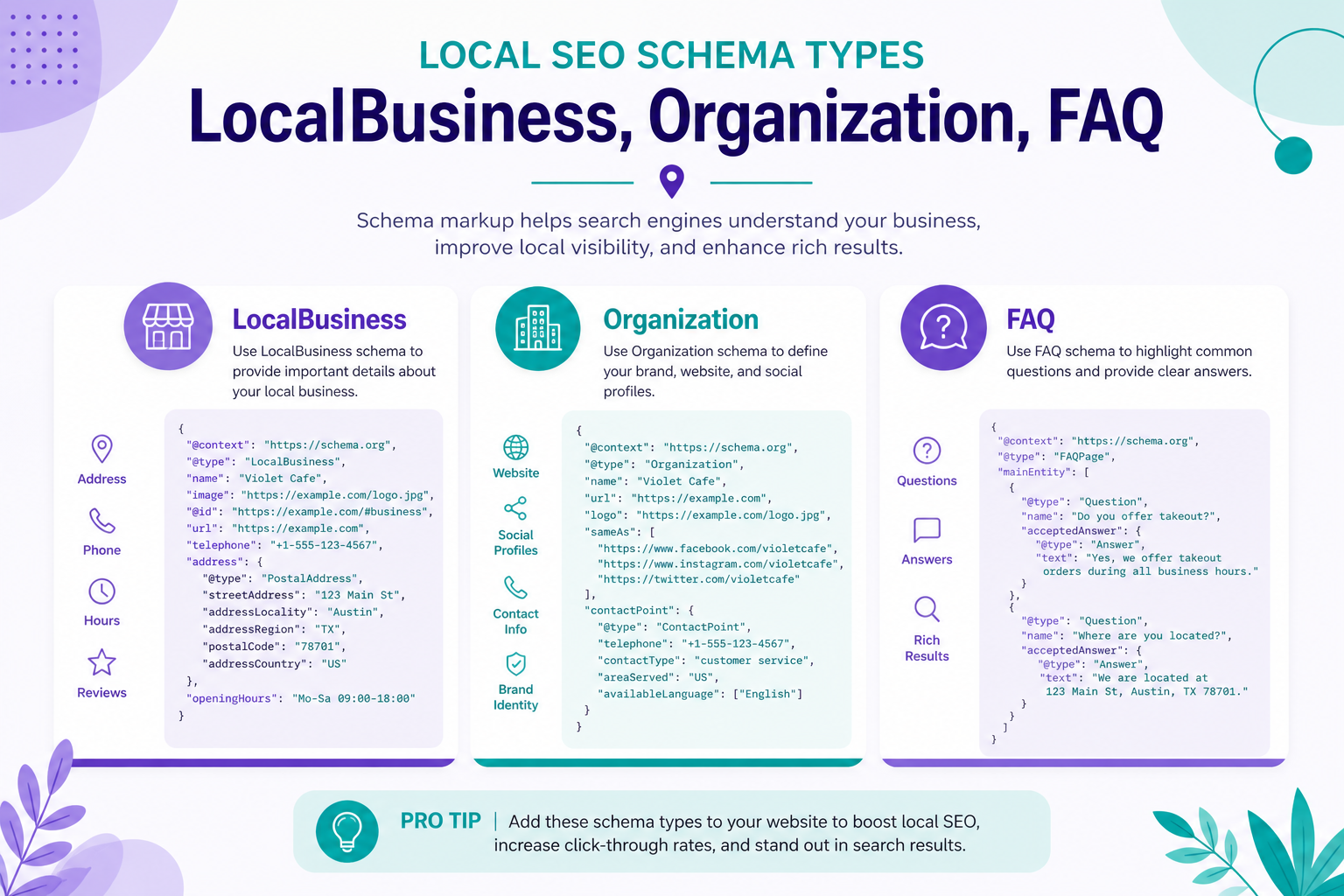
Schema markup is structured data — typically written in JSON-LD and embedded in a webpage's code — that describes the content on the page in a standardized vocabulary search engines can parse directly, rather than inferring meaning from unstructured text alone. LocalBusiness schema (and its more specific subtypes, like Restaurant, Dentist, or ProfessionalService) is the format built specifically to describe a physical or service-area business: its name, address, phone number, hours, price range, and geographic coordinates, expressed in a machine-readable structure rather than plain paragraph text.
What it tells search engines with more certainty
The core value of structured data is disambiguation. A search engine reading plain text has to infer that the string of numbers near the top of a page is a phone number, or that "Mon-Fri 9-6" means the business is open weekdays. Schema removes the guesswork by explicitly labeling each data point, giving search engines a higher-confidence, more machine-readable version of exactly the same information already on the page for human visitors.
What it is not
Schema markup is not a way to add information to a page that is not otherwise visible or true, and Google's guidelines are explicit that structured data must accurately reflect visible page content — adding a five-star rating in schema that does not correspond to real, visible reviews is a guideline violation, not a growth hack. Schema also is not a mechanism for directly telling Google to rank you higher; it is a clarity layer, not a ranking lever in the way a stronger review profile or a genuinely optimized Google Business Profile is.
| Area | Does Schema Affect It? | Honest Explanation |
|---|---|---|
| Google Maps / local pack ranking | Not directly | Map pack ranking is driven primarily by your Google Business Profile signals, not your website's schema |
| Rich results eligibility (organic search) | Yes, potentially | Correct schema is often a prerequisite for certain rich result types, though eligibility is never guaranteed |
| Search engine clarity about your business | Yes | Removes ambiguity about NAP, hours, and business type from unstructured text |
| Voice assistant / AI answer sourcing | Indirectly, sometimes | Structured, unambiguous data is easier for AI systems to extract confidently |
| Guaranteed higher rankings | No | No credible evidence supports schema alone moving map pack or organic position |
Where Schema Markup Genuinely Earns Its Place
Despite the limits above, implementing LocalBusiness schema correctly is still worth doing, for reasons that are more modest but real. It gives search engines an unambiguous, structured version of your NAP data that lines up exactly with your Google Business Profile and citations, reinforcing the same consistency signals covered in our guide on local business schema implementation . Consistency across every place your business is described — website, schema, citations, and your profile — is a real, if unglamorous, trust signal.
Rich results and how your listing can visually appear
Certain schema types are a genuine prerequisite for specific visual enhancements in organic search results, such as star ratings displayed under a search snippet (when backed by real, eligible review markup) or FAQ-style expandable answers. These are not guaranteed even with perfect markup — Google decides case by case whether to render them — but a business without the underlying schema is simply not eligible to be considered for them at all, which makes correct implementation a low-cost, no-downside step.
Helping AI-driven answers extract accurate information
As more search experiences summarize information directly in an AI-generated answer rather than a list of links, structured, unambiguous data becomes marginally easier for those systems to extract with confidence compared to parsing inconsistent prose. This is not a guaranteed inclusion mechanism, and no legitimate source can promise that clean schema gets you featured in an AI Overview, but it removes one plausible source of confusion when a system is deciding which facts about your business to trust.
| Field | Should Match | Common Mistake |
|---|---|---|
| name | Exact legal / DBA name on your Google Business Profile | Adding keywords not on real signage |
| address | Exact address on your lease and profile | Formatting inconsistently across pages |
| telephone | Primary tracked number shown on the site | Using a different number than what customers actually call |
| openingHoursSpecification | Real, current hours | Leaving outdated holiday hours in place |
| aggregateRating | Real, visible review count and average | Fabricating or inflating a rating not shown on the page |

How to Implement It Without Overcomplicating the Project
For most small and mid-sized local businesses, JSON-LD generated through a well-reviewed plugin or a simple, manually maintained template is entirely sufficient — this is not a project that requires an enterprise structured-data platform unless you are managing schema across hundreds of location pages. Place the LocalBusiness (or more specific subtype) schema on your homepage and, for multi-location businesses, a matching block on each individual location page, keeping every field in sync with your live Google Business Profile.
Validate the implementation with Google's Rich Results Test and the Schema.org validator before publishing, and revisit it any time your hours, address, or name changes — stale schema that contradicts your visible page content is worse than no schema at all, since it actively signals an inconsistency search engines are specifically built to notice. Treat it as a maintenance item tied to your Google Business Profile updates rather than a one-time task you never revisit.
Common Schema Markup Myths Worth Retiring
A lot of the confusion around schema markup comes from a handful of persistent myths that keep circulating in SEO content, often because a small correlation gets mistaken for causation. Separating these myths from the genuine, modest benefits covered above helps set realistic expectations before a business invests time or budget into a structured-data project.
Myth: schema markup is a hidden ranking hack
Some content implies that undisclosed or aggressive schema usage can trick search engines into ranking a page higher than its actual content deserves. This is not how modern search engines work, and Google has been explicit that structured data is a clarity tool, not a ranking signal that can be gamed. Any strategy built on this premise is wasting effort that would be better spent on the review, content, and profile fundamentals that genuinely move the needle.
Myth: adding more schema types is always better
Piling on schema types that do not accurately describe the page — marking up an FAQ that is not genuinely a set of frequently asked customer questions, for instance — does not add value and can create validation errors that make search engines trust your structured data less overall. A smaller, accurate set of schema types implemented correctly outperforms a large, sloppy set every time.
Myth: schema can compensate for a weak or outdated website
Structured data describes what is already on a page; it cannot substitute for genuinely useful content, a fast mobile experience, or an accurate business description. A thin, outdated website with perfect schema is still a thin, outdated website, and no amount of markup changes that underlying reality for either search engines or the actual customers reading the page.
Myth: once implemented, schema never needs revisiting
Schema is not a set-and-forget task any more than any other part of your online presence is. Businesses that change their hours, rebrand, move locations, or restructure their website often forget that the schema block embedded in their code still reflects the old details, quietly creating exactly the kind of contradiction between visible content and structured data that Google's guidelines warn against. A short check during any major business change keeps this from becoming a liability, and adding it to the same checklist used for updating your Google Business Profile after a change is the simplest way to make sure it never gets forgotten.
The Honest Bottom Line
Schema markup is not the secret unlock some content implies, and it will not move a struggling map pack ranking on its own — that work still comes from the fundamentals covered in our broader local SEO ranking factors guide: reviews, proximity, category accuracy, and genuine relevance. What schema does offer is real: cleaner signals for search engines, eligibility for certain rich results, and one more layer of consistency in an ecosystem where consistency compounds. It is worth the modest effort to implement correctly — just not as a substitute for the harder, more impactful work.
Frequently Asked Questions
Does adding schema markup directly improve Google Maps rankings?
No, there is no credible evidence that schema markup alone moves map pack rankings; those are driven primarily by your Google Business Profile signals.
Is LocalBusiness schema required to appear in the map pack?
No, appearing in the map pack depends on your Google Business Profile, not your website's schema markup. Treat “Frequently Asked Questions” as an operating checklist—not a one-time edit—so rankings compound instead of resetting every month.
Can schema markup get my business into an AI Overview?
There's no guarantee; clean, unambiguous structured data may make it marginally easier for AI systems to extract accurate facts, but inclusion is never promised.
Is it against the rules to add a star rating to schema that isn't shown on the page?
Yes, Google's guidelines require aggregateRating schema to match real, visible reviews on the page; fabricating or hiding the source violates the guidelines.
Do I need a developer to implement LocalBusiness schema?
Not necessarily; a well-reviewed plugin or a simple manually maintained JSON-LD template is sufficient for most small and mid-sized businesses.
How often should schema markup be updated?
Any time your hours, address, phone number, or business name changes, to keep it consistent with your visible page content and your Google Business Profile.
Will schema markup help if my Google Business Profile has weak reviews?
No, schema cannot compensate for weak reviews or profile fundamentals; it is a clarity layer, not a substitute for the core ranking factors.