"Just get more reviews" is some of the most repeated, least useful advice in local SEO, mostly because it treats review count as the whole story when it is really just one input among several. Reviews genuinely matter, but the honest picture is more nuanced than a simple star rating and total count: recency, response behavior, and the specific language inside a review all play a role in how much trust and relevance a profile actually earns.
This guide breaks down what reviews actually signal, where they sit relative to other ranking factors, and how to build a review system that keeps compounding over months instead of a one-time push that fades after the initial burst of enthusiasm wears off.
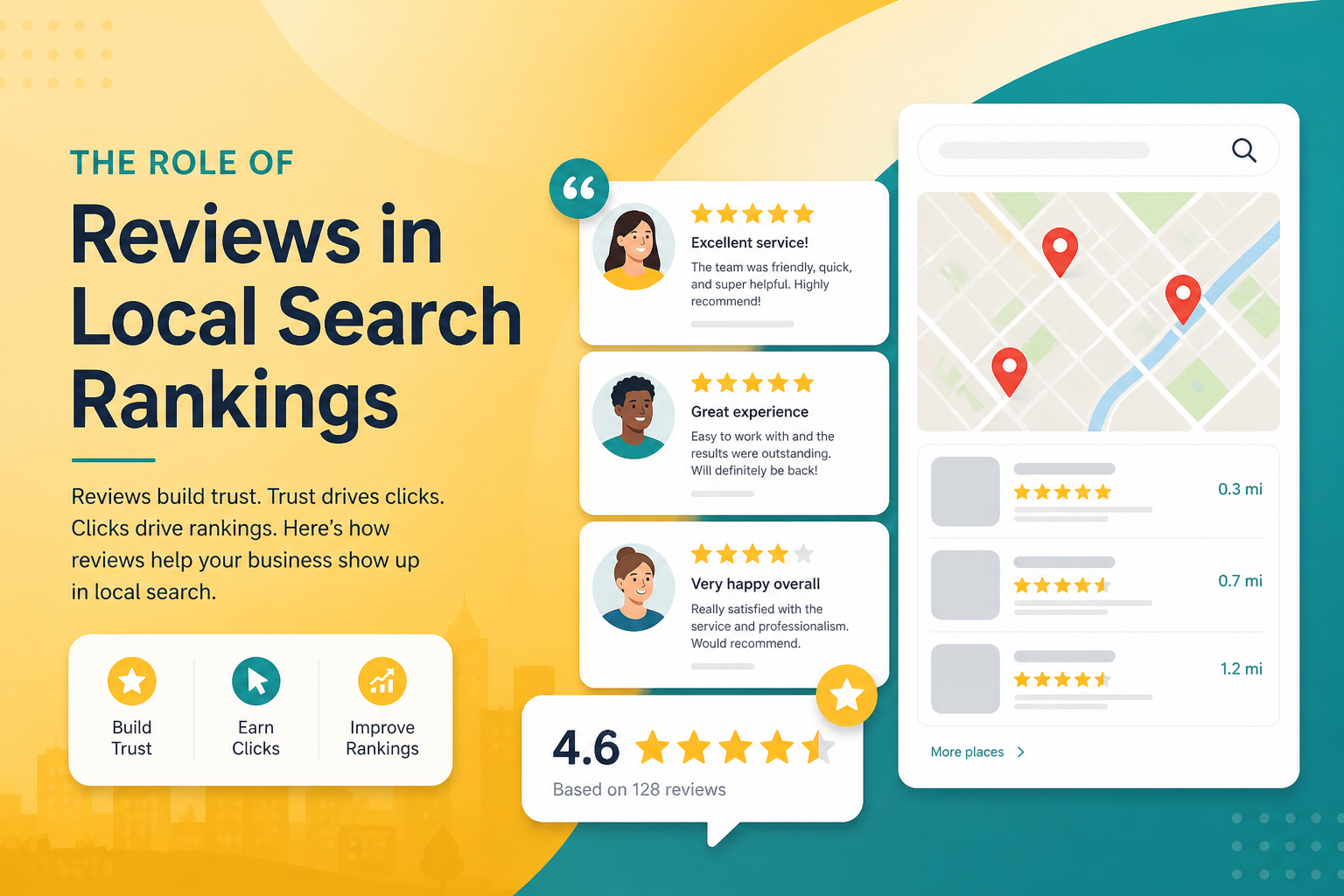
What Reviews Actually Signal to Google
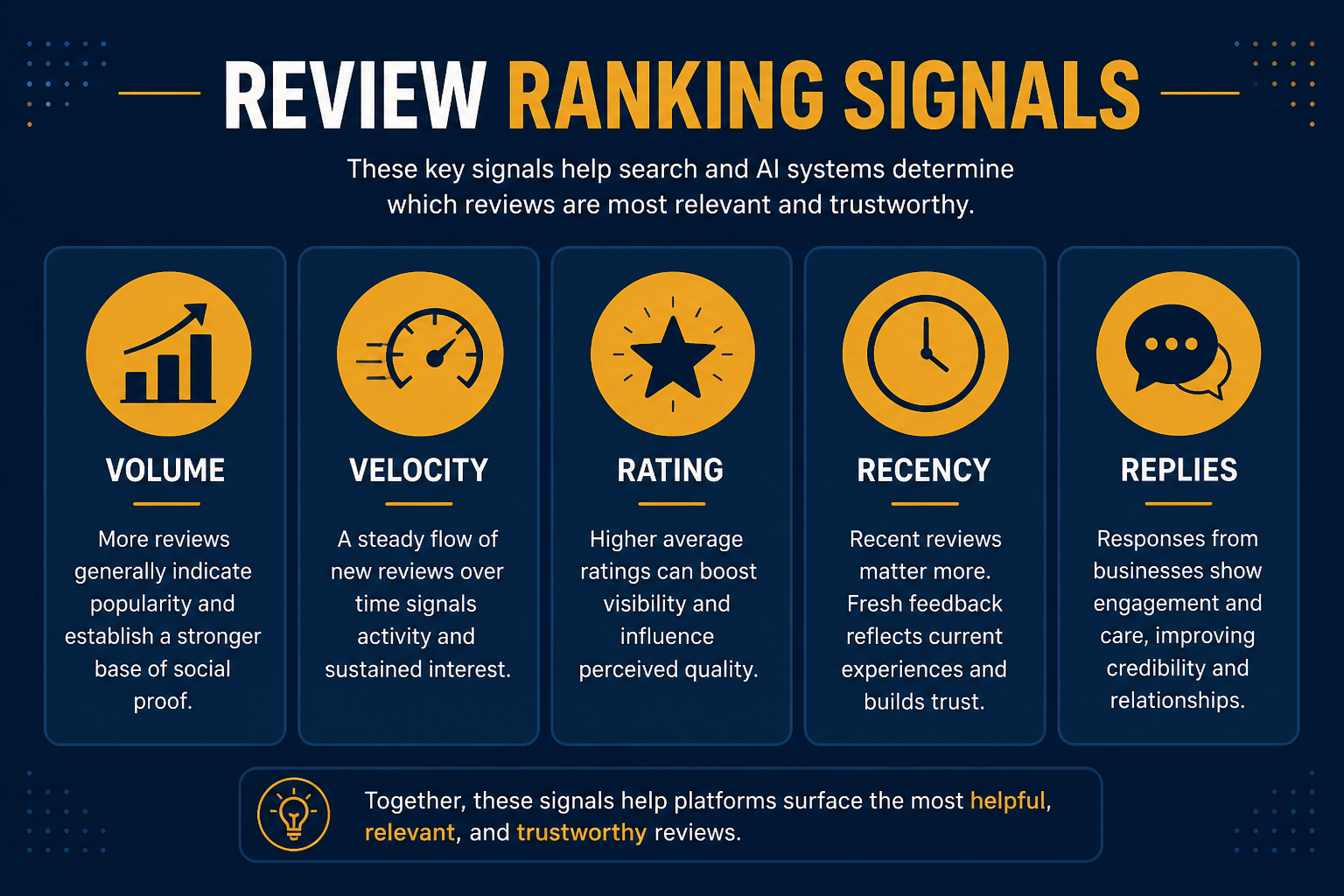
Reviews feed primarily into the prominence pillar of local ranking, which measures how well-known and trusted a business appears based on signals across the web. Total review count contributes to this, but so does the average rating, and increasingly so does recency — a profile with reviews arriving steadily looks more active and trustworthy than one with a large historical count and nothing new in months.
Response behavior adds another layer. A business that replies thoughtfully and promptly signals active management, which reinforces the same trust signal reviews themselves are building. None of these individual signals operates in isolation; they combine into a broader impression of whether a business is genuinely active, trusted, and worth surfacing for a given search.
| Signal | What it likely reflects | How to influence it honestly |
|---|---|---|
| Total review count | Overall accumulated trust and popularity | Build a steady, ongoing request habit over time |
| Average rating | General customer satisfaction level | Deliver consistent service quality; do not filter which customers get asked |
| Review recency | Whether the business is currently active and trusted | Request reviews continuously, not in isolated bursts |
| Reply rate and speed | Active management and responsiveness | Reply to every review within 48 hours, with specific, genuine responses |
Where Reviews Fit Among Other Ranking Factors
Reviews are one input into prominence, and prominence is one of three broad pillars alongside relevance and distance. A business with excellent reviews but a poorly matched category or an unrealistic service area can still underperform a competitor with fewer reviews but stronger fundamentals elsewhere. Our deeper analysis in the truth about GBP reviews and rankings covers this balance in more detail, including why review count alone rarely explains a ranking gap between two competitors.
Fake reviews create more risk than reward
Purchased or incentivized reviews violate platform guidelines and are increasingly detectable through pattern analysis — clusters of reviews arriving at the same time, from accounts with no other review history, or using suspiciously similar language. When caught, the consequences range from review removal to broader account penalties, which typically costs far more visibility than the fake reviews ever contributed in the first place.
Negative reviews are not automatically damaging
A profile with zero negative reviews at all can occasionally look less authentic than one with a small number of negative reviews handled professionally, since real businesses serving real customers over time rarely achieve a perfect record. A thoughtful, non-defensive response to a negative review often does more to build trust with future customers reading it than the negative review itself does to damage it.
Building a Review System That Compounds Over Time
The most effective review systems are boring and consistent rather than clever. Ask every satisfied customer at the natural moment of highest satisfaction — right after a completed job, a successful checkout, or a positive interaction — using a simple, low-friction method like a direct link sent by text or email. Avoid selectively asking only customers you suspect will leave a five-star review, since that practice violates most platforms' guidelines and produces an artificially inflated record that does not reflect genuine service quality.
| Day | Action |
|---|---|
| Monday | Send review requests to every customer served the previous week |
| Wednesday | Reply to any new reviews received since Monday |
| Friday | Send a single, polite follow-up to non-responders from the prior week only |
How to Respond to Reviews the Right Way
A good reply is specific, not generic. Mention the actual service performed or the detail the customer raised, thank them genuinely, and keep the tone consistent with your brand voice rather than sounding like a template pasted from a review management tool. For negative reviews, acknowledge the specific concern without being defensive, briefly explain what happened if appropriate, and note what you have done or will do differently — then take any lengthy back-and-forth offline through a direct contact method rather than continuing to argue publicly beneath the review itself.
Why Review Velocity Matters More Than a Static Total
Two businesses with an identical total of 150 reviews can be in very different positions depending on how those reviews accumulated. One earned all 150 within its first year and has added almost nothing since; the other built the same total gradually and continues adding four or five genuine reviews every month. Both look identical on a simple total-count comparison, but the second business is sending a much stronger, more current trust signal, and it is the one more likely to keep growing that advantage over the months ahead.
This is why velocity — the rate of new reviews arriving over a recent window, typically the last 30 to 90 days — deserves more attention than the lifetime total most owners fixate on. A sudden slowdown in velocity, even with a strong historical total intact, is often an early warning sign worth investigating before it shows up as a broader visibility decline. Treat velocity as a health metric to check monthly, not a vanity number to admire once and forget.
Reading Reviews for Business Insight, Not Just Ranking Signal
Reviews carry a second kind of value that has nothing to do with search rankings at all: they are a direct, unfiltered feedback channel from real customers. Recurring mentions of a specific problem — slow response times, a confusing booking process, inconsistent quality from one team member — are worth acting on for their own sake, independent of any SEO benefit. Businesses that treat reviews purely as a ranking input often miss this operational signal sitting in plain sight within their own review history.
Set aside time every month or quarter to actually read through recent reviews as a group rather than reacting to each one individually as it arrives. Patterns that are invisible one review at a time often become obvious once you see five or six similar comments clustered together, and addressing the underlying issue tends to improve both future reviews and the actual quality of the business at the same time.
What to Do When Review Growth Stalls Unexpectedly
A sudden drop in incoming reviews after a long period of steady growth is worth investigating rather than ignoring. Sometimes the cause is simple — a staffing change meant the person who used to remind customers to leave a review left the company, and nobody picked up the habit. Other times it reflects a genuine service issue that is quietly suppressing satisfaction before it ever reaches the point of a written complaint. Either way, a stall is a signal worth a few minutes of investigation rather than something to wait out and hope resolves itself.
Rebuilding momentum after a stall is usually a matter of returning to the basics rather than needing a dramatic new tactic: reinstating the request habit, checking that the request method still works technically, and confirming nothing changed on the customer-facing side that made leaving a review more difficult than it used to be. Most stalls trace back to a broken process rather than a sudden shift in customer sentiment, and the fix is almost always more mundane than it initially feels. Treat every stall as a prompt to check the mechanics first, before assuming something has gone fundamentally wrong with the quality of the business itself.
Final Takeaway
Reviews matter, but not as a standalone magic lever separate from everything else covered in this series. They are one meaningful input into the broader prominence pillar, most powerful when built through a steady, honest, ongoing system rather than a single dramatic push. Combine a genuine review habit with the rest of your local SEO foundation and GMB optimization work, and reviews become a durable, compounding asset instead of a number you check nervously once a month.
Frequently Asked Questions
How many reviews do I need to rank well?
There is no fixed threshold. Recency, average rating, and consistency of new reviews arriving over time matter more than hitting a specific total count.
Can a single negative review significantly hurt my ranking?
A single negative review rarely causes a meaningful ranking change on its own, especially if handled professionally, though a pattern of consistently poor reviews will affect prominence over time.
Is it worth offering a discount in exchange for a review?
No, this violates most platforms' guidelines against incentivized reviews and risks removal or penalties. Ask for honest reviews without offering compensation tied to the review itself.
Should I respond to every single review, even short positive ones?
Yes, a brief, genuine reply even to short positive reviews reinforces active management and shows future readers that the business engages consistently.
How quickly should I reply to a negative review?
Within 24 to 48 hours is a good standard, giving you enough time to gather facts while still responding promptly enough to show genuine attentiveness.
Can I ask Google to remove a review I believe is fake?
Yes, you can flag reviews that violate platform guidelines for removal, though only genuine violations like fake accounts or off-topic content are typically actioned, not simply reviews you disagree with.
Does review length matter for ranking purposes?
Longer, more detailed reviews may provide more contextual and keyword-relevant content than a one-word rating, but there is no evidence that length alone is a direct ranking factor.