Optimize Location Pages for is one of the highest-leverage local search topics in 2026. Location pages have a mixed reputation in local SEO, and honestly, both sides of the debate have a point. Done well, a location page gives Google clear, unique signals about where you genuinely operate and gives a searcher the exact local detail they came looking for. Done poorly — a template with the city name swapped and nothing else changed — a location page is thin, duplicated content that can actively work against the rest of your site.
This guide covers how to tell which situation applies to your business, how to structure a location page that clears the "genuinely useful" bar, and how to connect it properly to your Google Business Profile so the two reinforce each other instead of sending mixed signals.
Why Location Pages Matter — and When You Actually Need
If you operate from a single address and serve a single reasonably compact area, a strong homepage combined with a well-optimized Google Business Profile is usually sufficient, and building separate location pages adds complexity without a corresponding benefit. Location pages earn their value specifically when a business genuinely serves multiple distinct cities, neighborhoods, or regions — either through multiple physical locations or as a service-area business covering meaningfully different areas.
The purpose of a location page is to give search engines and searchers unambiguous, specific signals about a particular area you serve, something a single generic homepage genuinely cannot do once you are operating across several distinct markets. Skipping location pages when you need them leaves a gap; building them when you do not need them creates unnecessary thin content risk.
| Situation | Location pages needed? | Reasoning |
|---|---|---|
| Single address, one compact service area | No | A strong homepage and GBP profile already cover this adequately |
| Multiple physical branches in different cities | Yes | Each location needs its own address, hours, and local signals |
| Single base, service area spans several distinct cities | Often yes | Distinct pages can capture city-specific intent the homepage cannot |
| Multiple neighborhoods within one small city | Usually no | Overlap is often too close to justify separate pages without real differentiation |
Structuring a Location Page That Actually Helps
Fill it with genuinely unique, local detail
A location page should read like it was written by someone who actually knows that specific area — mentioning real nearby landmarks, genuine service area boundaries, local testimonials from customers in that city, and any location-specific detail like parking instructions or a dedicated local phone number. The goal is a page that would be noticeably wrong or incomplete if the city name were swapped for another one, which is the opposite of a page built from a rigid template.
Avoid thin, duplicated templates at all costs
The most common location page mistake is generating dozens of near-identical pages from a single template with only the city name changed. Search engines recognize this pattern easily, and it can suppress the entire set of pages rather than just the individual weak ones. If you cannot write at least a few genuinely unique paragraphs of real, specific content for a location, that location probably does not yet justify its own dedicated page.
Connecting Location Pages to Your Google Business Profile
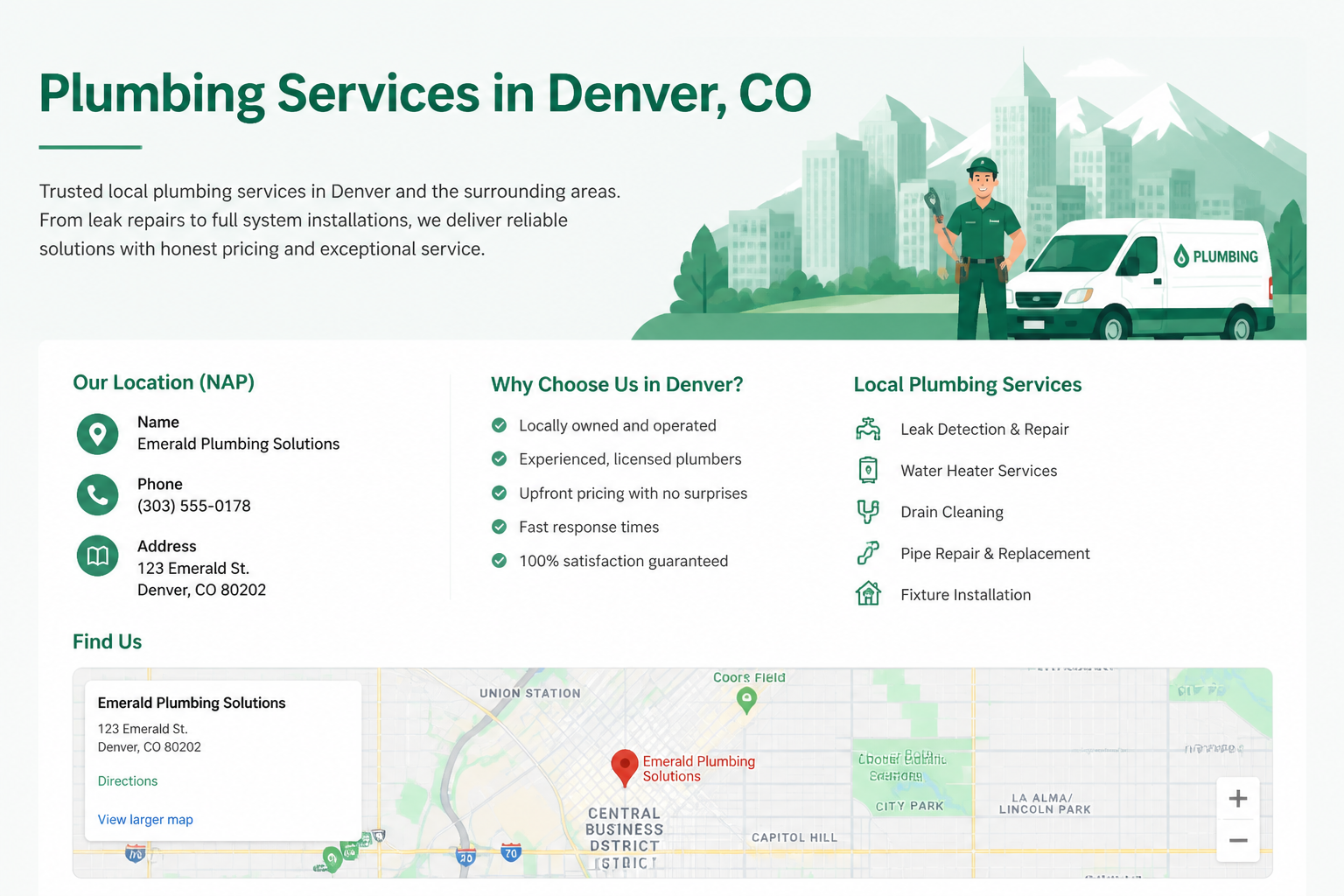
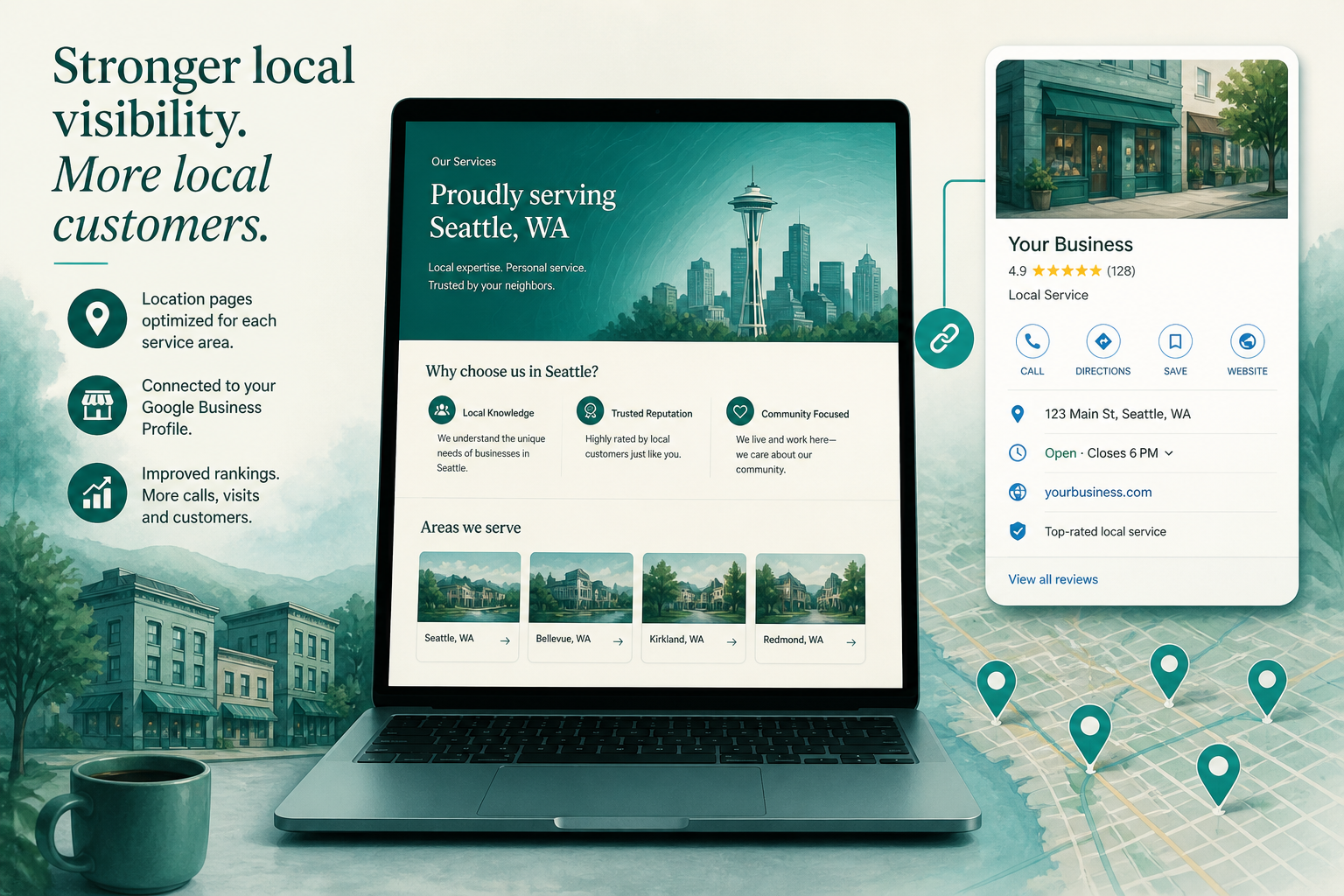
Each location page should link clearly to its corresponding Google Business Profile listing, and vice versa, so both search engines and visitors can move fluidly between your website content and your live profile. Embed a map showing the specific location, include the exact address matching your GBP listing precisely, and make sure hours displayed on the page match your live profile hours to avoid the kind of inconsistency covered in our GMB optimization guide .
| Element | Purpose |
|---|---|
| Unique intro paragraph naming the real service area | Establishes genuine local relevance immediately |
| Location-specific testimonials or case examples | Builds trust with proof relevant to that exact area |
| Embedded map and exact matching address | Reinforces consistency with the Google Business Profile |
| Local contact detail or dedicated phone line if applicable | Improves both trust and conversion for that specific location |
Common Location Page Mistakes
Beyond thin templates, businesses sometimes build location pages for areas they do not actually serve well, hoping to capture broader visibility. This creates the same relevance and trust problems as an overly broad service-area list on a Google Business Profile — the page might technically rank, but it sets up a poor experience for anyone who reaches out expecting service that does not genuinely extend that far. Keep location pages limited to areas you can confidently and consistently serve, consistent with the honest approach covered throughout our local SEO playbook .
How Many Location Pages Is Too Many?
There is no universal number, but a useful gut check is whether you could confidently write a genuinely unique paragraph about each area right now, without research, based on real operational knowledge of serving customers there. If the honest answer is no for a given city, that location either needs more real experience behind it before it earns a page, or it should be folded into a broader regional page rather than forced into its own thin, under-supported entry.
Growing businesses often make the mistake of launching location pages for every city on a five-year expansion roadmap all at once, well before there is any real local history, reviews, or completed work to draw from. It is almost always stronger to launch a handful of genuinely well-supported pages first and add new ones as real local presence develops, rather than diluting quality across a large set of pages that all sound equally generic because none of them are backed by real experience yet.
Measuring Whether Your Location Pages Are Actually Working
Track each location page individually rather than looking only at aggregate site traffic, since a handful of strong pages can mask several underperforming ones in a combined view. Watch organic traffic to the specific page, along with calls or form submissions attributed to it, and compare that against the corresponding Google Business Profile's performance for the same area using a tool like GBP Local Ranker to see whether the two are reinforcing each other or telling conflicting stories.
If a location page is consistently underperforming months after launch despite genuine effort, treat that as useful data rather than a reason to simply add more thin content hoping something eventually sticks. Sometimes the honest conclusion is that the area does not yet have enough real business history to support a dedicated page, and folding it back into a broader page until that changes is a perfectly reasonable, non-permanent decision.
Writing Location Page Content Without It Feeling Forced
A common struggle when writing location pages is that the content starts to feel artificially padded once the writer runs out of genuinely unique things to say about a specific area. Rather than forcing filler paragraphs, lean on real operational detail: a brief mention of a specific job completed nearby, an honest note about typical response times in that area, or a short quote from a local customer review. These small, concrete details are far more convincing than generic paragraphs about the city's population or history that have nothing to do with your actual business.
It also helps to write location pages after you have accumulated some real experience in an area rather than before, precisely because genuine detail is what separates a useful page from a padded one. A newly launched service area with no completed jobs yet, no local reviews, and no real operational history to draw from is a strong signal that the location page should wait a few months rather than being rushed out alongside an announcement that has not been backed by actual local delivery yet. Patience here consistently produces a stronger page than rushing one out ahead of the real experience needed to fill it with anything genuinely useful. A few months of real local delivery almost always produces better raw material for a page than any amount of creative writing could substitute for.
Before you publish a new location page, write a one-page brief: primary keyword, secondary neighborhood phrases, unique proof (staff, parking, languages, payment options), internal links to service pages, and the matching GBP fields that must stay identical. That brief prevents thin duplicate pages and keeps website SEO aligned with Maps. After launch, monitor calls and direction requests for 30 days; if traffic rises but conversions do not, strengthen the above-the-fold CTA and trust elements before rewriting the whole page.
Final Takeaway
Location pages are a genuine local SEO asset when built with real, specific content for areas you actually serve well, and a liability when built as thin, templated duplicates chasing broader visibility. Build them only where you have a real story to tell, connect them clearly to your Google Business Profile, and resist the temptation to scale them faster than you can genuinely differentiate each one. A handful of strong location pages will consistently outperform dozens of weak ones.
Frequently Asked Questions
Do I need a location page for every city I technically serve?
No, only for cities or areas where you have enough genuine, specific local detail to write a unique, valuable page. Thin pages for marginal areas do more harm than good.
How long should a location page be?
There is no fixed length requirement. Focus on including genuinely useful, specific local content rather than padding to hit an arbitrary word count.
Should each location page have its own Google Business Profile?
Only if each location is a genuinely separate, independently verifiable business location. A single business serving multiple areas from one base typically needs one GBP listing, not several.
Can duplicate location page content get my whole site penalized?
It can suppress the visibility of the thin pages themselves and, in severe cases, create broader quality concerns across the site, so it is worth avoiding entirely rather than risking the downside.
What is the minimum unique content needed to avoid a thin content problem?
There is no official minimum, but a page should contain enough genuinely unique, location-specific detail that a reader could tell it was written specifically for that area rather than copied from a template.
Should location pages target different keywords than my homepage?
Yes, each location page should focus on that specific area's intent rather than duplicating the broader keyword focus of your homepage, to avoid internal competition between pages.
How often should I update location page content?
Review them at least annually, and update immediately if hours, service areas, or contact details for that specific location change.