Improve Google Maps Visibility is one of the highest-leverage local search topics in 2026. It is entirely possible to build strong Google Maps visibility without spending a cent on Google Ads or Local Services Ads, and plenty of businesses do exactly that — the organic map pack results sitting below any sponsored placements are earned through the same relevance, distance, and prominence signals whether or not a competitor nearby is also running paid campaigns. Ads can buy visibility for a search, but they cannot buy the organic ranking itself, which is entirely separate and driven by different mechanics that reward consistent, unpaid effort over time.
This guide focuses specifically on building genuine, sustainable organic visibility in Google Maps: the profile fundamentals, the prominence-building work that substitutes for a paid budget, and a realistic sense of how long organic-only growth actually takes. There is no guarantee attached to any of this — Google's local results are genuinely competitive in most categories — but a disciplined, patient approach to the fundamentals consistently outperforms shortcuts and one-off tactics that fade as quickly as they appeared.
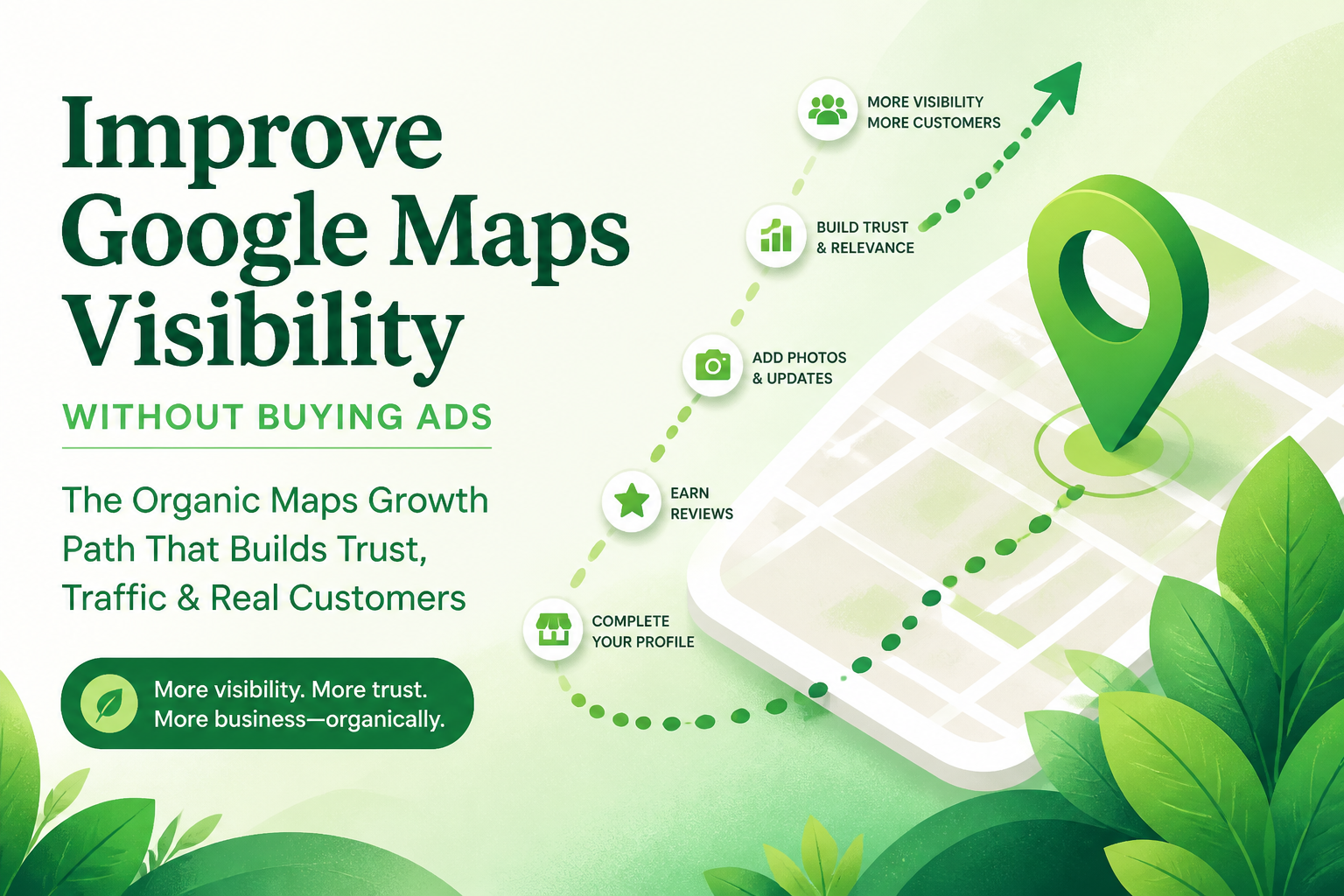
Organic Map Pack vs. Paid Placements: What You're Actually Competing
When Google Ads or Local Services Ads appear above or alongside the map pack, they occupy a separate, clearly labeled placement — the organic three-pack below is unaffected by whether a competitor is paying for ads, and your organic rank there is determined purely by the same relevance, distance, and prominence factors that govern every unpaid local result. Understanding this separation matters because it means a smaller business with a tighter budget is not structurally locked out of strong Maps visibility; it simply has to compete on the organic mechanics instead, the same mechanics every other organic competitor in the market is also working within.
The Three Pillars, Applied to a No-Ads Strategy
Google has long described local ranking as resting on relevance, distance, and prominence, and a no-ads strategy simply means building every one of those three as strongly as possible through organic means. Relevance comes from an accurate category, a complete and honest profile, and content that genuinely matches what searchers are looking for. Distance is largely fixed by your actual location or service area, though accurate address and service-area configuration prevent you from being unfairly penalized. Prominence — how well-known and well-regarded your business is — is where the bulk of organic, no-budget effort pays off.
Relevance you control almost entirely for free
Choosing the single most accurate primary category, adding every genuinely applicable secondary category, writing a complete and specific business description, and keeping your services list accurate all cost nothing but time, and they directly shape which searches your profile is even eligible to compete for. This is foundational work that a paid ad budget cannot substitute for — a poorly categorized profile ranks poorly in organic results and performs worse in paid campaigns too.
| Pillar | What Drives It | Budget Required |
|---|---|---|
| Relevance | Category accuracy, complete profile, matching content | None — pure effort and accuracy |
| Distance | Real location or honestly configured service area | None — configuration, not spend |
| Prominence | Reviews, citations, mentions, backlinks, engagement | Minimal — mostly time and consistency |
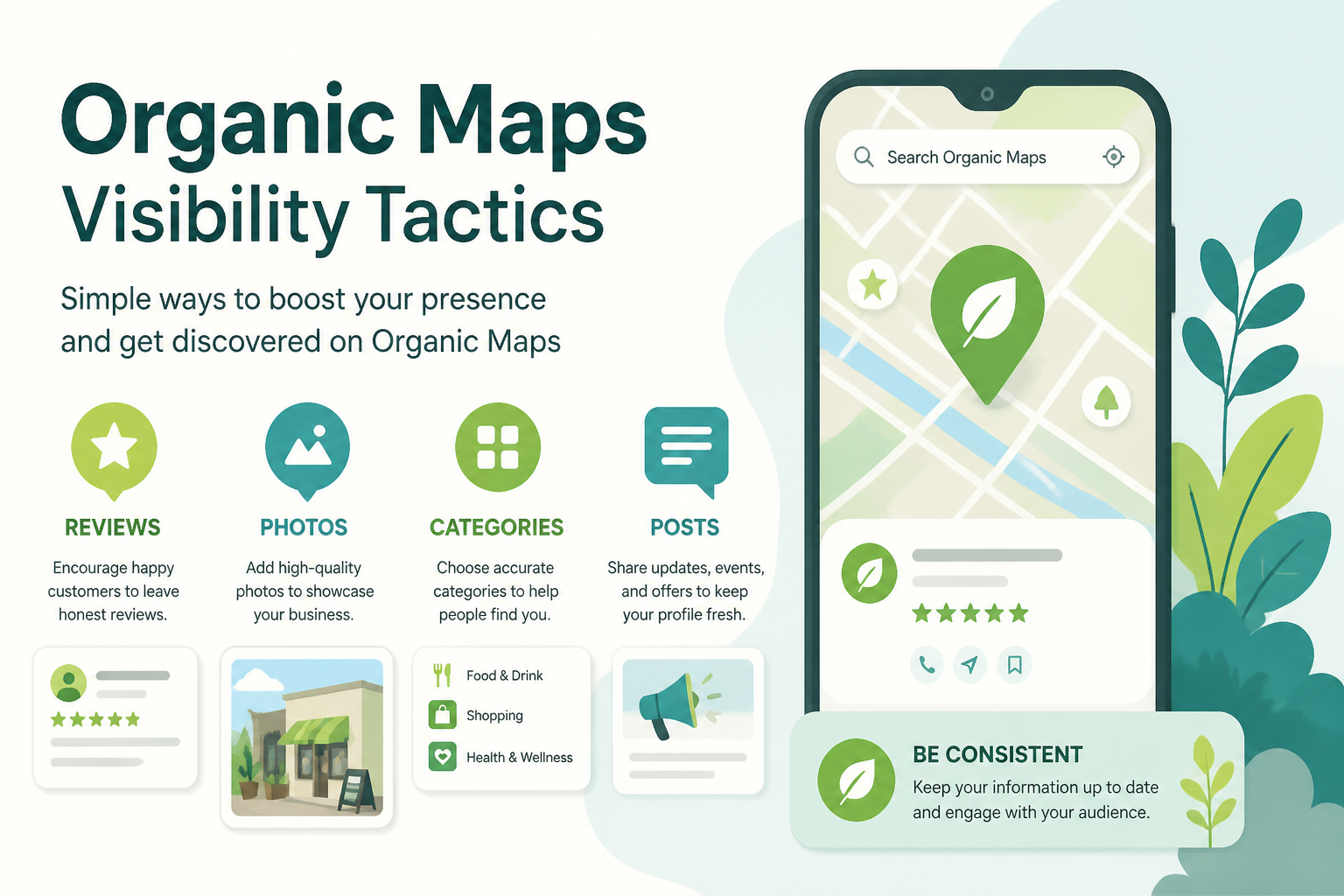
Building Prominence Without Spending on Ads
Prominence is the pillar most people assume requires money, but the vast majority of genuine prominence signals are built through consistent, unpaid effort rather than a media budget. A steady flow of real customer reviews, accurate listings across major citation sites, mentions from local news, community organizations, or industry associations, and a small number of genuine backlinks from other local businesses or organizations all contribute, and none of them require an advertising spend to build over time.
Reviews remain the highest-leverage prominence lever
A consistent, ongoing review generation habit — asking every customer, making it easy, and responding to what comes back — does more for organic prominence than almost any other single unpaid activity, and it costs nothing beyond the time it takes to ask. Businesses that treat this as a system rather than an occasional afterthought consistently outperform competitors who assume reviews will simply accumulate on their own.
Local relationships translate into real citations and mentions
Sponsoring a local youth sports team, joining the chamber of commerce, or getting listed in a local business directory each generates a real citation or mention that reinforces your business's presence across the web, distinct from anything Google itself controls. These relationships take time to build but cost little to nothing financially, and they produce exactly the kind of independent, third-party validation that prominence signals are built on.
| Activity | Cost | What It Builds |
|---|---|---|
| Consistent review request habit | Time only | Volume, recency, and detail in reviews |
| Local citation cleanup and additions | Time, or a low-cost tool | Consistency and directory presence |
| Community sponsorships and partnerships | Often in-kind or low-cost | Real mentions and local relationships |
| Guest content for local partner sites | Time only | Genuine backlinks and referral traffic |
| Regular Google Business Profile posts | Time only | Fresh, engaging activity on your listing |
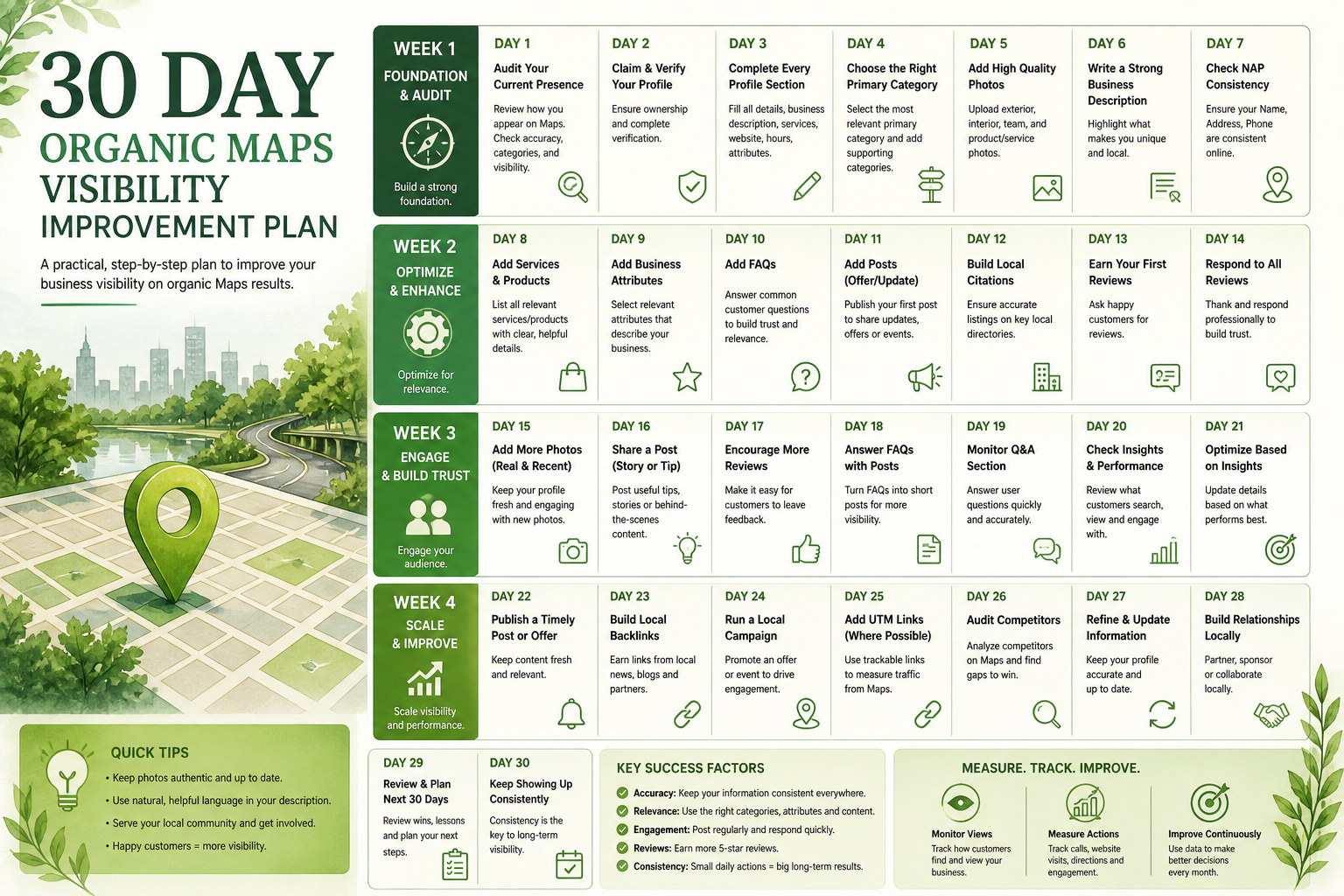
Content and Website Signals That Support Organic Maps Visibility
Your website plays a supporting role in organic Maps performance, particularly through location-specific pages, genuinely helpful service content, and a fast, mobile-friendly experience, all covered in more depth in our Google Maps optimization checklist . None of this requires paid promotion — it requires genuinely useful content that answers the questions your actual customers ask, published consistently rather than as a one-time project.
A Realistic Timeline for Organic-Only Growth
Organic growth is genuinely slower to show results than paid placements, which appear the moment a campaign launches. Expect the first meaningful movement in organic visibility somewhere in the first two to three months of consistent effort on the fundamentals, with more substantial gains typically compounding over six months to a year for competitive categories. This is not a discouraging timeline — it simply reflects that organic prominence, once built, tends to be more durable than a paid placement that disappears the moment spending stops. Our deeper guide to ranking higher on Google Maps in 2026 covers the fuller strategy and timeline expectations.
Mistakes That Quietly Undermine an Ads-Free Strategy
Choosing to grow organically does not automatically mean it will work — the same discipline that makes the approach effective can be undone by a handful of common, avoidable mistakes that quietly erode momentum before it compounds into visible results.
Treating profile setup as a one-time task
A profile optimized once at launch and never revisited gradually falls behind as categories, attributes, and customer expectations evolve. Businesses that keep growing organically tend to revisit their profile every few months, checking for new attributes Google has added, confirming the description and services list are still accurate, and making sure nothing has drifted since the last review.
Chasing citation volume over citation accuracy
Submitting your business to dozens of low-quality directories quickly, without verifying the information matches exactly, can create more NAP inconsistency than it resolves. A smaller number of accurate, well-maintained citations on genuinely relevant directories is worth more than a large volume of listings nobody ever checks again for accuracy.
Expecting a straight, guaranteed line of growth
Organic visibility does not move in a perfectly linear fashion — algorithm updates, seasonal demand shifts, and competitor activity all cause natural fluctuation even for a business doing everything right. Judging progress over a single week or month rather than a multi-month trend is one of the most common reasons businesses abandon a genuinely working organic strategy too early.
Comparing yourself to a competitor who is already spending on ads
It is easy to mistake a competitor's paid placement above the map pack as evidence that organic effort is not working, when in reality the two are unrelated. A more useful comparison looks specifically at the organic three-pack results and asks honestly whether your relevance, distance, and prominence genuinely match or exceed the businesses ranking there organically, rather than being discouraged by a paid ad that occupies an entirely separate placement above it.
Final Takeaway
Strong Google Maps visibility without an advertising budget is achievable, but it is built the same way any durable competitive advantage is built: through consistent, unglamorous effort on relevance, distance configuration, and prominence, sustained over months rather than days. Focus first on the parts entirely within your control — your profile accuracy and your review system — and let the fundamentals compound, paired with a genuine Google Business Profile foundation. There is no shortcut that skips this work, but there is also no requirement to outspend a competitor to eventually outrank them.
Frequently Asked Questions
Do Google Ads or Local Services Ads affect my organic map pack ranking?
No, paid placements and organic map pack results are separate systems; running ads does not directly improve or hurt your organic ranking.
How long does it take to build strong organic Maps visibility?
Expect early movement within two to three months of consistent effort, with more substantial gains typically building over six months to a year in competitive categories.
Is it possible to outrank a competitor who runs paid ads using only organic effort?
Yes, since ads occupy a separate placement; your organic position is determined by your own relevance, distance, and prominence relative to other organic competitors.
What's the single highest-leverage free activity for organic Maps growth?
A consistent, ongoing review request system tends to produce the most noticeable compounding benefit relative to the time it takes.
Do I need a big website to compete organically in Maps?
No, a smaller but genuinely useful, accurate, and fast website that supports your Google Business Profile is more valuable than a large site with thin content.
Can citations and directory listings really help without paid promotion?
Yes, accurate, consistent citations across relevant directories reinforce prominence signals and cost only the time it takes to build and maintain them.
Is it ever worth combining organic effort with a small ad budget?
Yes, ads can supplement organic visibility during a launch or a genuinely slow season, but they should never be relied on as a substitute for building the durable, organic fundamentals covered throughout this guide.