Perform a Complete Google is one of the highest-leverage local search topics in 2026. Most business owners "fix" their Google Business Profile the way people clean out a junk drawer: a quick pass whenever something looks obviously wrong, then nothing for months. The problem is that the fields most likely to hurt your ranking are rarely the ones that look obviously wrong. An outdated service, a subtly incorrect category, or a slow reply rate on reviews can quietly cap visibility for a long time before anyone notices, simply because nothing about the profile looks broken at a glance.
A structured audit fixes this by replacing random spot-checks with a repeatable process across every part of the profile that actually influences ranking and conversion. This guide walks through that process section by section, with a simple scoring approach so you can turn a subjective "does this look okay" feeling into a concrete list of prioritized fixes.
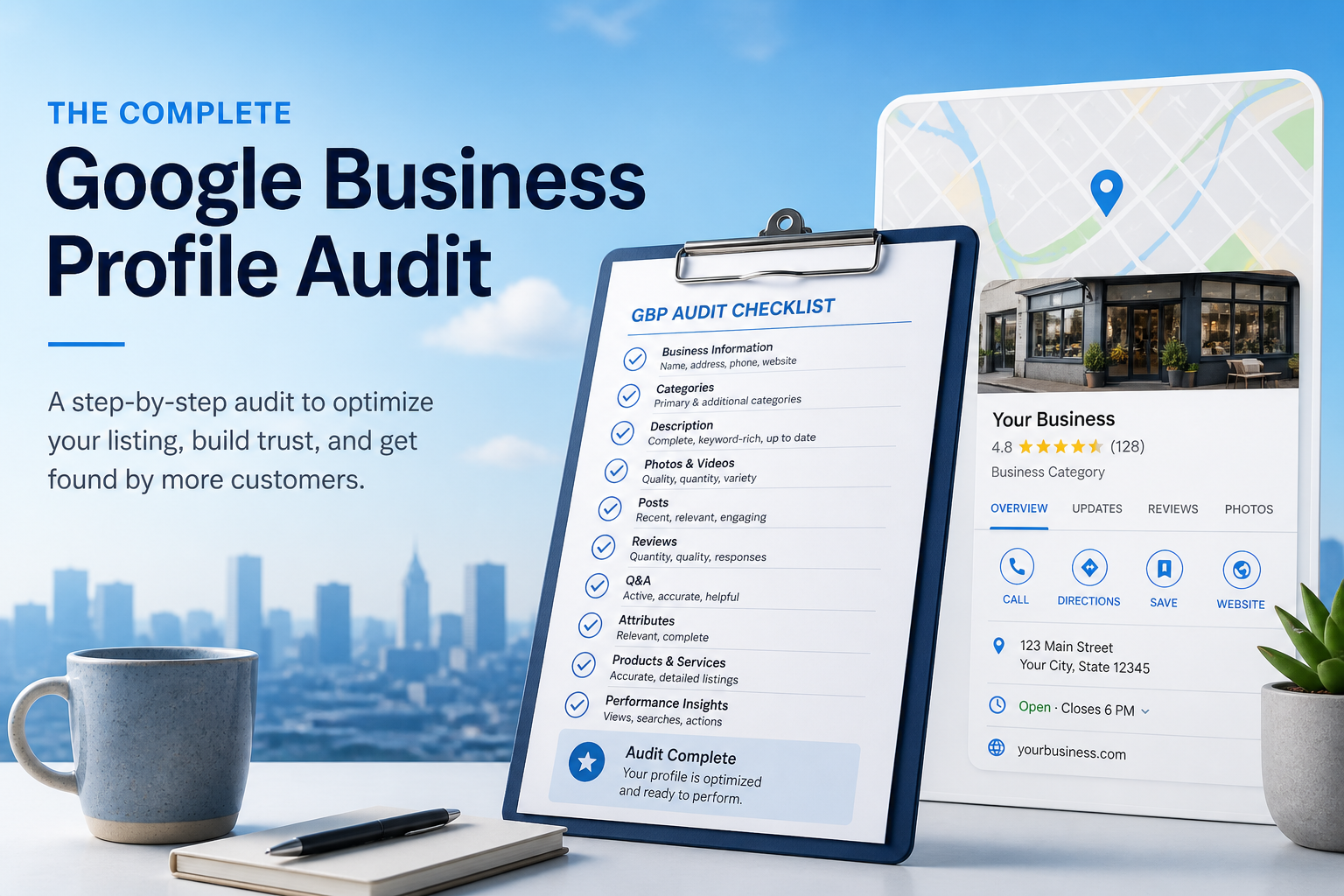
Why a Full Audit Beats Random Fixes
Random fixes tend to concentrate on whatever the owner happens to notice — usually a wrong phone number or an old photo — while entire sections like attributes, Q&A, or the services list go unreviewed for years. A full audit forces you to look at every section on a fixed schedule, which surfaces the quiet, compounding issues that never trigger an obvious complaint but steadily erode relevance and trust.
It also creates a baseline you can compare against later. Without a documented audit, "did last quarter's changes actually help" is a guess. With one, you have a specific before-and-after record across accuracy, completeness, and engagement that makes the value of your ongoing work visible rather than assumed.
| Audit area | What it covers | Why it matters |
|---|---|---|
| Profile accuracy | NAP, hours, website link, attributes | Errors here directly confuse customers and Google's matching systems |
| Categories, services, description | Relevance signals describing what you do | Directly affects which searches you can realistically rank for |
| Reviews and engagement | Volume, recency, replies, Q&A activity | Core prominence and trust signal, and a major conversion factor |
| Photos, posts, freshness | Visual content and activity signals | Affects both perceived trust and how "active" the profile appears |
Section 1: Profile Accuracy and NAP
Start with the fields customers rely on directly
Confirm your business name matches your real-world signage exactly, without added keywords Google's guidelines prohibit. Verify your phone number connects to a line that is actually answered during posted hours, and check that your website link points to a live, relevant page rather than a broken or outdated one. These sound obvious, but audits regularly turn up at least one of these quietly wrong on profiles that otherwise look fine.
Check hours against reality, including holidays
Standard hours drift out of date more often than owners expect, especially after a schedule change made "temporarily" that was never reverted. Holiday hours are an even more common gap — an unset holiday schedule can show customers your default hours on a day you are actually closed, producing a frustrating trip for nothing and a bad review that had nothing to do with your actual service quality.
Section 2: Categories, Services, and Description
Confirm your primary category still reflects your main revenue driver, not an earlier version of the business, and review our guide on choosing the right GBP categories if you are unsure whether a more precise option exists. Then work through your services list using the same specificity standard covered in our GBP services best practices guide — vague entries and outdated offerings are among the most common findings in this section of an audit.
Reread your business description as if you were a stranger seeing it for the first time. Does it clearly explain what you do, where, and for whom, without keyword stuffing or vague marketing language that could describe almost any business in your category? A description that could be copy-pasted onto a competitor's profile without anyone noticing is a sign it needs a rewrite grounded in what actually makes your business specific.
Section 3: Reviews and Engagement Health
Look beyond the star average to the trend underneath it. Are reviews arriving steadily, or did the pace slow sharply months ago? What is your average reply time, and are replies personal or copy-pasted? Check the Q&A section for unanswered questions, which is a commonly overlooked area — an unanswered question sitting for months looks neglected to anyone who scrolls down far enough to see it.
| Signal | Strong (score 2) | Needs work (score 1) | Weak (score 0) |
|---|---|---|---|
| Review recency | New reviews within the last two weeks | New reviews within the last month | No new reviews in over two months |
| Reply rate | Every review answered within 48 hours | Most reviews answered within a week | Reviews frequently left unanswered |
| Q&A section | All questions answered, some added proactively | Most questions answered eventually | Multiple unanswered questions visible |
Section 4: Photos, Posts, and Overall Freshness
Count how many photos were added in the last ninety days versus the total photo count. A profile with two hundred photos but none added recently looks less active than one with thirty photos and a steady monthly trickle of new ones. Check whether Google Posts are being used at all, and if so, whether the most recent one is weeks or months old — a stale post sitting at the top of the profile is a small but visible sign of neglect to anyone who checks.
How Long a Complete Audit Should Realistically Take
A first-time, genuinely thorough audit across every section described here typically takes between one and two hours for a single-location business, longer for a multi-location brand auditing each listing individually. That time investment feels significant next to a quick five-minute glance, but it is trivial compared to the months of quietly capped visibility that an unnoticed category mismatch or a stagnant review pace can otherwise cause without anyone realizing the profile itself was the bottleneck.
Section 5: Cross-Checking Against Your Website and Citations
A profile audit is incomplete if it stops at the Google Business Profile itself. Open your website alongside the profile and confirm the name, address, phone number, and hours match exactly — even small discrepancies like "St." versus "Street" or a slightly outdated hours page can create the kind of inconsistency that confuses both customers and automated matching systems. Spot-check three or four of your most important citations, such as major directories, and confirm the same details line up there too.
This cross-check matters because a perfectly optimized Google Business Profile sitting next to a mismatched website or outdated directory listing undermines exactly the trust and accuracy signals the rest of the audit is trying to strengthen. It typically takes only ten or fifteen extra minutes but regularly catches a genuine, quietly damaging inconsistency that would otherwise go unnoticed for months.
Common Audit Findings and What They Usually Mean
Certain patterns show up repeatedly across real audits. A profile with strong reviews but poor rank often has a category or services mismatch rather than a trust problem. A profile with a great category and services list but weak visibility often has a stagnant review pace or slow reply rate dragging down prominence. A profile with everything else strong but inconsistent rank across different neighborhoods often has a distance or pin-placement issue rather than anything content-related at all.
Recognizing which pattern matches your own findings helps you avoid spending weeks polishing an area that was never actually the bottleneck. If your audit surfaces multiple issues at once, it is usually more effective to fix the accuracy errors first, since they are quick and low-risk, before moving into the deeper relevance and engagement work that takes longer to show results. Document these patterns as you find them, since they often repeat again in future audits and become faster to diagnose the second and third time around.
Turning the Audit Into an Action Plan
An audit only creates value if it produces a prioritized list, not just a pile of observations. Sort your findings into three buckets: accuracy errors that need fixing immediately regardless of ranking impact, relevance gaps like weak categories or thin services that deserve the next block of focused time, and ongoing habits like reviews and posting that need a recurring system rather than a one-time fix. Our broader local SEO playbook and GMB optimization guide are useful references while working through each bucket, and a tool like GBP Local Ranker helps confirm whether the fixes are translating into measurable rank movement over the following weeks.
Final Takeaway
A complete audit is not a glamorous task, and it will not produce an overnight ranking jump on its own. What it does produce is clarity — a specific, prioritized list of what is actually wrong or missing, instead of a vague sense that "something should probably be better." Run this process quarterly, keep a simple record of what changed each time and what happened afterward, and the accumulated effect over a year is almost always larger than any single dramatic fix could ever have been on its own.
Frequently Asked Questions
How often should I run a full Google Business Profile audit?
Quarterly is a reasonable cadence for most businesses, with a lighter monthly check on reviews, hours, and posts in between full audits.
How long does a complete audit actually take?
A thorough first audit typically takes one to two hours. Once you have a documented baseline, subsequent quarterly audits are faster since you are mainly checking for drift.
Should I audit competitor profiles at the same time?
It can be useful context, but the primary value of an audit comes from comparing your own profile against its own past state and against accuracy standards, not just against competitors.
What is the most commonly missed item in a self-audit?
Holiday hours and the Q&A section are two of the most frequently overlooked areas, since neither shows up prominently unless someone specifically checks them.
Can an audit alone fix a ranking drop?
An audit identifies the likely causes, but fixing a ranking drop requires actually implementing the changes it surfaces and then giving Google's systems time to reflect them, typically a few weeks.
Do I need special software to run this audit?
No, a simple spreadsheet or document alongside direct review of your live profile is sufficient. Rank tracking tools add value for measuring outcomes afterward, but are not required to complete the audit itself.
Should multi-location businesses audit every location the same way?
Yes, each location should be audited individually since accuracy issues, review health, and content freshness often vary significantly between locations even under the same brand.