There is a specific kind of frustration in local SEO: a competitor sits two streets away, offers a nearly identical service, and consistently beats you in the Map Pack even though your reviews look just as good. When distance is roughly equal, the outcome stops being about proximity and starts being about everything else Google can measure — relevance depth, review quality, engagement, and how complete each profile looks compared to the other. This guide is a practical playbook for winning that specific fight.
Beating a nearby competitor is not about tricks or reporting their listing out of spite. It is about running an honest gap analysis, finding the two or three places where their profile is genuinely stronger, and closing those gaps faster than they can widen them. Combined with the fundamentals covered in our GBP ranking factors guide , this is the sharper, competitor-specific layer on top.
Start With an Honest Side-by-Side Audit
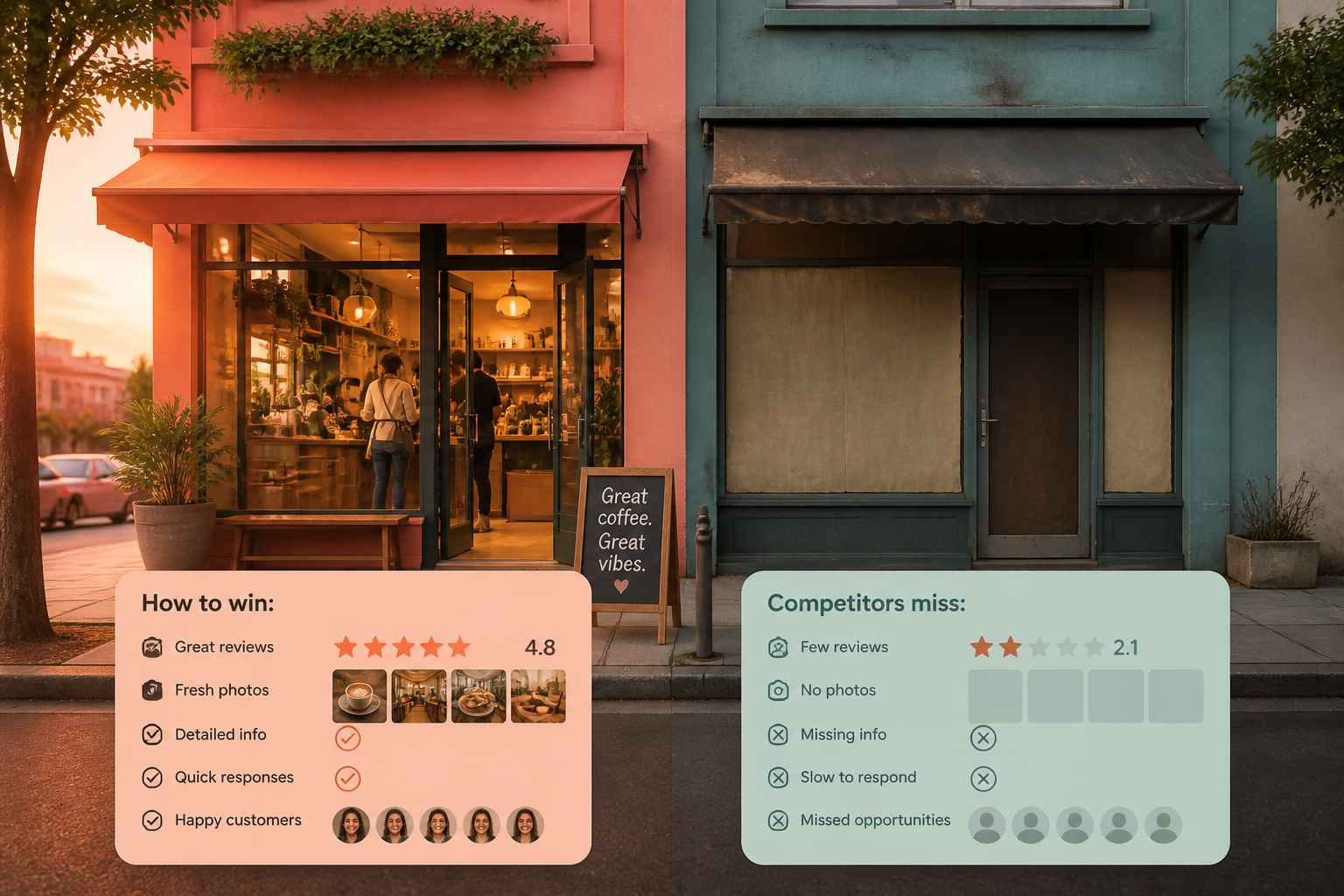
Open both profiles on a phone, not a desktop, since that is how most local searches actually happen. Compare primary and secondary categories first — a competitor might be capturing an adjacent search because they added a category you never considered relevant. Then compare the services list, business description, and how specifically each profile names what it does. Vague profiles lose relevance points to specific ones even when both businesses do genuinely similar work.
Next, compare review count, average rating, and — more importantly — review recency. A competitor with fewer total reviews but three new ones this week often looks more active and trustworthy to both customers and Google's systems than one sitting on a large but stagnant total. Note photo count, photo freshness, and whether they are running Google Posts regularly. Write all of this down; a scattered mental comparison misses patterns that a simple table reveals immediately.
| Factor | Your profile | Competitor profile | Gap to close |
|---|---|---|---|
| Primary category | Fill in | Fill in | Confirm yours matches search intent precisely |
| Reviews in the last 30 days | Fill in | Fill in | Build a steady request habit if behind |
| Services listed | Fill in | Fill in | Add specific, real services you actually offer |
| Photos added in the last 90 days | Fill in | Fill in | Upload fresh, real photos monthly |
| Posting activity | Fill in | Fill in | Match or exceed cadence with genuine updates |
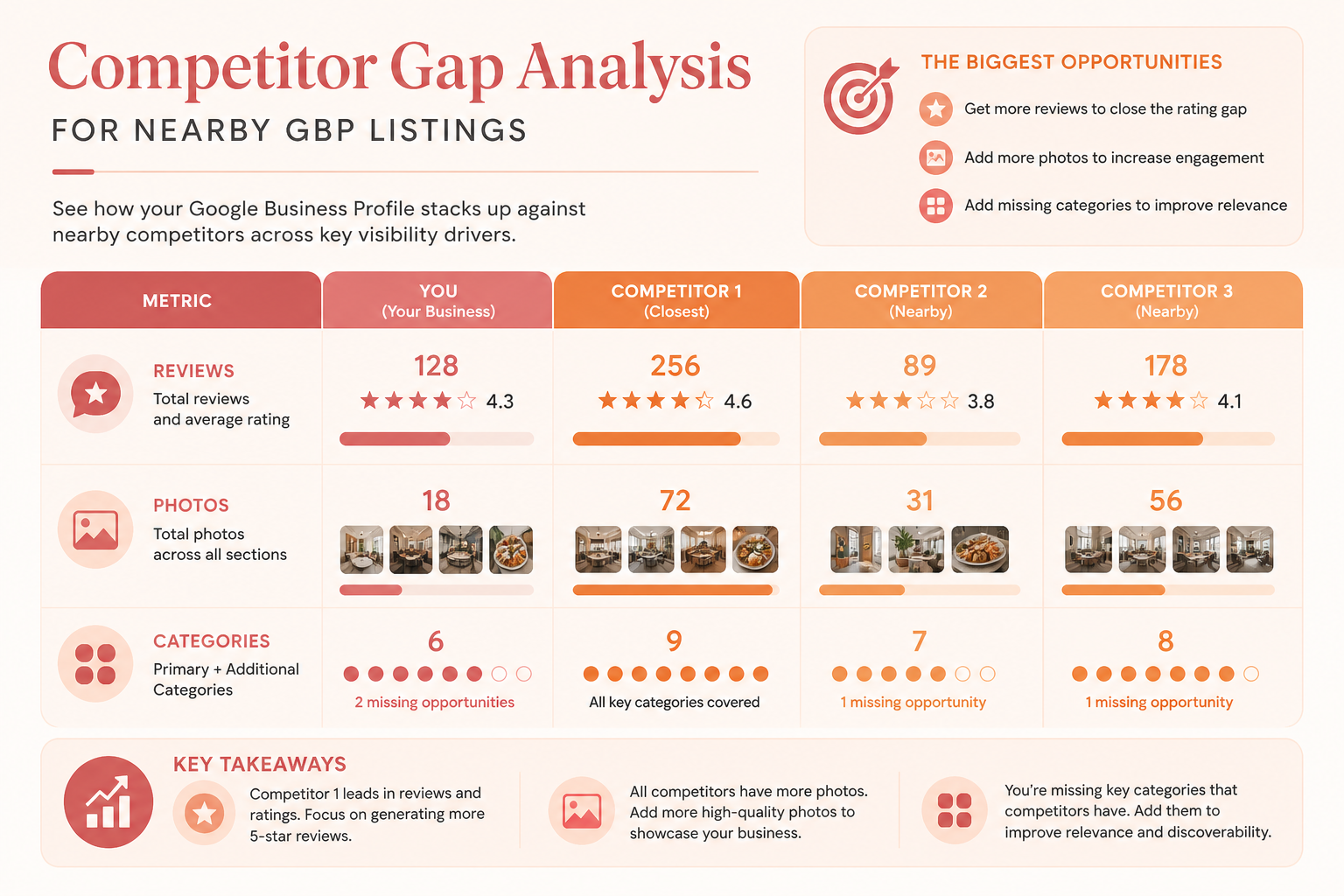
Where Nearby Competitors Usually Win — and How to Respond
They reply to every review, you reply to none
Reply quality and speed are one of the clearest, most controllable prominence signals. If a competitor answers every review within a day and yours sit unanswered for weeks, that gap alone can explain a persistent rank or conversion disadvantage. Set a standing habit of replying within 48 hours, thanking specific details customers mentioned rather than pasting a generic template.
They post weekly, you post occasionally
Consistent Google Posts are not a guaranteed ranking hack, but they do keep a profile looking active and can noticeably improve click-through once someone is comparing two similar listings side by side. If a nearby competitor clearly outposts you, matching a simple weekly rhythm often closes more of the visible gap than any single technical fix.
Their service list reads like a menu, yours reads like a slogan
Profiles that spell out individual services — "drain unclogging," "water heater installation," "emergency leak repair" — tend to match more specific searches than a profile that only says "plumbing services." Rewrite your services list in the same specific language customers actually type, without duplicating a competitor's exact wording.
Fair, Compliant Tactics That Actually Work
Track your rank movement for the exact keywords where the nearby competitor beats you, not just a generic "main keyword," since local rank varies by query and even by which street you are testing from. A neighborhood-level rank tracker like GBP Local Ranker or the tools covered in our rank tracking tools guide shows whether your fixes are actually moving the needle in the specific micro-area you compete in, rather than guessing from a single search on your office Wi-Fi.
Improve response time to inquiries, since faster first-response is increasingly a competitive differentiator that shows up in reviews ("called back within ten minutes") and indirectly reinforces prominence. None of this guarantees overtaking a well-run nearby competitor overnight — a business that has genuinely earned its position through years of consistent reviews and accurate information deserves that position. The realistic goal is closing controllable gaps steadily, not chasing a shortcut.

| Timeframe | Focus | Expected outcome |
|---|---|---|
| Days 1-30 | Fix categories, services list, photos, and reply backlog | Profile completeness matches or beats competitor |
| Days 31-60 | Build a steady weekly review-request and posting habit | Review recency and posting cadence close the gap |
| Days 61-90 | Track grid rank for money keywords, adjust based on data | Measurable rank or conversion movement, not guesswork |
What Not to Do When a Competitor Outranks You
Do not mass-report a legitimate competitor out of frustration; Google increasingly detects patterns of coordinated or bad-faith reporting, and it can backfire on the reporting account. Do not copy their exact service descriptions or photo captions word for word, since duplicate content across two local listings can look suspicious rather than competitive. And do not chase every micro-tactic at once — pick the two or three gaps with the clearest evidence from your audit and fix those thoroughly before moving to the next.
Sustainable competitive pressure comes from being the more complete, more actively managed, more responsive profile over months, not from a single clever edit. That is a slower story than most people want to hear, but it is the honest one, and it is also the version that survives the next algorithm update instead of getting wiped out by it.
Building a Repeatable Competitive Monitoring Habit
Set a fixed monthly check-in, not a constant watch
Checking a competitor's profile daily creates anxiety without adding useful information, since meaningful changes rarely happen that fast. A fixed monthly check-in — same day, same short checklist — gives you enough signal to catch real shifts in categories, reviews, or posting activity without turning competitive awareness into a distraction from actually running your business.
Track your own trend line, not just the comparison
It is easy to fixate entirely on the gap between you and one competitor and lose sight of whether your own profile is improving in absolute terms. Keep a simple record of your own review count, reply rate, and rank position over time so you can tell whether you are genuinely closing the gap or simply reacting to noise in a single comparison.
Expect the gap to move both directions over time
Competitive standing is never permanent. A competitor who currently outranks you can lose ground if they get complacent about reviews or let their profile go stale, just as you can lose ground if you stop the habits that got you close in the first place. Treat this as an ongoing discipline rather than a project with a finish line, and revisit your gap analysis periodically even after you feel you have caught up.
When It Makes Sense to Coexist Instead of Compete Head-On
Different sub-niches within the same broad category
Not every nearby competitor is actually fighting you for the same customer. A general dentist and a pediatric dental specialist both show up under similar categories but often serve different intent, and trying to out-rank a specialist for a search you do not actually want is wasted effort. Clarify which specific searches genuinely represent your ideal customer before assuming every visible competitor is a rival worth chasing.
Price and service-tier differentiation
A budget-focused competitor and a premium-positioned business can both rank well in the same area without directly cannibalizing each other's customers, since the searcher's intent often already leans toward one tier before they even open the Map Pack. Understand where you genuinely sit on that spectrum and lean into it in your reviews, photos, and description rather than trying to look identical to a competitor targeting a different budget.
Micro-geographic sub-zones within a shared service area
Two businesses technically serving the same city can still specialize in different neighborhoods based on where their actual customer base and reputation are strongest. Rather than fighting for every single search across the whole area, some businesses find more sustainable growth by doubling down on the specific zones where their reviews and word-of-mouth are already strongest.
Final Takeaway
Beating a nearby competitor rarely comes down to one dramatic move. It comes from an honest audit that shows exactly where their profile is stronger, a focused plan that closes those specific gaps, and the patience to keep measuring instead of guessing. Distance may be equal between you and the business two streets away, but relevance, reviews, and consistency almost never stay equal for long — make sure they tilt in your direction.
Frequently Asked Questions
Why does a nearby competitor keep beating me even with similar reviews?
Small differences in category accuracy, review recency, photo freshness, and reply consistency often explain the gap when distance and star ratings look similar. Run a side-by-side audit to find the specific factors, rather than assuming it is random.
Is it worth reporting a competitor's listing if I suspect it is fake?
Only report genuine, provable policy violations like a fake address or fabricated reviews, through Google's official process. Reporting a legitimate competitor out of frustration wastes time and can damage your own account's credibility if it looks like abuse.
How often should I check a competitor's profile for changes?
A monthly check is usually enough to catch meaningful shifts like new categories, posting habits, or review velocity changes, without turning competitor-watching into a daily distraction from running your business.
Can I use a competitor's service list as a template?
You can use it for inspiration about which services to add, but always write original descriptions in your own words that accurately reflect what you offer, rather than copying language directly.
Does posting more often than a competitor guarantee I will outrank them?
No single tactic guarantees a rank change. Posting consistently is one of several factors that, combined with stronger reviews, accurate categories, and good response times, can close a competitive gap over time.
What if the competitor is genuinely closer to most searchers than I am?
You cannot change physical distance, but you can compete harder on relevance and prominence — sharper categories, stronger reviews, and better engagement can still narrow or close an otherwise proximity-driven gap.
How long does it usually take to close a nearby-competitor gap?
Most realistic gains from fixing profile completeness and review habits show up over 60 to 90 days. Anyone promising a guaranteed overtake in a week is not describing how local ranking actually works.