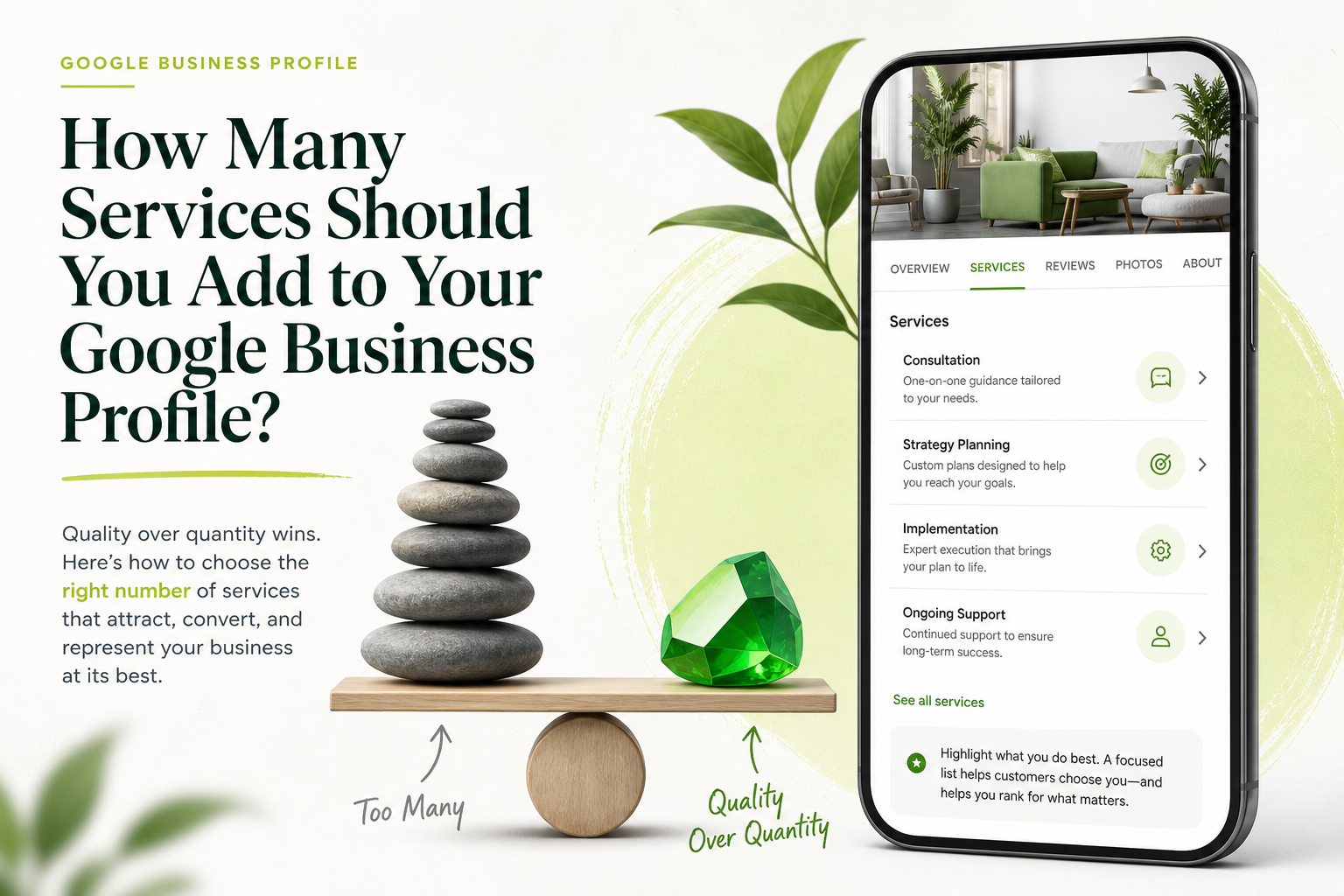
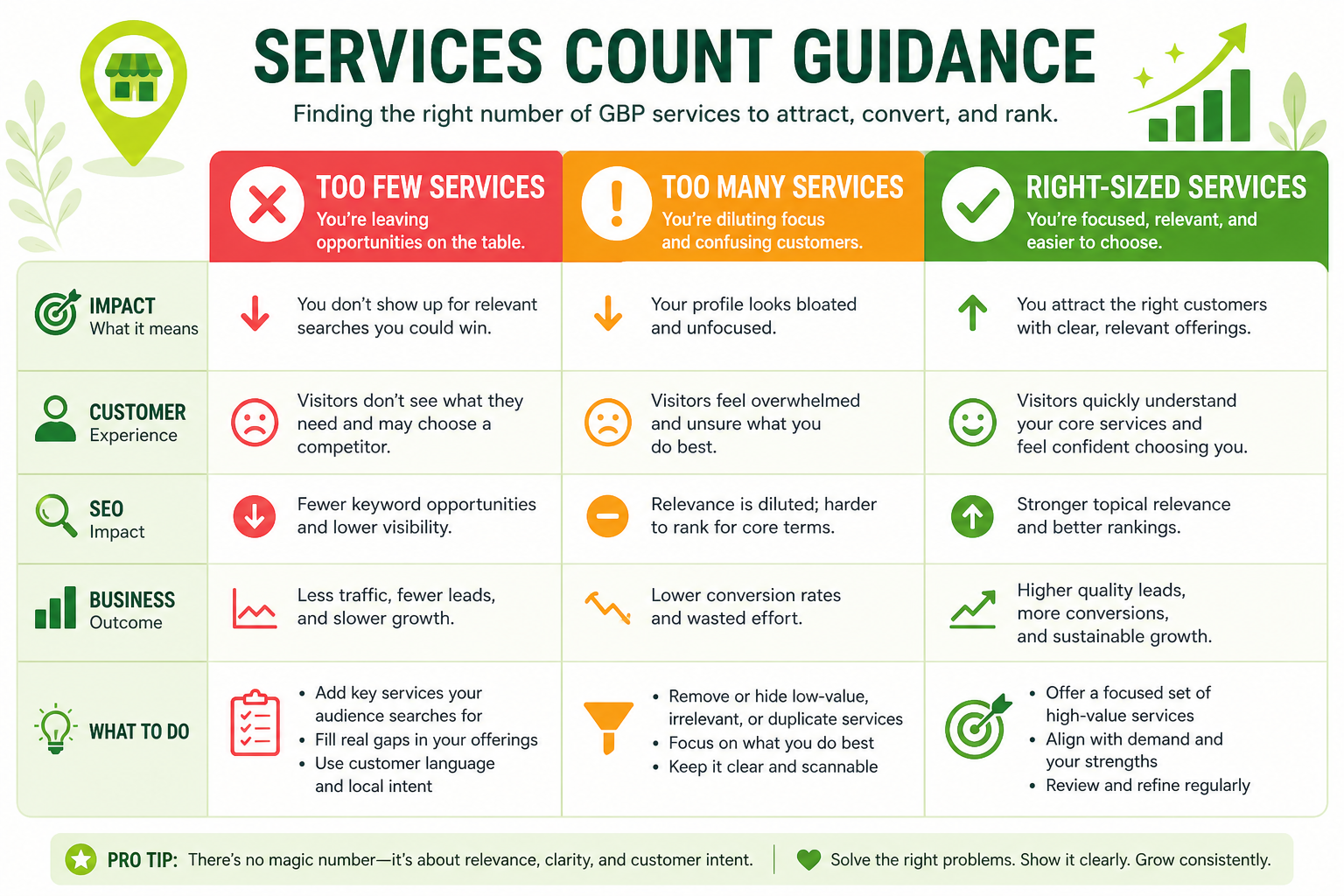
Many Services Should You is one of the highest-leverage local search topics in 2026. Owners regularly ask whether adding more services to their Google Business Profile improves visibility, and the honest answer is that the number itself is almost irrelevant compared to accuracy and specificity. A profile with twelve well-described, genuinely offered services almost always outperforms one with forty vague, half-relevant entries added purely to cover more search terms.
This guide covers how to decide what genuinely belongs in your services list, how larger, multi-department businesses should structure a longer list without losing focus, and the mistakes that quietly hurt both relevance and customer trust. It pairs well with our guide on choosing the right GBP categories , since categories and services work together to define your relevance.
The Services Section Is Not a Keyword Dump
It is tempting to treat the services field as free real estate for extra keywords, listing every conceivable variation of a service to maximize search coverage. In practice, Google and customers both read this section for genuine specificity, and a bloated list of near-duplicate or barely relevant entries reads as noise rather than signal. Each service you add should be something a customer could reasonably book or ask about today, not an aspirational offering you hope to grow into.
Quality vs Quantity: What Practitioner Testing Suggests
Local SEO practitioners consistently observe that profiles with focused, well-described service lists tend to convert better and appear more trustworthy, even when they list fewer total items than a competitor. A short description for each service—what it involves, who it is for, roughly what it costs if pricing is public—does more for both relevance and conversion than simply adding more one-line entries.
| Approach | Relevance impact | Customer trust impact |
|---|---|---|
| Few services, well-described | Strong, specific match | High—reads as focused expertise |
| Many services, one-line entries | Diluted, generic match | Lower—reads as generic or padded |
| Services matching real offerings only | Accurate, sustainable | High—matches customer expectations |
| Aspirational or rarely-offered services | Weak or misleading match | Low—creates mismatched expectations |
How to Decide What Belongs in Your Services List
Start from your actual booking or sales data: which services do customers genuinely request, and how do they phrase the request when they call or message you. That real language should shape both the service names and their short descriptions. If a service represents less than a handful of jobs a year and is not a strategic focus, consider leaving it out or mentioning it briefly in your description rather than giving it equal billing with your core offerings.
What Customers Actually Read Before They Call
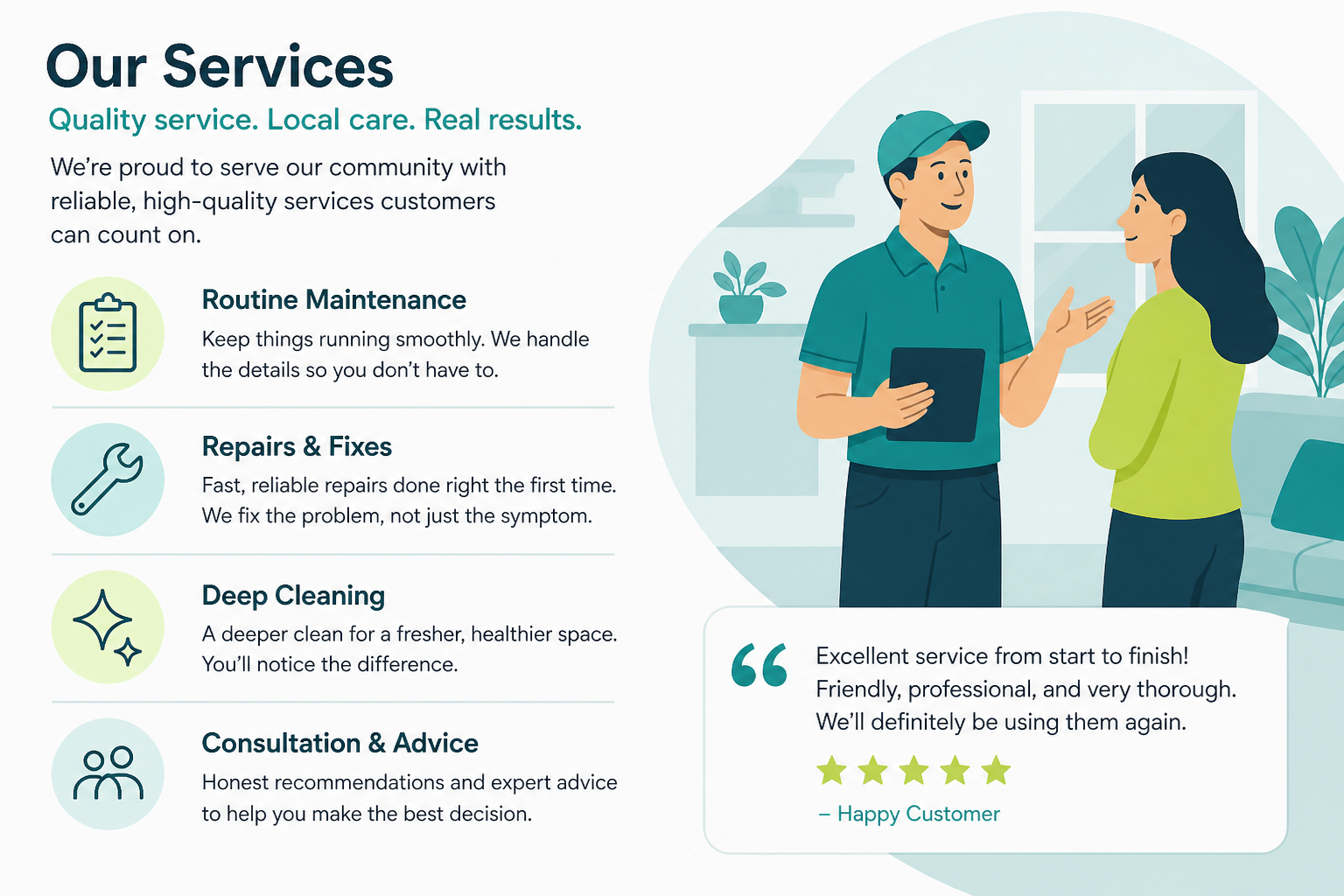
It is easy to forget that the services list is not only read by Google's ranking systems—it is one of the first things a genuinely interested customer scans before deciding to call or message. A vague, one-word entry like "repairs" leaves a hesitant customer guessing whether their specific problem is covered, while a slightly longer entry like "appliance repair, including washing machines and refrigerators" answers the question before it is even asked, reducing hesitation at exactly the moment that determines whether they reach out or keep scrolling to a competitor.
This is why the quality-over-quantity argument holds up from both angles at once: Google rewards specificity because it improves relevance matching, and customers respond to specificity because it reduces uncertainty. Very few optimization decisions on a Google Business Profile satisfy both the algorithm and the human reader this cleanly, which is exactly why the services list deserves more careful attention than owners typically give it.
Structuring Services by Category for Larger Businesses
Businesses with genuinely broad offerings—a multi-department clinic, a full-service auto shop, a large salon—can still avoid diluting relevance by grouping services logically and writing each one with enough specificity that it reads as a real, bookable offering rather than a category label repeated with small variations. Consistency in naming convention across similar services also helps customers scan the list quickly instead of feeling overwhelmed.
| Business type | Suggested structure | Example grouping |
|---|---|---|
| Multi-department clinic | Group by department, then service | Dermatology: acne treatment, skin checks |
| Full-service auto shop | Group by system, then task | Brakes: pad replacement, rotor resurfacing |
| Large salon or spa | Group by treatment area | Hair: cut, color, keratin treatment |
| Home services company | Group by trade, then task | Electrical: panel upgrade, outlet installation |
A Note on Pricing and "Starting From" Ranges
Including at least approximate plan selection context in your services descriptions, even a simple "starting from" figure, tends to improve the quality of inquiries you receive rather than reducing their volume, as some owners fear. Customers who see rough plan selection upfront and still reach out are typically further along in their decision and less likely to disappear after learning the actual cost during a call. Businesses that omit plan selection entirely often spend more time on calls or messages that end once price comes up, simply because that conversation happens later instead of earlier in the process.
Mistakes That Hurt Relevance and Trust
Listing services you have never actually performed, hoping to appear more capable than you are, creates a mismatch that damages trust the moment a customer asks about it. Duplicating near-identical services with slightly different wording to capture extra keyword variations reads as spam rather than thoroughness. And leaving every service description blank, relying only on a title, wastes an opportunity to reinforce relevance with natural, specific language.
How Services Interact With Reviews and Posts
A clean, specific services list also makes the rest of your profile management easier. When a customer leaves a review mentioning a specific service by name, that language reinforces the relevance signal your services list already established, and it gives you material for future Google Posts that describe the same offering in fresh, specific language rather than vague generalities.
This creates a small but genuine compounding effect: an accurate services list attracts search traffic for the right terms, satisfied customers reference those same terms in their reviews, and future posts and photos can highlight the same specific services again. None of this works if the underlying services list is vague or padded, because there is nothing specific for reviews, posts, or photos to reinforce in the first place.
A Simple Framework to Audit Your Services Today
Pull your list and ask three questions for each entry: do we genuinely offer this today, does it have a short, specific description, and would a real customer recognize this as something they could book right now. Remove or rewrite anything that fails those checks. Then compare your list against your website's service pages to confirm they tell the same story, and check with GBP Local Ranker whether the cleanup changed your visibility for the services you kept. Our GMB optimization guide covers how this fits into the broader optimization sequence.
A Quick Monthly Habit Worth Keeping
Set a short recurring reminder to reread your services list once a month, ideally alongside your regular photo and review check-in, so it never drifts too far out of sync with what the business actually offers. This habit takes only a few minutes once the list is already accurate, and it consistently catches small issues—an outdated price range, a service that quietly stopped being offered—well before they accumulate into a noticeable mismatch that confuses customers or dilutes relevance.
Businesses that pair this monthly review with their broader profile maintenance routine, alongside the fundamentals in our local SEO playbook , tend to keep the entire listing coherent over time, rather than letting different fields drift out of sync with each other at different speeds.
Special Cases: New Businesses and Seasonal Offerings
A brand-new business without much operating history should still list every service it genuinely intends to deliver from day one, since there is no benefit to withholding accurate information while waiting to "earn" the right to list it. What matters is that the business can actually fulfill each listed service if a customer calls today, not how long the business has existed.
Seasonal offerings deserve a slightly different approach. Rather than removing and re-adding a seasonal service every year, which can create unnecessary churn on the profile, consider keeping it listed year-round with a description that notes its seasonal availability, or use Google Posts to highlight it specifically during the active season while the core services list stays stable. This keeps the profile consistent while still surfacing timely, relevant information when it matters most to searchers.
Final Takeaway
There is no magic number of services that maximizes Google Business Profile visibility. What matters is that every listed service is genuinely offered, clearly described, and consistent with your website and category choice. A focused, accurate list of a dozen well-described services will outperform a padded list of forty vague ones almost every time, both for search relevance and for the trust of the customer reading it.
Frequently Asked Questions
Is there a maximum number of services I should list?
There is no strict maximum, but past a certain point, more entries add diminishing or negative value if they are not genuinely distinct, well-described offerings.
Should I write a description for every single service?
Yes, at least a short one. Even a single specific sentence per service adds more relevance and trust value than a bare title alone.
Can too many services make my profile look unfocused?
Yes. A long, generic list can read as unfocused or padded, especially compared to a competitor with a shorter, sharper, more specific list.
Should I remove services I rarely perform anymore?
Generally yes, unless it remains a strategic offering you want to grow. Keeping rarely-performed services can create mismatched customer expectations.
Do services and categories need to match exactly?
They should tell a consistent story. Services provide the specific detail that supports and expands on the broader categories you have chosen.
How often should I update my services list?
Review it whenever you add or drop a genuine offering, and do a light full audit at least once a year even without major changes.
Does pricing information in services help conversion?
Often yes, especially "starting from" ranges, since transparent pricing context helps customers self-qualify before calling or messaging. Treat “Frequently Asked Questions” as an operating checklist—not a one-time edit—so rankings compound instead of resetting every month.