"How long until I rank?" is one of the most common questions new and existing business owners ask, and it is also one of the hardest to answer honestly, because the real answer is "it depends on your market, competition, and how consistently you work the fundamentals" — not a satisfying number, but the accurate one. Anyone offering a fixed guaranteed timeline, like "rank #1 in 30 days," is either describing an unusually low-competition niche or simply not being straight with you.
This guide breaks down the realistic timeline ranges by scenario — brand-new listing, existing but neglected listing, and competitive rebuild — along with the factors that most influence how fast or slow your specific situation moves. It draws on the same ranking fundamentals covered in our ranking factors guide and Maps ranking guide.
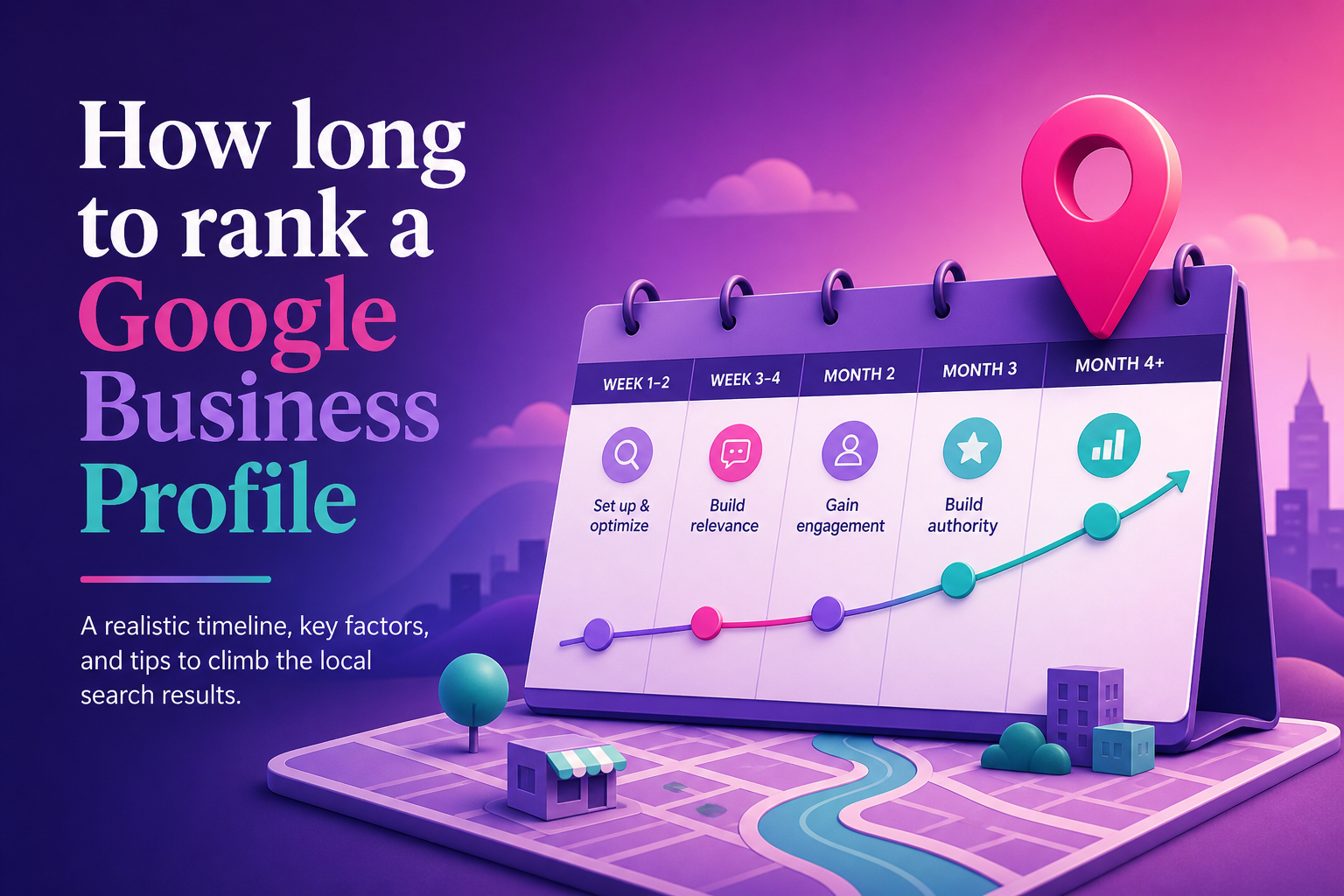
Why There Is No Single Universal Timeline
Local ranking is relative — you are not being measured against an absolute standard, you are being measured against whoever else is competing for the same search in the same area. A dentist opening in a town with two established, well-reviewed competitors faces a fundamentally different timeline than one opening in an area with almost no active listings at all. Competition density is the single biggest variable most timeline questions ignore.
Category also matters enormously. Niches with lower search volume and fewer active competitors, like a specialty repair service, tend to show meaningful movement faster than saturated categories like restaurants, dentists, or lawyers in a major city, where dozens of well-established profiles have been accumulating reviews and citations for years.
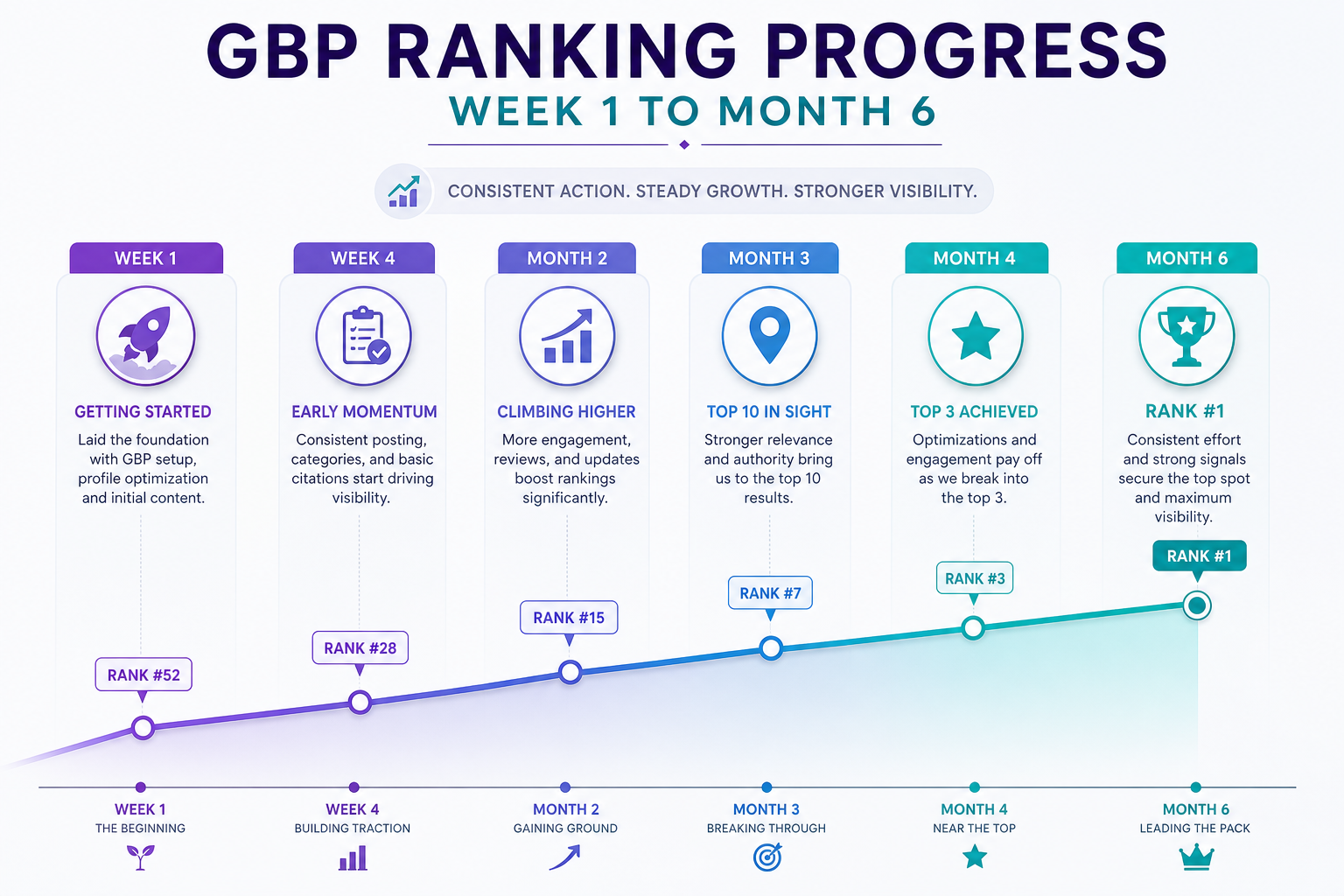
| Scenario | Realistic timeline for meaningful movement | Key variable |
|---|---|---|
| New listing, low-competition niche/area | 4-8 weeks for initial visibility | Fast, consistent review requests |
| New listing, moderately competitive market | 2-4 months for 3-pack presence | Profile completeness plus steady reviews |
| New listing, highly saturated market | 4-8+ months, sometimes longer | Sustained effort across every ranking pillar |
| Existing but neglected listing being fixed | 4-10 weeks after fixes for noticeable recovery | How severe the neglect was |
What Speeds Up the Timeline (and What Does Not)
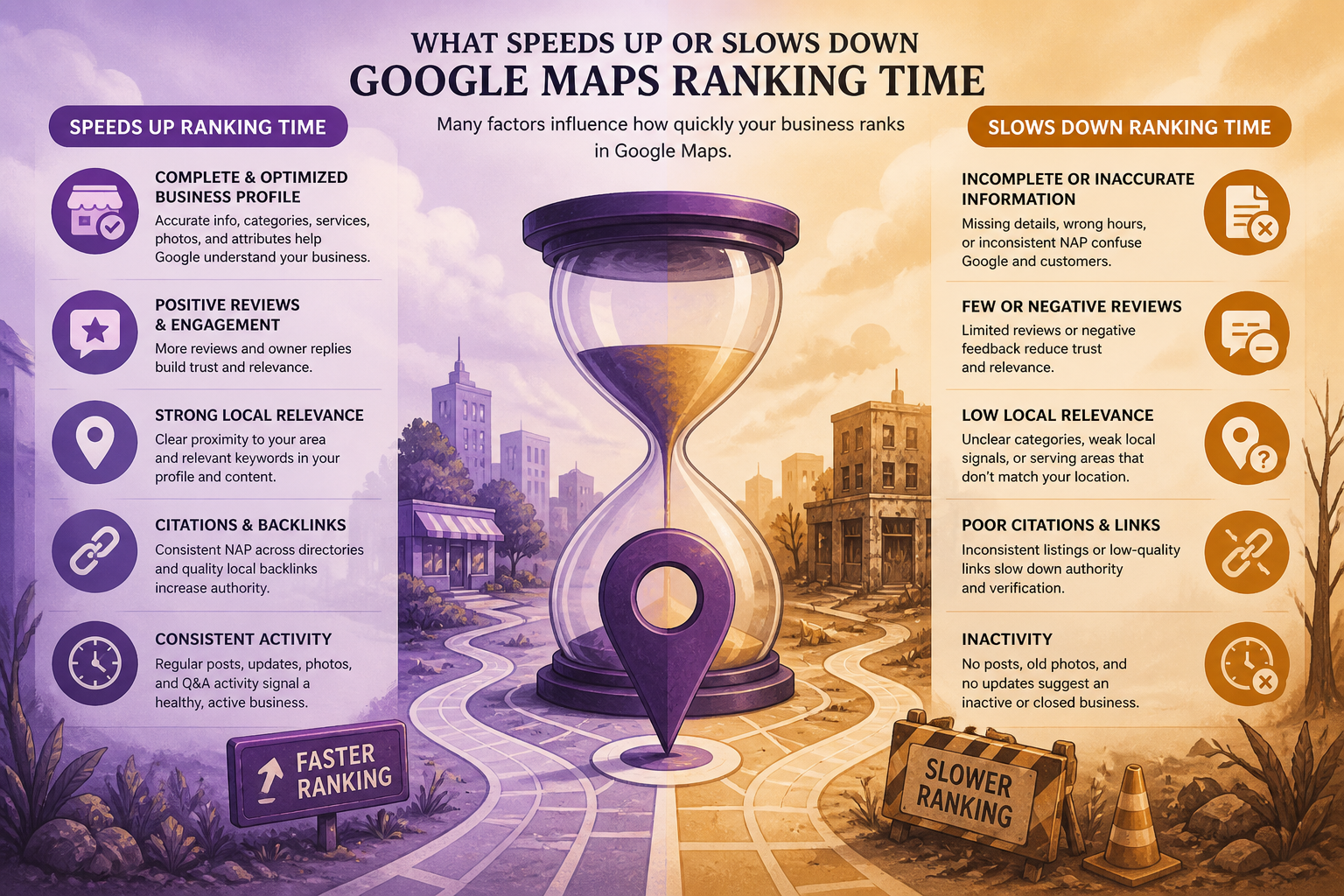
Speeds it up: getting the foundation right immediately
Correct primary category, complete profile fields, accurate address or service-area setup, and early review requests all compress the realistic timeline compared to a listing that trickles these in over months, as covered in our optimization checklist.
Speeds it up: consistent weekly habits from day one
A steady rhythm of review requests, fresh photos, and occasional posts, maintained from the very beginning, builds prominence signals earlier than waiting until the business feels "established" to start.
Does not speed it up: paid ads or a bigger marketing budget alone
Google Ads and Local Services Ads occupy separate placements from organic Map Pack results and do not directly accelerate organic ranking, though they can drive traffic and reviews that indirectly help over time.
Does not speed it up: aggressive or manipulative tactics
Keyword-stuffed names, fake reviews, or virtual addresses might create a brief illusion of faster progress, but they carry suspension risk that can erase months of legitimate progress in a single enforcement action.
How to Set Realistic Expectations With Clients or Stakeholders
If you manage GBP for clients, set expectations using ranges tied to competition level rather than fixed dates, and explain the difference between "profile fully optimized" (achievable in days) and "ranking well against established competitors" (a months-long, ongoing process). Clients who understand this distinction are far less likely to panic at week six and demand a drastic, unnecessary change.
Track progress with actual data rather than a single anecdotal search. A grid-based rank tracker like GBP Local Ranker shows incremental movement across a realistic service area over time, which is far more useful for setting and managing expectations than checking one keyword from the office every few days and drawing conclusions from noisy, single-point data.
| Factor | Impact on timeline | What you can do |
|---|---|---|
| Number and strength of local competitors | High | Run a gap audit, focus on your controllable advantages |
| Category search volume | Medium-high | Set expectations accordingly, do not compare across niches |
| Consistency of your review request habit | High | Build it into service delivery from day one |
| Profile completeness at launch | Medium | Complete every field before expecting meaningful movement |
| Whether the business is new or has prior history | Medium-high | New listings should expect a longer initial ramp |
What to Do While You Wait
Waiting does not mean doing nothing. Use the early months to build the habits that compound — steady, genuine review requests, monthly photo updates, and accurate service-list maintenance — so that by the time enough time has passed for meaningful ranking movement, the foundation is already strong rather than needing a rushed catch-up. Track Insights data even before rank movement is visible, since calls and direction requests sometimes improve before grid position does.
Resist the temptation to make dramatic changes every few weeks out of impatience. Switching categories, rewriting the description repeatedly, or chasing a new tactic every month prevents any single approach from having enough time to actually show its effect, which paradoxically slows the timeline further rather than speeding it up.
How Agencies Should Frame Timeline Conversations
Present a range tied to evidence, not a single confident number
Instead of promising "three months," present a range grounded in the competitive audit you actually ran: "based on your two established competitors and current review pace, expect meaningful 3-pack movement in roughly three to five months." This framing is both more honest and, ultimately, more credible once results start arriving on schedule.
Revisit the estimate after the first 30 days of real data
Early Insights and grid data often reveal whether a market is moving faster or slower than the initial estimate suggested. Treat the first month as a calibration period and be willing to adjust the projected timeline honestly in either direction rather than defending an initial guess that new data has already contradicted.
Separate "profile is ready" milestones from "ranking well" milestones
Clients and stakeholders respond well to seeing concrete completion milestones — foundation finished, review habit established, first grid data collected — even before rank position itself has moved meaningfully. This keeps confidence high during the necessary waiting period without requiring premature or misleading claims about rank.
How Seasonality Interacts With Ranking Timelines
New listings launched right before a demand spike
A new profile launched just before a predictable seasonal spike can accumulate reviews and engagement faster than the same business launching during a quiet period, simply because more genuine customer interactions are happening in a shorter window. This can make an otherwise typical timeline look unusually fast, which is worth remembering before assuming your specific speed will repeat in every season.
New listings launched during a slow season
Conversely, a business opening during its industry's naturally quiet period may see a slower initial ramp not because anything is wrong, but because there is simply less overall customer activity generating reviews and engagement. Patience during this period, combined with continued foundation work, sets up a faster-looking jump once the next natural demand cycle arrives.
Comparing your timeline against the correct season
When benchmarking your own progress against a competitor or a case study, confirm you are comparing similar seasonal windows rather than a competitor's peak-season ramp against your own slow-season timeline, since the two are not directly comparable and can create a misleading sense of falling behind.
Building a simple internal record of your own launch date, industry season, and early milestones also helps future decisions, whether that means opening a second location or advising a client considering a similarly seasonal business. Over time, this record becomes a genuinely useful reference for what a realistic timeline actually looked like in your specific market, which is far more reliable than any generic industry benchmark pulled from an unrelated niche or region. This is particularly relevant for agencies managing several clients across different industries at once, where a landscaping client and a tax-preparation client will show completely different ranking rhythms throughout the year even if both are performing equally well relative to their own specific competitive and seasonal context.
Final Takeaway
There is no universal number of days, weeks, or months that answers "how long does it take to rank a Google Business Profile," because the honest answer depends on competition, category, and consistency. What is true across every scenario is that a complete, accurate profile with a steady review habit ranks faster than an incomplete one, regardless of the specific niche. Set expectations using ranges, track real data instead of single searches, and give the fundamentals enough time to actually work before concluding they have not.
Frequently Asked Questions
How long does it take for a brand-new Google Business Profile to rank?
In low-competition areas, initial visibility can appear within four to eight weeks. In saturated markets, meaningful 3-pack presence often takes four months or longer.
Can I speed up ranking by paying for Google Ads?
Ads occupy separate placements from organic Map Pack results and do not directly speed up organic ranking, though the additional traffic and reviews they generate can help indirectly.
Why is my competitor ranking faster than I am with a newer listing?
Differences in profile completeness, review request consistency, and category accuracy at launch commonly explain a faster timeline for an otherwise similarly new competitor.
Does fixing an existing neglected profile rank faster than starting fresh?
Often yes, since an existing profile usually retains some review history and citation presence, giving it a head start compared to a completely new listing with zero track record.
Is it normal to see no movement in the first month?
Yes, especially in competitive markets. The first month is typically about foundation-building rather than visible rank movement, and impatience-driven changes can slow progress further.
How do I know if my timeline is normal or if something is wrong?
Compare your progress against the competitive scenario that matches your market, and check GBP Insights for gradual improvement in calls and direction requests even before rank movement appears.
Should I switch strategies if I do not see results after a few weeks?
Generally no, especially in competitive markets where a few weeks is not enough time for fundamentals like reviews to compound. Give a consistent approach at least 60-90 days before major changes.