Every year someone claims Google has completely rewritten how Business Profiles rank. It has not. What changes year over year is emphasis, enforcement, and how much slack Google gives an incomplete or careless listing. In 2026, the Map Pack still answers three questions before anything else: how relevant are you to what someone typed or said, how close are you to that person, and how much can Google trust you compared to the two competitors sitting beside you. Everything else—posts, photos, attributes, review scripts—exists to reinforce one of those three pillars.
This guide separates confirmed, high-confidence ranking factors from the ones agencies love to sell but rarely move a single position. Use it to audit your own listing, or a client's, before spending another hour on tactics that look busy but change nothing. If you track rankings with a grid tool like GBP Local Ranker , treat this as the checklist behind every report you pull—because a rank grid only tells you what moved, not why.
The Three Pillars Still Decide Everything
Relevance is whether your profile matches the intent behind a search. Google reads your primary category, secondary categories, services list, business description, and even the language inside your reviews to decide what you actually do. A plumber who lists "emergency plumber," "drain cleaning," and "water heater repair" as real services is more relevant to those exact searches than a plumber whose profile only says "plumber" with a one-line description.
Distance is the pillar businesses complain about most because it is the one you genuinely cannot fake. Google estimates how far a searcher is from your pinned location, or from your declared service area if you are a service-area business. A locksmith three kilometres away almost always beats an equally excellent locksmith twelve kilometres away for a "near me" search. You cannot out-optimize physics, but you can make sure your pin, address, and service-area radius are honest and precise instead of accidentally working against you.
Prominence is reputation at scale: review volume and quality, citation consistency, website authority, brand search volume, and how people engage with your listing once they see it. Prominence is the pillar most influenced by consistent, unglamorous work over months—not a single optimization sprint.
| Pillar | What Google evaluates | Signals you control | What you cannot fake |
|---|---|---|---|
| Relevance | Category, services, description match to query | Primary/secondary categories, service list, on-profile language | Claiming services you do not actually deliver |
| Distance | Physical proximity or service-area coverage | Accurate pin, honest service-area radius, correct address | Appearing closer than you physically are |
| Prominence | Trust, popularity, and web-wide authority | Reviews, citations, engagement, backlinks, brand mentions | Buying instant authority or review volume |
What Actually Changed Heading Into 2026
AI-assisted search summaries and Maps answer experiences now lean harder on structured, complete profile data because a summarization layer needs clean facts to summarize confidently. A profile with missing hours, vague services, or contradictory attributes is harder for Google to summarize well, which quietly reduces how often it gets surfaced in richer answer formats—even before we talk about classic ranking.
Spam enforcement is faster and less forgiving than it was two or three years ago. Fake pins, duplicate listings, keyword-stuffed business names, and review-gating schemes get flagged and suspended more quickly, sometimes through automated detection rather than manual review. A short-term trick that once survived for months can now disappear in days, taking your visibility with it.
Engagement quality has become a more visible tie-breaker among profiles of similar underlying strength. Calls, direction requests, website clicks, and how long people linger on your photos all feed into how "alive" and useful your listing looks. Two dentists with similar reviews and categories can still separate in the pack based on which one people actually choose to interact with once they see both options side by side.
The Ranking Factors That Matter Most Right Now
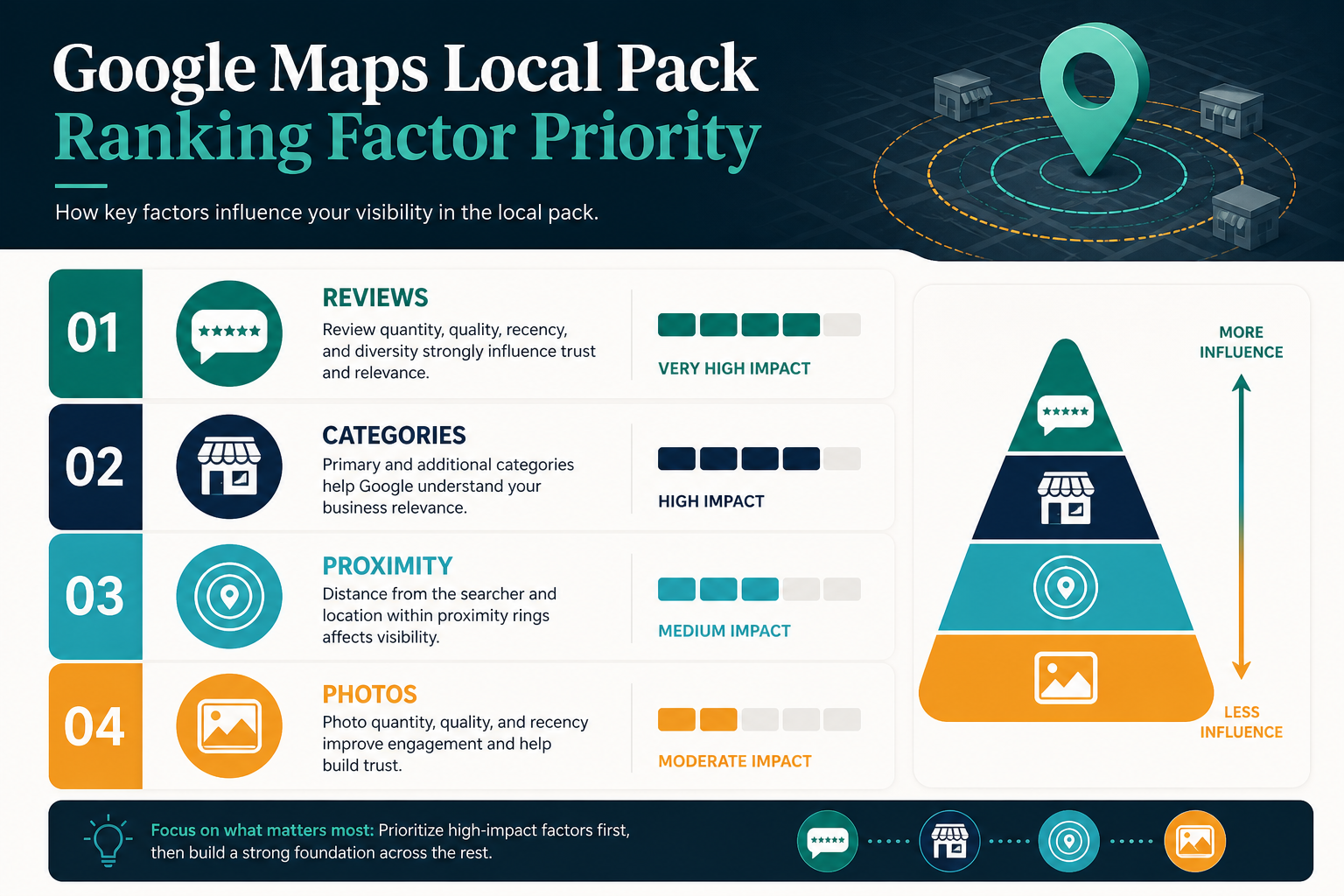
Strip away the noise and a short list of factors explains most of the variance you see between profiles competing for the same searches. None of them work in isolation—a perfect category with zero reviews still loses to a good-enough category with a strong reputation.
| Factor | Why it matters | Practical action |
|---|---|---|
| Primary category accuracy | Directly ties your profile to matching search intent | Audit against how customers actually phrase searches, not internal jargon |
| Proximity / service-area honesty | Distance is weighted heavily and cannot be gamed | Verify the pin and keep service-area radius realistic |
| Review velocity, recency and replies | Signals ongoing trust and active management | Build a steady request habit; reply within 48 hours |
| Profile completeness | Feeds both relevance and AI-assisted summaries | Fill hours, attributes, services, products, and description fully |
| Website relevance and speed | Supports prominence and post-click conversion | Match landing pages to the services you rank for |
| Engagement (calls, directions, clicks) | Acts as a real-world quality signal | Use clear CTAs, accurate hours, and current offers |
| Photo and video freshness | Improves trust and click-through in the pack | Add new, real images monthly, not stock photography |
Overrated or Misunderstood Factors
Stuffing keywords into your business name still shows up as advice in 2026, and it is still against Google guidelines and still risky. It might produce a short-term bump before someone reports it, then you lose the listing entirely while it gets reviewed. The math rarely works in your favor once you weigh a few weeks of extra clicks against the possibility of a suspension during your busiest season.
Posting frequency alone is another overrated lever. Publishing daily updates without fixing category accuracy or review velocity does very little for rank, even though it clearly helps conversion and freshness. We cover that distinction in detail in our dedicated look at whether GBP posts still help rankings , and the short version is: posts support prominence indirectly, they do not replace it.
Raw backlink volume borrowed from generic website SEO thinking will not rescue a wrong category or a drifted map pin. Backlinks and brand mentions do support prominence over the long run, but they are a slow multiplier on a healthy foundation, not a shortcut around one. Similarly, chasing review count without quality backfires: fifty rushed, generic five-star reviews often carry less trust weight in practice than fifteen detailed, specific ones that read like real customers wrote them.
A Practical Priority Order for 2026
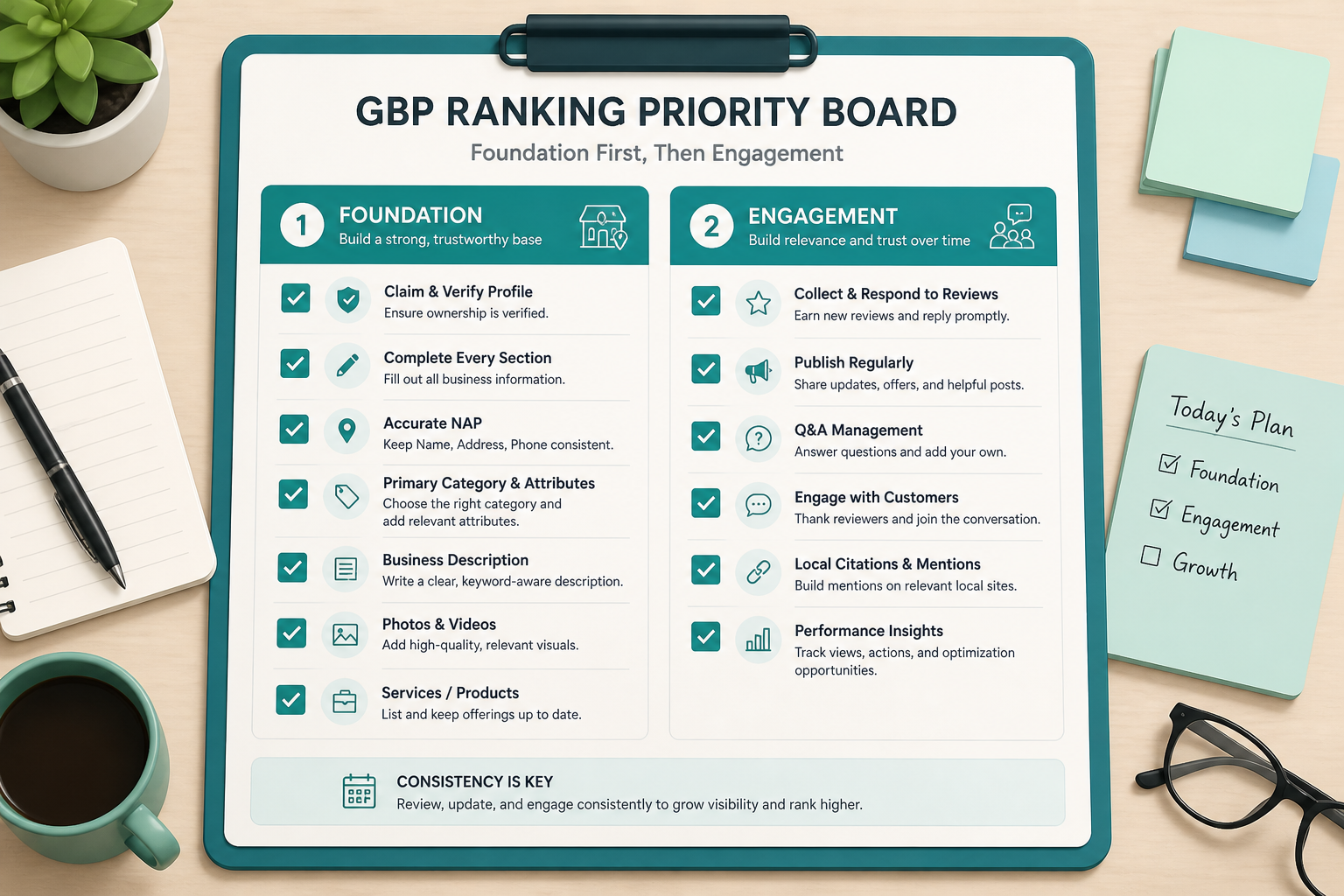
If you only have a few hours a month, sequence matters more than volume. Start by confirming ownership and correcting the primary category—this single field influences relevance more than almost anything else on the profile. Next, verify your address pin and make sure your name, address, and phone number match exactly across your website and major directories.
From there, build a simple, repeatable review request habit rather than a one-time push, and complete every field Google offers: attributes, services with real descriptions, products, hours including holiday exceptions, and a description written for humans instead of stuffed with keywords. Finally, connect your website's local landing pages so the services you rank for on the profile match what a visitor finds after clicking, and start tracking a neighborhood grid instead of a single search from your office—see our local SEO playbook and GMB optimization guide for the full rollout.
How Competition Density Should Change Your Approach
The right emphasis among these factors shifts depending on how crowded your specific market is. In a low-competition category—say, a specialty repair trade in a smaller town—a merely complete, accurate profile with a handful of genuine reviews can comfortably hold a top position for years with minimal ongoing effort. In dense urban categories like dentists, lawyers, or cafes, the same baseline effort barely earns a seat at the table, because dozens of nearby competitors are all doing the fundamentals correctly too.
Before investing heavily in any single tactic, spend an afternoon studying the profiles currently occupying the top three spots for your core keywords. Note their review count and how recently those reviews arrived, how complete their services and photos look, and how their category choices compare to yours. This competitive baseline tells you whether you need incremental polish or a genuinely aggressive rebuild, and it stops you from either under-investing in a competitive market or over-investing effort where you already comfortably lead.
Reassess this competitive picture every few months rather than once and never again, since new entrants and improving competitors can quietly shift the bar upward without any single dramatic change you would otherwise notice. Businesses that treat competitive benchmarking as an ongoing habit consistently make better decisions about where to spend their limited optimization time than those relying on a single audit from years ago.
Final Takeaway
Google Business Profile ranking factors in 2026 are not a mystery, and they are not a hack list either. Relevance, distance, and prominence still explain almost everything, and the businesses that win consistently are the ones that treat category accuracy, honest proximity, and steady reputation-building as the actual job—not the warm-up before some clever trick. Skip the shortcuts, fix the foundation, and measure with a real grid using something like GBP Local Ranker so you know whether your effort is working near the customers who actually matter.
Frequently Asked Questions
What is the single most important Google Business Profile ranking factor in 2026?
There is no single factor that outweighs everything else. Primary category accuracy, honest proximity, and review-driven prominence work together, and weakness in any one of them limits how far the others can carry you.
Does profile completeness actually affect ranking, or is it just good practice?
Completeness supports relevance directly and increasingly supports how confidently AI-assisted answer experiences summarize your business, which affects visibility even outside the classic Map Pack.
How much do reviews affect ranking compared to conversion?
Reviews influence both. Their impact on conversion (whether someone chooses you) is usually larger and easier to prove than their impact on raw rank position, but healthy review activity does support prominence over time.
Can I outrank a competitor who is physically closer to the searcher?
It is possible but harder. A meaningfully stronger relevance and prominence profile can offset a moderate distance disadvantage, though you cannot overcome physics entirely for very local, high-intent searches.
Do backlinks to my website help my Google Business Profile ranking?
Yes, indirectly, by supporting overall prominence and brand authority. They are a slow, compounding factor rather than a quick fix for a weak or inaccurate profile.
How often does Google change its local ranking factors?
Google adjusts weighting and enforcement continuously through smaller updates rather than dramatic yearly overhauls. The underlying relevance, distance, and prominence framework has stayed remarkably stable for years.
Should small businesses use a rank tracking tool, or is checking Google manually enough?
Manual checks from one location badly overstate visibility because rank varies by neighborhood. A grid-based tracking tool shows the real picture across the area customers actually search from.