Google Business Profile (GBP) is the control center of local visibility. If your listing is incomplete, inconsistent, or unmanaged, you lose map pack impressions, calls, and direction requests, even when your website ranks. This guide covers both sides of the job: optimization (making the profile complete and relevant) and management (keeping it accurate, active, and measurable every week).
Use it as an operating manual for owners, in-house marketers, and agencies running one location or many. Pair the checklists with neighborhood-level rank tracking so you know whether profile work is improving Maps visibility near real customers, not only from your office Wi-Fi. Teams that separate one-time setup from weekly ownership usually see steadier call and direction-request growth within one to two months.

Optimization vs Management: Know the Difference
Optimization is the foundation: categories, NAP, description, services, attributes, photos, and first-wave review systems. Management is the recurring operating system: weekly posts, review replies, hours updates, Q&A, spam monitoring, access control, and reporting. Strong optimization without management decays. Strong management on a weak foundation underperforms. You need both. Think of optimization as renovating the storefront and management as staffing it every day, customers and Google notice when either side slips.
| Area | Optimization focus | Management focus | Owner |
|---|---|---|---|
| Categories & services | Pick accurate primary/secondary categories | Review seasonally as offers change | Owner / SEO lead |
| NAP & hours | Exact match across site + directories | Update holidays, temporary closures fast | Ops manager |
| Photos & media | Seed 15–30 quality assets | Add fresh photos weekly | Store / content lead |
| Reviews | Create request link + QR process | Reply to every review in 48 hours | Frontline + marketing |
| Posts & offers | Define brand voice templates | Publish 1–2 posts per week | Marketing |
| Tracking | Set baseline Insights + keyword grid | Weekly Insights + rank review | SEO / agency |
1) Profile Foundation Checklist
Before creative posts or advanced tactics, lock ownership and accuracy. Google cannot confidently recommend a listing that contradicts itself across the web. A wrong pin, outdated phone, or keyword-stuffed name can quietly suppress pack visibility while ads and social spend keep rising. Fix the foundation first; then scale creative work.
- ☐ Primary owner verified; add a backup admin who is not a single contractor
- ☐ Business name matches signage and legal branding, no keyword stuffing
- ☐ Primary category matches what customers search; secondaries support real services
- ☐ Address pin is exact; service areas are honest for SABs
- ☐ Phone, WhatsApp, website, and appointment URL match the website footer
- ☐ Hours include exceptions for holidays and special events
- ☐ Attributes enabled (women-led, wheelchair access, online appointments, parking, etc.)
- ☐ Description written in clear language with city/service context, no spammy keyword walls
2) On-Profile Optimization That Moves Maps
Categories, services, and photos are among the highest-leverage GBP fields because they shape relevance and click behavior. Relevance tells Google you match the query. Photos and reviews help users choose you over the two competitors sitting beside you in the local pack. Prefer truthful specificity over stuffing every possible category, accuracy compounds; spam invites review and possible suspension.
- ☐ Audit competitors’ categories in your map pack, mirror only what is truthful
- ☐ List services the way customers phrase them (“emergency plumber,” “bridal saree stitching”)
- ☐ Upload cover + logo that look professional on mobile Maps
- ☐ Keep a photo cadence: interior, exterior, team, product/service proof, before/after where relevant
- ☐ Use Products / Services modules with real prices or “from” ranges when helpful
- ☐ Answer GBP Q&A with owned, helpful responses before competitors plant misleading ones
3) Weekly GBP Management Rhythm
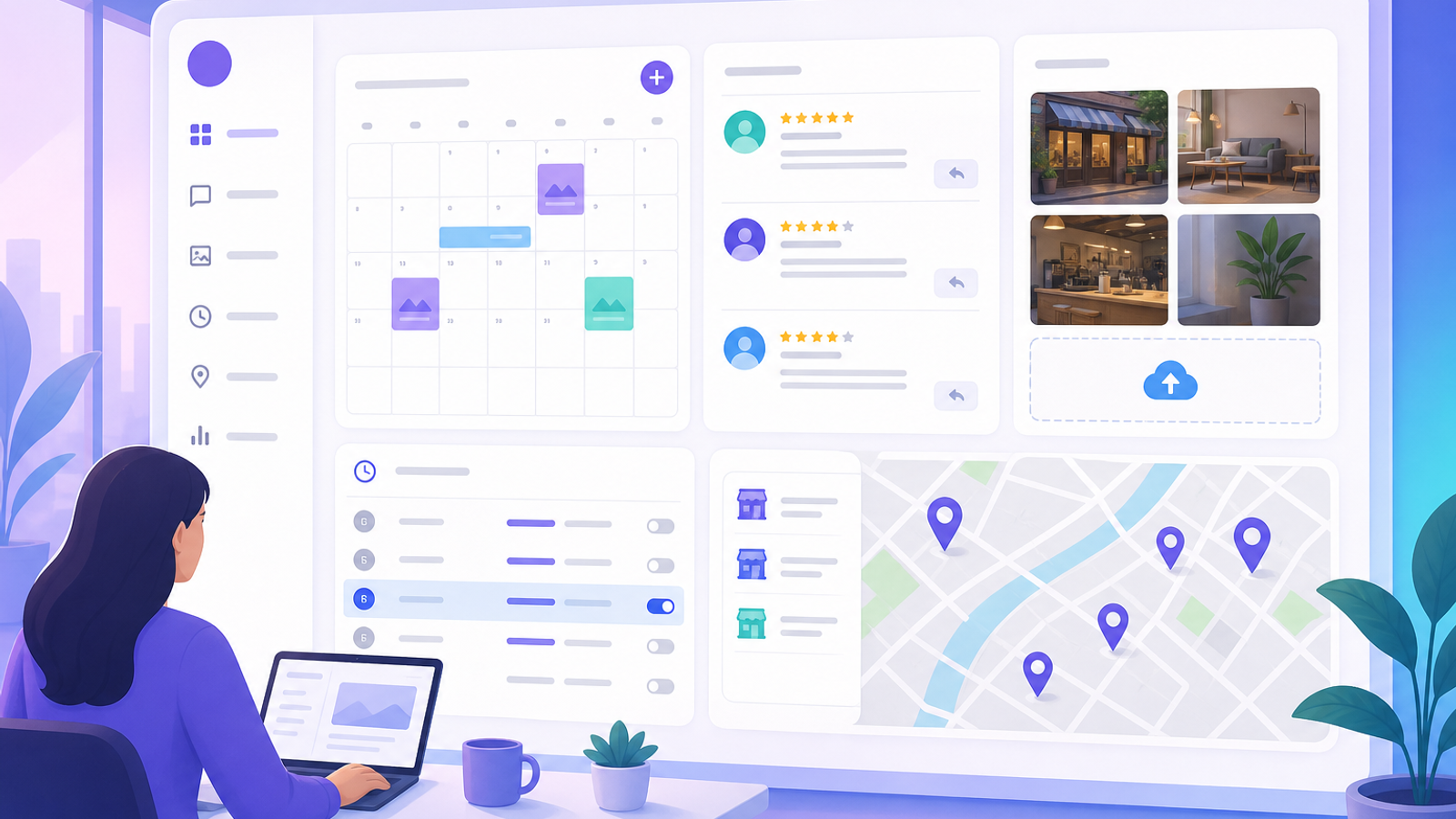
Treat the profile like a storefront that must stay open, stocked, and staffed. A simple weekly rhythm beats occasional “SEO projects.” Assign owners the same way you assign opening and closing duties. When peak season hits, the profiles that already have a cadence stay visible while neglected competitors go quiet.
- ☐ Monday: publish one Google Post (offer, update, event, or tip)
- ☐ Daily: reply to new reviews and messages within one business day
- ☐ Midweek: upload 3–5 new photos or a short video
- ☐ Friday: check Insights (calls, direction requests, website clicks) vs last week
- ☐ Monthly: audit NAP, categories, Q&A, duplicate listings, and staff access
- ☐ Quarterly: deep competitor photo/review comparison and citation cleanup
4) Reviews, Trust & Policy-Safe Growth
Review velocity and reply quality influence both ranking and conversion. Ethical generation beats shortcuts: ask real customers after successful jobs, make the link easy, and never buy fake reviews. A suspension during peak season can erase months of map visibility. Train frontline staff with a short script and a QR card so requests feel natural, not pushy or transactional.
- ☐ Short review link + QR at checkout, invoice, or job completion
- ☐ Reply templates for 5-star, mixed, and negative reviews, personalized, not robotic
- ☐ Flag clear spam through Google’s tools; document policy violations
- ☐ Never offer payment or discounts in exchange for 5-star wording
- ☐ Track review count, rating, and reply rate in monthly reports
5) Multi-Location & Agency Management
Agencies and franchise teams fail when every location uses a different naming style, photo quality, or reply voice. Standardize the operating system, then localize only what must be local (hours, team photos, neighborhood keywords). Document who can edit what, and remove access the day a contractor or employee leaves, hijacked listings are still a common recovery nightmare.
- ☐ Location naming convention documented (brand + city/area rules)
- ☐ Shared post calendar with local editable fields
- ☐ Role-based access: remove ex-employees immediately
- ☐ White-label or client-ready reporting: Insights + rank grids + review KPIs
- ☐ Escalation path for suspensions, hijacks, and duplicate claims
6) Measure What Matters
Vanity screenshots of “#1 on Maps from HQ” hide neighborhood losses. Combine GBP Insights with grid-based local rank tracking around each pin. Watch calls, direction requests, website clicks, discovery queries, and review velocity together, then connect changes to profile actions you shipped that week. If posts and photos increase but calls do not, revisit categories, landing pages, and review reply quality before buying more ads.
For deeper playbooks, see our GMB Optimization guide, GMB Management guide, and Local SEO playbook. Treat “6) Measure What Matters” as an operating checklist, not a one-time edit, so rankings compound instead of resetting every month.
Final Takeaway
Google Business Profile optimization and management is not a one-time checklist, it is a local growth system. Optimize the foundation so Google understands who you are. Manage the profile weekly so customers keep choosing you. Measure neighborhood outcomes so your team knows what to improve next. Do that consistently and Maps stops feeling random.