Predicting the future of local search has become something of a cottage industry, and a lot of it overpromises: breathless claims that AI has "killed" traditional search, that Google Business Profiles will be irrelevant within a year, or that some new tactic is the only thing that will matter going forward. None of that holds up to scrutiny. What is genuinely changing is worth understanding clearly, and what is genuinely not changing is just as important to hold onto amid the noise.
This guide takes an honest, grounded look at where local search is actually heading — the real effect of AI-generated answers on how customers find local businesses, why entity consistency is becoming more important rather than less, and which fundamentals are likely to remain the backbone of local visibility regardless of how much the interface around search continues to change.
Where Local Search Actually Stands
Search behavior has genuinely diversified. A meaningful share of informational queries — "how much does a root canal cost," "what to look for in a moving company" — increasingly get answered directly by an AI-generated summary before a searcher ever scrolls to a list of websites or businesses. But the searches that actually drive local business decisions — "plumber near me," "best sushi open now," "dentist accepting new patients" — still rely heavily on the same map-based, business-listing-driven results they always have, because these queries are fundamentally transactional and location-specific in a way a generic AI summary cannot fully substitute for.
AI-Generated Answers and What They Change
Where AI answers do increasingly enter the picture is in comparison and research-stage queries — "which type of contractor do I need for a kitchen remodel," "questions to ask before hiring a personal injury lawyer" — where a generative summary can genuinely shortcut research that used to require visiting several websites. For businesses, the practical implication is that being cited as a source within these AI-generated answers is becoming a new, if still poorly understood, visibility surface, distinct from but related to traditional organic and map pack rankings.
What AI answers do not replace
AI-generated summaries are not well-suited to the final "which specific business do I choose and how do I contact them" decision, because that decision depends on real-time information — is this location currently open, what do actual recent customers say, how far away is it from me right now — that a static generative answer is poorly positioned to provide reliably. This is exactly the kind of query the map pack and individual Google Business Profiles remain built to answer, and there is no credible evidence that this transactional layer of local search is disappearing.
| Query Type | AI Answer Role Today | Business Listing Role |
|---|---|---|
| Informational ("how does X work") | Increasingly answered directly by AI summaries | Minimal, unless cited as a source |
| Comparison / research ("best type of X for Y") | Growing role in shortcutting research | Being cited as a source is emerging value |
| Transactional ("X near me", "X open now") | Limited — needs real-time, local data | Central — map pack and profiles remain primary |
| Reputation ("is X any good") | Can summarize sentiment broadly | Reviews remain the authoritative source |
Entity Consistency: The Quiet Foundation Under Every Scenario
Why every future path leads back to the same data
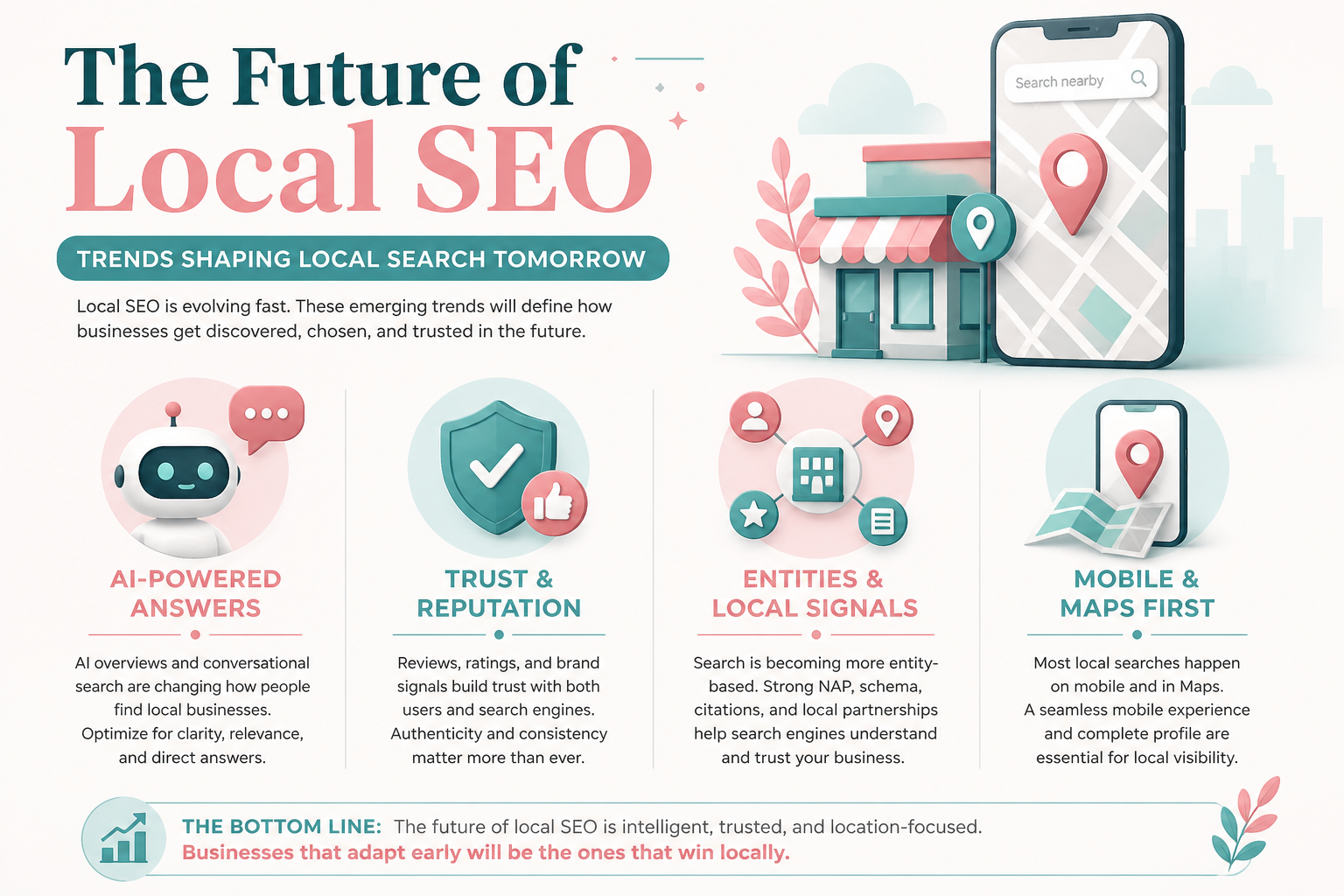
Whether a customer finds you through a traditional map pack, a comparison-style AI answer, or a future search interface that does not exist yet, every one of these systems relies on confidently knowing basic facts about your business: your real name, your real address or service area, your real hours, and a body of real, independently verifiable reviews. This is precisely why entity consistency — the same accurate facts represented identically everywhere your business appears online — becomes more valuable, not less, as more systems try to synthesize an answer on your behalf rather than simply linking to your listing.
Trust signals compound in an AI-mediated search environment
A system generating a summarized answer has to decide which sources to trust, and a business with consistent NAP data, a strong and current review profile, and accurate structured data on its website presents a much clearer, more confidently verifiable signal than one with scattered, contradictory information across the web. This is not a new requirement invented for AI search — it is the same discipline good local SEO has always required — but the cost of getting it wrong is arguably higher now, since an AI system with conflicting source data may simply exclude a business from a summary altogether rather than guessing.
| Signal | Why It Matters More Going Forward | Action |
|---|---|---|
| NAP consistency | Conflicting data makes a business less trustworthy to summarize | Regular citation and schema audits |
| Genuine, detailed reviews | A richer, more verifiable trust signal than star rating alone | Sustained, honest review generation |
| Accurate structured data | Easier for automated systems to extract confidently | Keep LocalBusiness schema current |
| Real, specific website content | A credible source an AI system might actually cite | Publish genuinely useful, specific content |
What Probably Won't Change, Even as Interfaces Do
The core mechanics Google has used for local ranking for years — relevance, distance, and prominence — are unlikely to disappear even as the surfaces displaying results evolve, because they reflect genuinely useful, durable principles: match the right business to the right search, favor businesses that can actually serve the customer nearby, and reward businesses the wider world has independently validated as trustworthy. Chasing every new interface change while neglecting these fundamentals is a consistent mistake across every past shift in how search has looked, and there is no reason to expect this one is different.
How to Prepare Without Chasing Hype
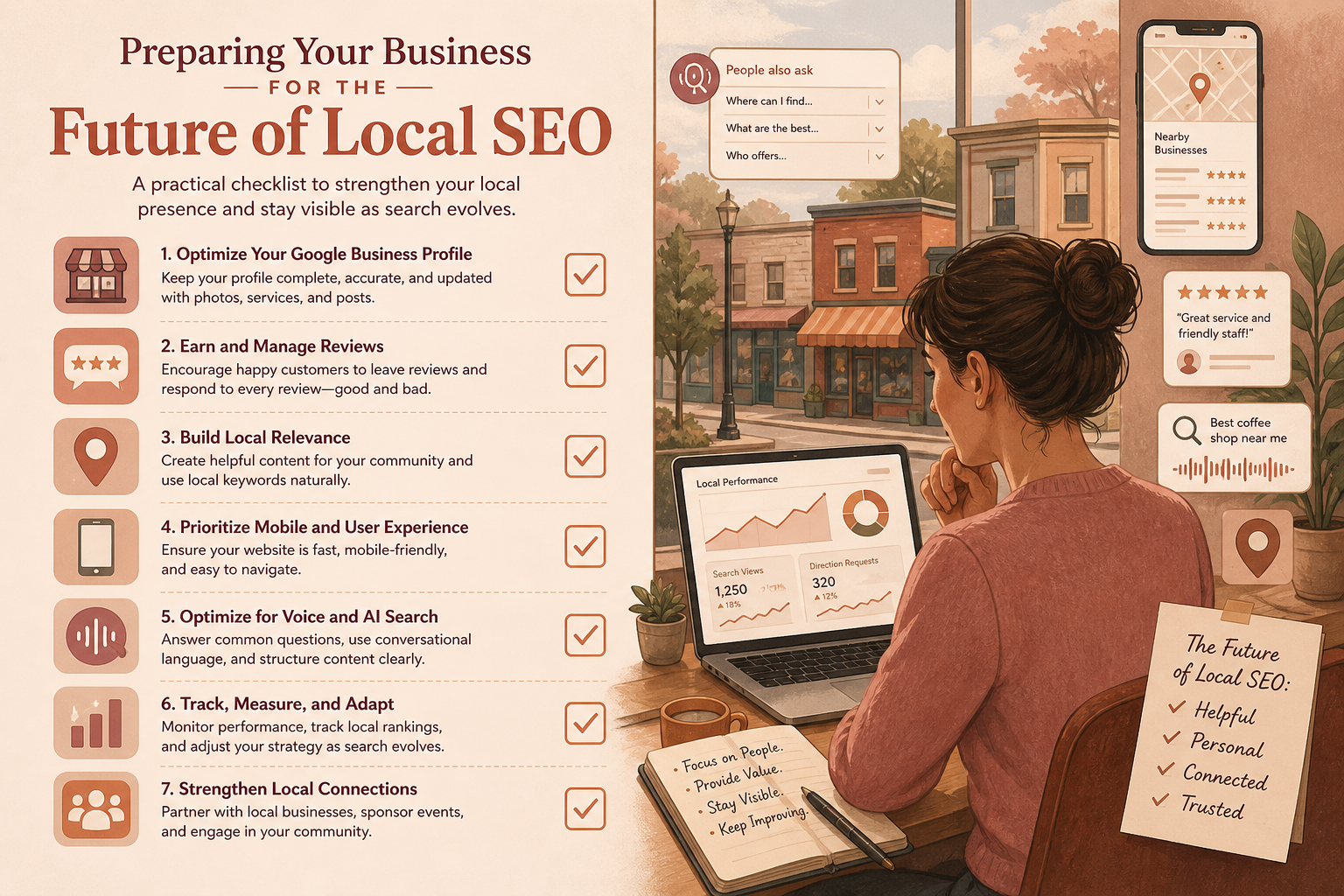
The most useful preparation is not a dramatic pivot but a doubling-down on fundamentals that were already worth doing: keep your Google Business Profile accurate and active, build a genuine, sustained review system, keep your website's local content specific and genuinely useful rather than thin and generic, and maintain consistency across every place your business is described online. Businesses waiting for a single new tactic to master before "AI search" arrives are likely to find there was never a single tactic to wait for in the first place — just the same disciplined fundamentals, executed a bit more rigorously. Our related look at whether ChatGPT search changes local search goes deeper into one specific piece of this shift.
Practical Signals Worth Watching Over the Next Year
Rather than reacting to every headline about AI and search, it is more useful for a small business to watch a handful of concrete, practical signals in its own data and its own market, adjusting only when there is real evidence something has genuinely changed for that specific business.
Watch whether AI-driven traffic starts showing up in your own numbers
Some analytics tools have begun distinguishing referral traffic that originates from AI chat or answer products, and tracking whether this becomes a meaningful, growing share of your website visits over the coming months is a far more reliable indicator of relevance to your specific business than any general industry statistic. A business seeing zero measurable AI referral traffic after a year has very different priorities than one seeing it grow steadily.
Pay attention to how competitors who are already thriving are adapting
Rather than speculating abstractly, look at the businesses in your own category and area that are visibly thriving in search results today, and notice what they are actually doing differently — often it is simply a more complete profile, a stronger and more recent review base, and more specific, genuinely useful website content, rather than any exotic new tactic. Grounding a future strategy in observable, local evidence tends to be far more productive than reacting to broad, national-level speculation about where search is heading.
Revisit your assumptions periodically, not constantly
A quarterly check-in on how search behavior in your specific category appears to be shifting is enough for almost any small business; there is little value in reassessing strategy weekly based on the latest speculative headline. This measured cadence keeps a business genuinely informed without becoming reactive to every incremental announcement, most of which will have little practical bearing on a local business's day-to-day visibility. Most of the genuine value still comes from the same fundamentals — accurate data, genuine reviews, and useful content — rather than from a distinct set of tactics built solely around whichever AI answer engine happens to be trending that quarter.
Final Takeaway
The future of local search is less dramatic than headlines suggest and more demanding in a quieter way: the businesses that will do well are the ones that treat entity consistency, genuine reviews, and accurate, helpful content as non-negotiable, not the ones chasing whichever tactic is trending this quarter. Build the local SEO fundamentals properly now, and most future shifts in how search looks will find your business already well-positioned rather than scrambling to catch up.
Frequently Asked Questions
Is Google Business Profile becoming less important because of AI search?
No, transactional local searches still rely heavily on map-based business listings, and there is no credible evidence this is changing soon.
How can my business get cited in AI-generated search answers?
There's no guaranteed method, but consistent, accurate, and detailed information across your website and profile makes you a more confidently citable source.
Will traditional local SEO fundamentals stop mattering?
Unlikely; relevance, distance, and prominence reflect durable principles that have persisted through many past shifts in how search results are displayed.
Should I completely change my local SEO strategy for AI search?
No, the most useful preparation is strengthening the same fundamentals — profile accuracy, reviews, and consistent data — rather than pursuing a dramatically different strategy.
Do reviews matter more or less in an AI-driven search future?
Likely more, since a richer, more verifiable review profile gives AI systems and human searchers alike a stronger, more confident trust signal.
What is entity consistency and why does it matter now?
It means your business's name, address, hours, and other facts are represented identically everywhere online, which matters more as more systems try to synthesize answers automatically.
Is it too early to worry about AI search's effect on local SEO?
It's reasonable to stay informed without overreacting; strengthening core fundamentals now benefits your business regardless of how quickly AI search features evolve.