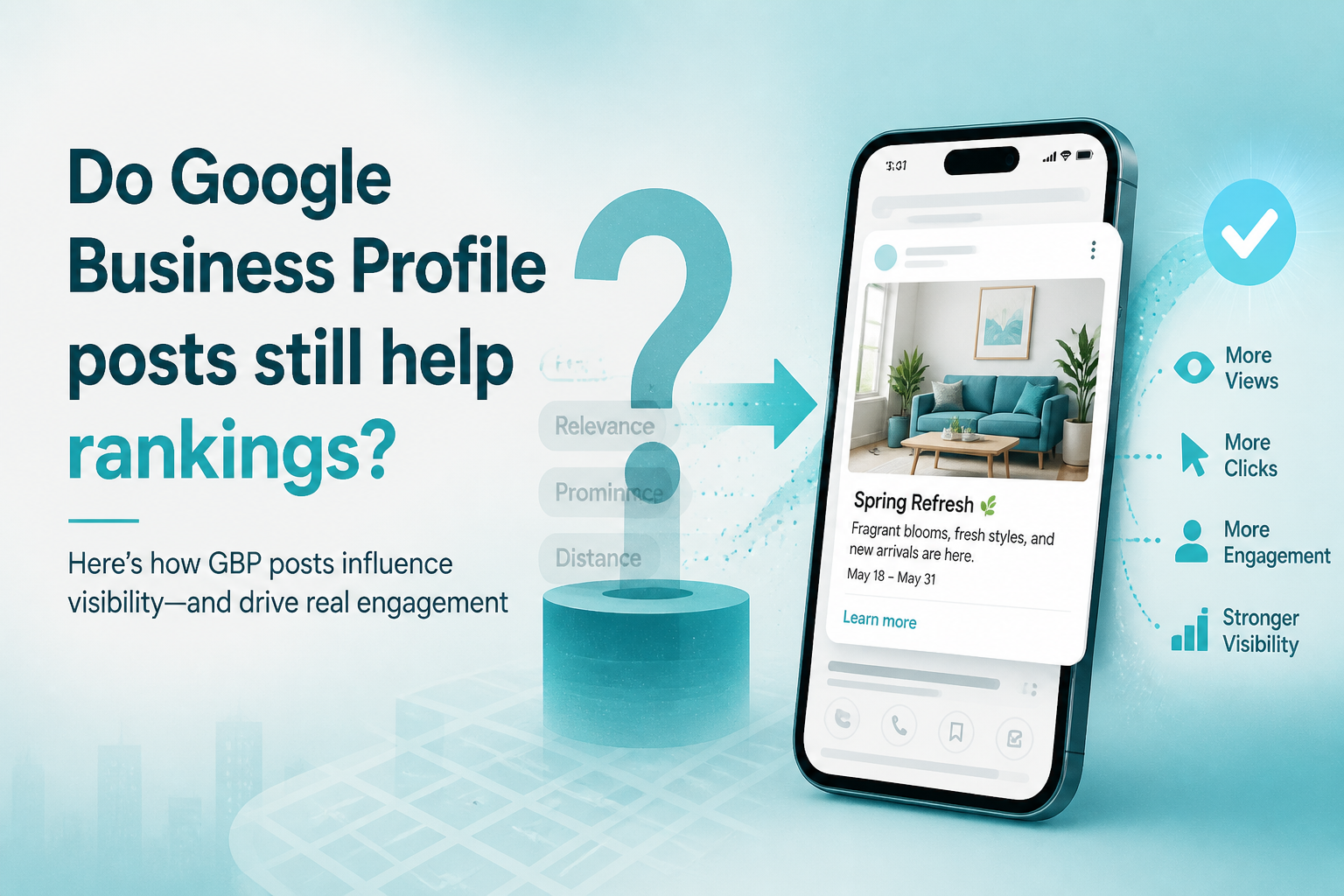
Do Google Business Profile is one of the highest-leverage local search topics in 2026. The short, honest answer in 2026 is that Google Business Profile posts are not a confirmed direct ranking lever—but dismissing them as pointless goes too far in the other direction. Posts clearly influence how active and trustworthy your profile looks, and they clearly affect whether someone calls you instead of the competitor sitting right next to you in the pack. Both of those things matter for a local business, even if neither shows up as a clean "post equals rank" formula.
We covered the deeper ranking-factor mechanics of this question in our earlier analysis of whether GBP posts actually help rankings . This piece takes a different angle: breaking posts down by type, looking at what each one is genuinely good for, and giving you a cadence that respects your time instead of demanding a full-time content calendar.
The Four Post Types and What They Are Actually For
Google groups posts into a small number of formats, and each one serves a different job. Update posts share general news or tips and work best for education and ongoing relevance. Offer posts create urgency around a specific promotion and tend to produce the clearest conversion lift. Event posts announce time-bound happenings and perform well for appointment-driven or seasonal businesses. Product posts highlight a specific item or service and function almost like a mini landing page inside the listing.
| Post type | Primary strength | Best used for |
|---|---|---|
| Update | Education, freshness | Tips, news, general announcements |
| Offer | Conversion, urgency | Discounts, limited-time promotions |
| Event | Timely demand | Workshops, sales, appointment slots |
| Product | Specific service visibility | Featured service or seasonal item |
What the Evidence Actually Shows
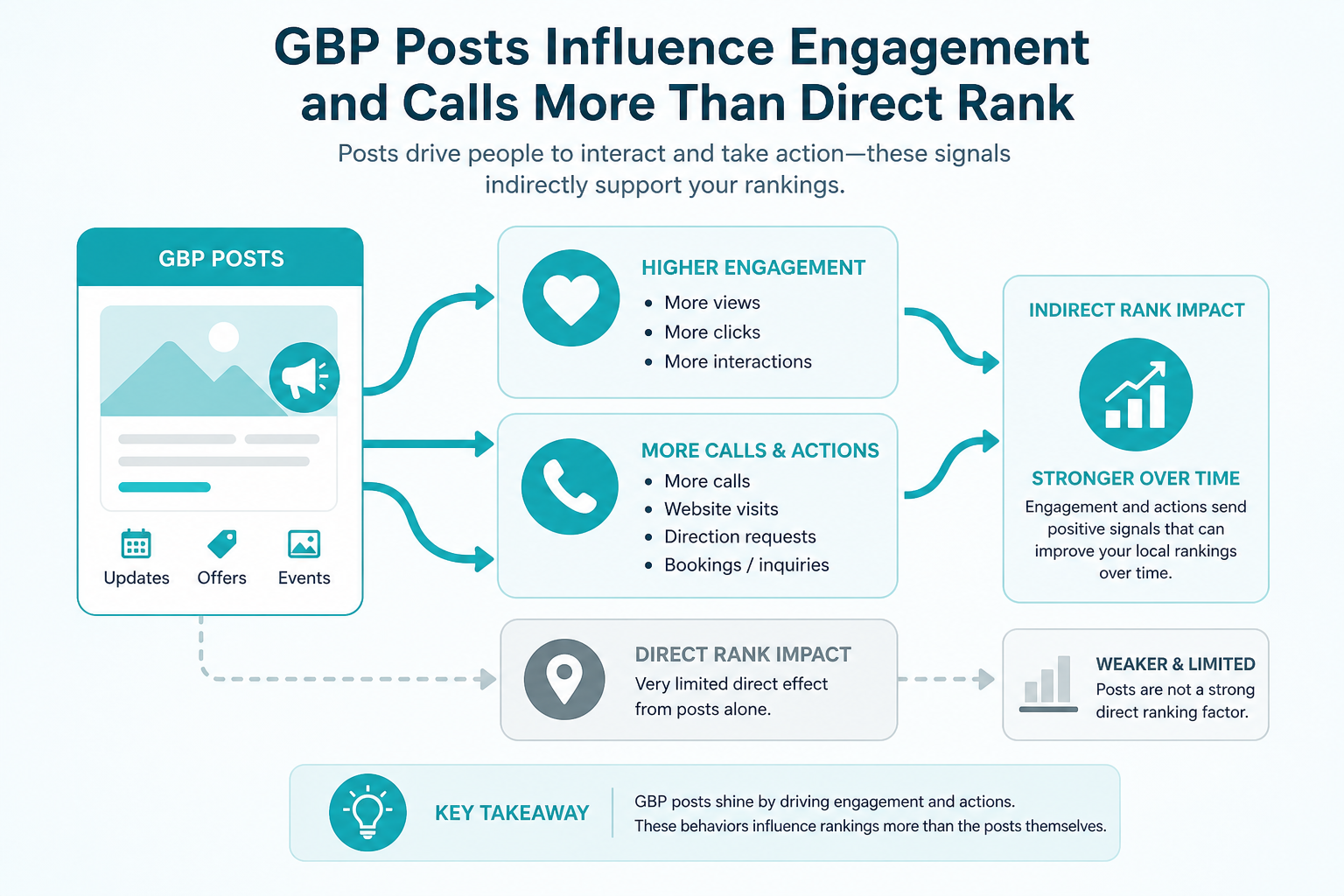
Google has never published a formula linking post volume or frequency to Map Pack position, and independent practitioner testing over the past several years has been mixed and often confounded by other simultaneous changes to a profile. What is consistently observable, rather than theorized, is that posts increase profile views, photo engagement, and click-through on offers when the creative and call-to-action are genuinely strong.
That distinction—inconsistent evidence for direct rank impact, consistent evidence for engagement impact—is exactly why honest local SEO guidance in 2026 treats posts as a conversion and freshness tool first, with any ranking benefit treated as a possible, unproven side effect rather than the main reason to bother.
Where Posts Genuinely Move the Needle
Posts earn their keep most clearly in three situations: seasonal demand spikes where timely relevance beats a static profile, competitive markets where two similarly ranked businesses fight for the same tap, and appointment-based businesses that need a clear, current reason for someone to book today rather than browse further. In each case, the value shows up as more calls and clicks at the same rank position, which is still real revenue even without a rank change.
How Posts Fit Alongside Photos and Q&A
Posts rarely operate alone on a well-managed profile—they usually work best alongside a steady flow of fresh photos and an actively monitored Q&A section. A new post announcing a seasonal offer lands better when it is paired with a genuinely current photo rather than an old stock image, and an active Q&A section that already answers common objections means the post does not have to carry the entire burden of persuading a skeptical searcher on its own.
Businesses that treat these three elements—posts, photos, and Q&A—as one coordinated freshness system tend to see stronger engagement results than those managing each in isolation. A monthly content session that updates all three at once is usually more efficient and more effective than three separate, disconnected habits scattered across different days of the month.
Where Posts Cannot Save You
No amount of posting fixes a wrong primary category, a drifted map pin, thin or dishonest reviews, or a suspended profile. Posts also cannot overcome a genuine distance disadvantage for tightly local searches. Treating a posting calendar as a substitute for fixing these fundamentals is the single most common mistake we see in local SEO strategy conversations.
| Problem | Can posts fix it? | What actually fixes it |
|---|---|---|
| Wrong primary category | No | Category correction and audit |
| Weak or thin reviews | No | Ongoing ethical review request system |
| Distance disadvantage | No | Nothing content-based; physical reality |
| Stale, inactive-looking profile | Yes | Consistent weekly posting |
| Low conversion at a decent rank | Yes, partially | Strong offers and clear CTAs |
A Cadence That Respects Your Time
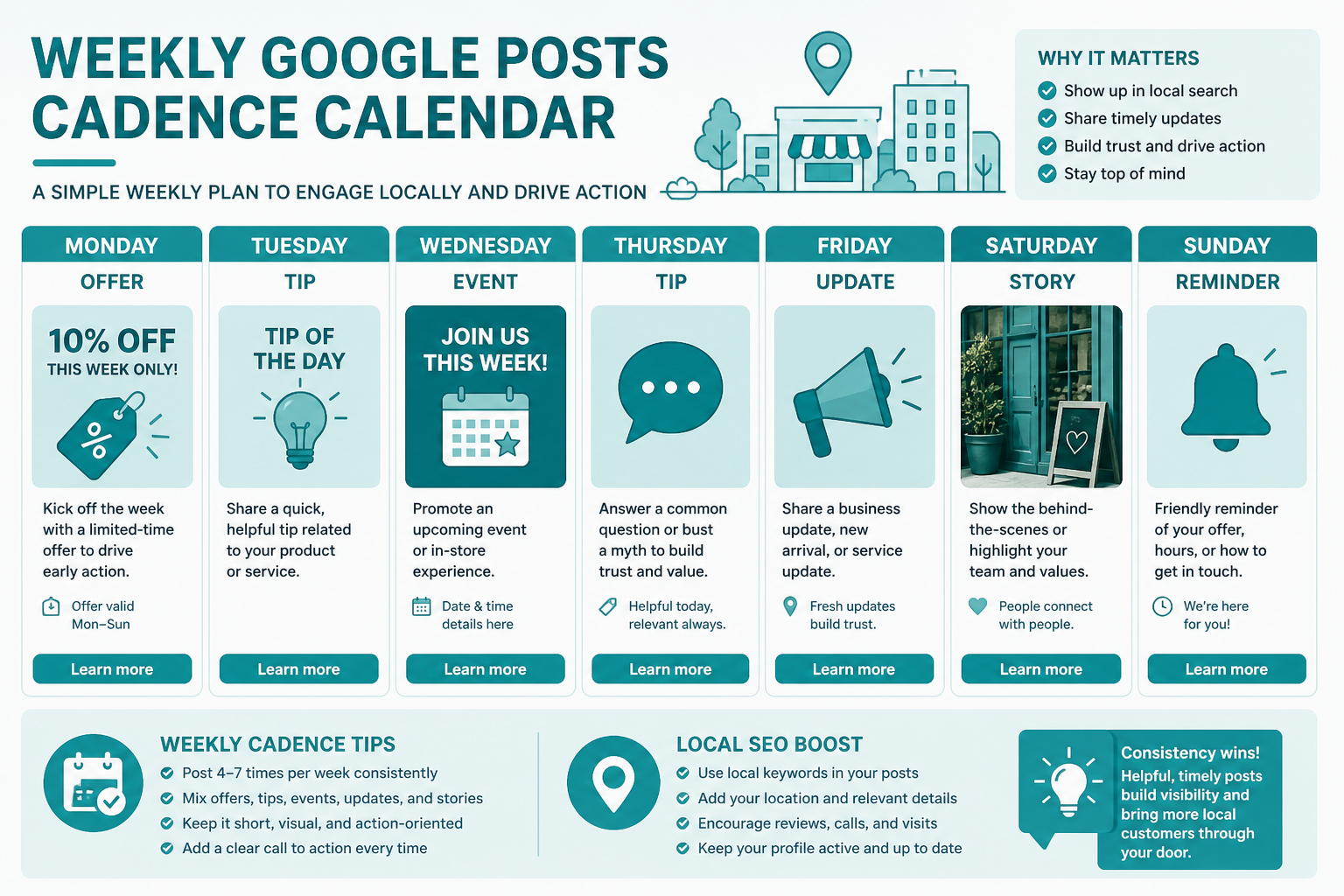
One to two posts per week is enough for the large majority of local businesses. Batch four weeks of content in a single sitting once a month: pick real photos, write short, mobile-friendly captions, and match each call-to-action button to the actual next step you want—call for urgent services, book for appointments, learn more when a landing page carries the detail. Pair this with the broader operating rhythm in our GMB optimization guide so posting does not become an isolated task disconnected from the rest of your profile management.
Multi-location brands should keep a shared calendar with fields that stay editable at the local level—neighborhood name, current hours, a location-specific phone number—so posts do not read as obviously corporate and identical across every branch. A regional promotion can still feel local if the caption references the actual street or neighborhood, and that small effort noticeably improves how genuine the post feels to someone scrolling past it. This same principle of local specificity runs through our broader local SEO playbook , not just the posting calendar.
Setting Expectations With Clients and Business Partners
If you manage posting on behalf of a client or a business partner, set expectations before you start, not after the first month of results comes in flat on rank position. Frame the service explicitly around engagement, conversion, and profile freshness rather than promising a rank improvement you cannot guarantee. This framing protects your credibility and keeps the relationship focused on outcomes you can actually control and measure honestly.
Reporting should reflect this same honesty: show calls, direction requests, and post engagement alongside rank data rather than leading with rank alone. A client who understands that posts are working as intended—driving clicks and calls even at a stable rank—is far less likely to churn over a metric that was never the primary promise in the first place.
What to Write When You Have Nothing New to Announce
Owners often stall on posting because they feel like they need genuine news every single week, and most weeks do not bring a new offer or event. In practice, some of the most effective ongoing content is quietly educational: a short tip related to your service, a answer to a question customers ask often, a seasonal reminder relevant to your trade, or a behind-the-scenes look at how a job gets done. None of this requires a special announcement, and it keeps the profile looking active during the weeks between real news.
Recycling proven photo and caption formats is also perfectly reasonable once you find what resonates—there is no rule requiring constant novelty. A seasonal offer that performed well last year can return with updated dates and a refreshed photo rather than requiring an entirely new concept every single time. The goal is consistency and usefulness, not creative reinvention on a weekly schedule.
A Quick Gut Check Before You Publish
Before publishing any post, ask a simple question: would a real customer find this genuinely useful or interesting, or does it exist purely because the calendar says it is Monday? Posts written to satisfy a schedule rather than to say something worth reading tend to blur together and get ignored, while posts written with an actual reader in mind—even a short, simple one—consistently earn more attention and clicks regardless of how they might or might not influence rank.
This gut check takes seconds but noticeably improves post quality over time, especially once several people rotate through the task of drafting content and each one is tempted to fall back on filler just to keep the calendar full. A brief written style guide covering tone, banned clichés, and a short list of approved CTA phrases keeps quality consistent even as different team members take turns writing.
Final Takeaway
Do Google Business Profile posts still help rankings in 2026? Not as a proven, direct lever you can point to with confidence. Do they still deserve a permanent spot in your weekly routine? Yes, because they reliably improve engagement, freshness, and conversion—outcomes that matter for revenue regardless of what they do or do not do to your exact position in the pack. Put your heaviest effort into categories, reviews, and honest proximity, then let posting multiply the value of that foundation. Track the combined effect with GBP Local Ranker so you can see calls and rank movement together instead of guessing.
Frequently Asked Questions
Which type of Google Post converts best?
Offer posts typically produce the strongest short-term conversion lift because they create clear urgency, though event posts perform similarly well for appointment-driven businesses.
Do I need to post every single day?
No. Daily posting rarely outperforms one to two well-made posts per week and risks looking repetitive or spammy if content quality drops to hit volume.
Can old, unused Google Posts hurt my profile?
Expired offers or outdated events left visible can confuse customers, but they are unlikely to directly harm ranking. Clean them up for trust and clarity regardless.
Should every post include a call-to-action button?
Yes, whenever relevant. A clear, accurate CTA button meaningfully improves click-through compared to a post with no obvious next step.
Is it worth hiring someone just to manage Google Posts?
For most single-location businesses, a monthly batch session is manageable in-house. Larger multi-location brands often benefit from a dedicated coordinator or agency.
Do product posts work differently from regular update posts?
Yes. Product posts function more like a small landing page for a specific offering and tend to perform well when paired with pricing or clear availability information.
How quickly will I see the effects of a consistent posting habit?
Engagement changes like views and clicks can appear within days to a couple of weeks. Any ranking-adjacent effect is slower and harder to isolate from other changes.