Short answer for 2026: GBP posts are not a confirmed direct ranking factor that reliably pushes you from #5 to #1 in the Map Pack by themselves. Google has never published a clean “posts = rank” rule. What posts still do—very clearly—is keep your profile looking alive, surface timely offers, improve click behavior, and give customers a reason to call before they compare three competitors.
That distinction matters. Many agencies still sell “daily Google Posts for rankings” as if volume alone moves local pack position. Meanwhile, owners who stopped posting after hearing “posts don’t matter” quietly lose calls because their listing looks abandoned next to active competitors. This guide separates rank influence from revenue influence , shows what actually moves Maps in 2026, and gives you a practical posting system that is worth the time.
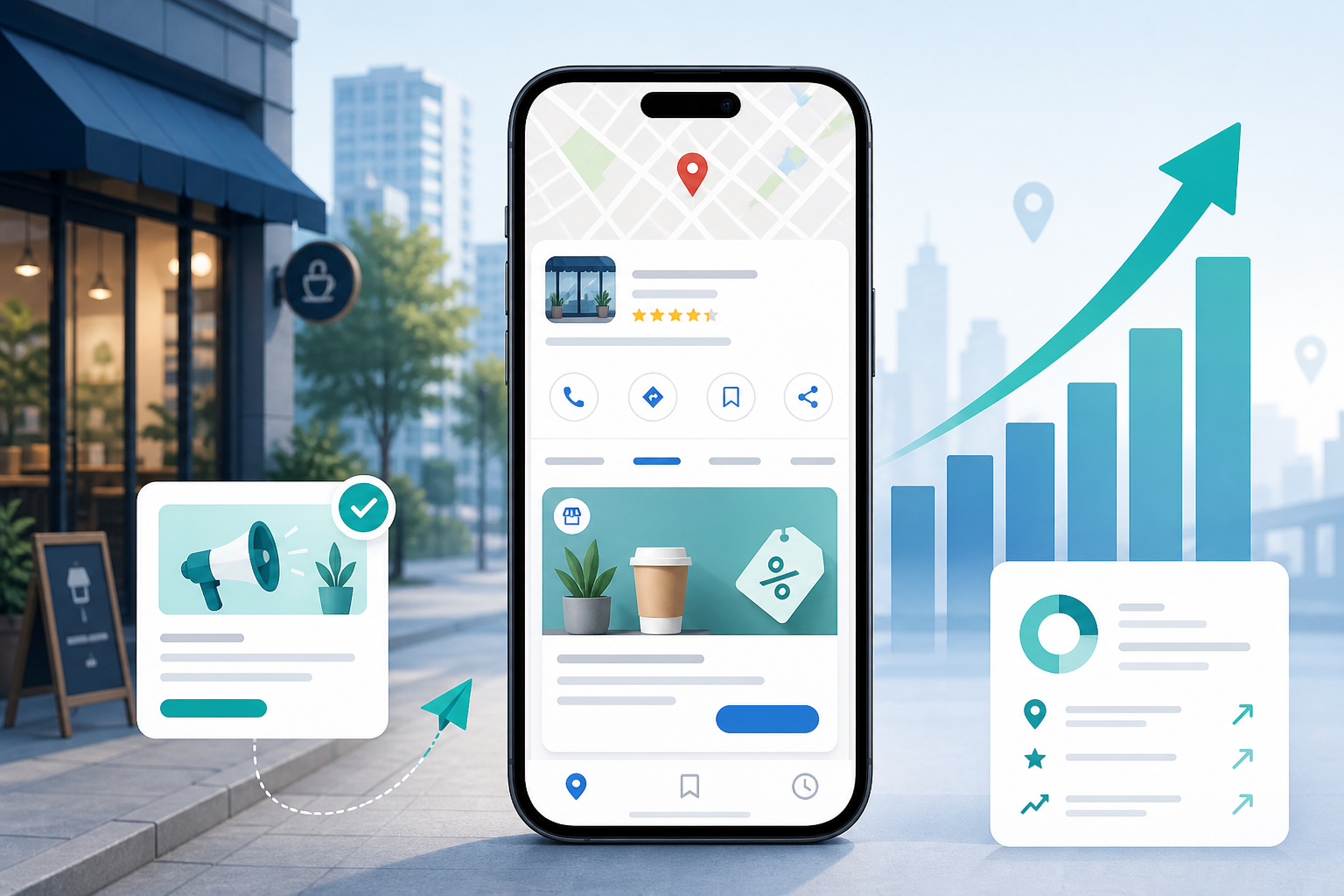
What “Helping Rankings” Means in Local SEO
Local pack ranking is still best understood through Google’s long-standing pillars: relevance (do you match the query?), distance (are you close enough?), and prominence (are you trusted and popular?). Reviews, categories, citations, website strength, engagement history, and spam risk all sit inside that model. A Google Post is a short-lived content unit on the profile—not a citation, not a review, and not a category change.
So when people ask “do posts help rankings?”, they usually mix three different outcomes: Treat “What “Helping Rankings” Means in Local SEO” as an operating checklist—not a one-time edit—so rankings compound instead of resetting every month.
- <strong>Direct rank lift:</strong> publishing a post instantly improves Map Pack position for “plumber near me” — weak / unproven as a primary lever in 2026
- <strong>Indirect rank support:</strong> posts increase clicks, calls, photo views, and “active profile” behavior that can reinforce prominence over time — plausible, hard to isolate
- <strong>Conversion lift at the same rank:</strong> you stay #2 or #3 but win more taps because your offer, photo, and CTA are fresher — strong and measurable
If your only KPI is “average grid rank,” posts will look disappointing. If your KPI is “calls and direction requests per 1,000 map impressions,” posts often look excellent—especially for seasonal offers, new services, and appointment-driven businesses.
2026 Reality Check: Direct Ranking Factor or Not?
Across practitioner testing, Google documentation, and local SEO conference consensus in 2025–2026, the cautious position remains the correct one: treat posts as an engagement and freshness channel first, a possible soft prominence signal second, and never as a substitute for category accuracy, reviews, or proximity reality .
Profiles that post weekly but keep the wrong primary category, a drifted map pin, thin review velocity, or broken NAP rarely leapfrog competitors. Profiles that fix those fundamentals and then post useful updates tend to convert better—and sometimes hold pack positions more stably because engagement stays healthier. Correlation is not causation, but ignoring posts entirely is still a competitive mistake in busy niches.
Also remember that “rankings” on Maps are query-specific and geo-specific. A post about monsoon AC service may help you win attention for seasonal searches while doing almost nothing for a different head term across town. That is another reason posts look inconsistent in rank case studies: people test one keyword from one pin and declare a universal rule. In 2026, mature local teams test grids, not screenshots.
| Signal / action | Likely rank impact | Conversion impact | Effort | 2026 recommendation |
|---|---|---|---|---|
| Primary category accuracy | Very high | High | Low one-time | Fix before scaling posts |
| Review velocity + reply quality | High | Very high | Medium ongoing | Priority #1 recurring work |
| Proximity / service-area honesty | Very high | Medium | Low | Cannot “content” your way around it |
| Photos & media freshness | Medium (indirect) | High | Medium | Weekly cadence |
| Google Posts (updates/offers/events) | Low–medium indirect | High | Low–medium | 1–2 quality posts / week |
| Website + local landing pages | Medium–high | High | High | Support posts with real pages |
| Citations / NAP consistency | Medium | Medium | Medium | Clean, then maintain |
| Keyword stuffing in posts | Negative risk | Negative | Low | Avoid spammy patterns |

How Posts Can Still Influence Visibility Indirectly
Even without a published “posts ranking weight,” several second-order effects remain real in 2026: Treat “How Posts Can Still Influence Visibility Indirectly” as an operating checklist—not a one-time edit—so rankings compound instead of resetting every month.
1) Profile freshness and “this business is open for business”
An abandoned listing with a 2023 last photo and zero posts looks less trustworthy than a competitor showing this week’s offer, team update, or seasonal tip. Humans notice. Algorithms that optimize for satisfaction have every reason to prefer listings people actually engage with. Freshness is not a magic boost button—but dormancy is a quiet penalty in competitive markets.
2) More inventory for discovery surfaces
Posts can appear on the profile and, in some cases, get additional exposure in Search/Maps experiences when Google surfaces updates. That does not guarantee Map Pack rank, but it can increase branded and non-branded discovery moments—especially for offers and events with clear dates.
3) Better click and call rates at the same position
Two clinics can sit side by side in the pack. The one featuring “Same-day cleaning · Book today” with a sharp photo often wins the tap. Winning the tap increases engagement history. Over months, stronger engagement is part of how prominence compounds. Posts are one of the easiest ways to change the creative that sits on your listing without rebuilding the whole website.
4) Relevance hints through language and entities
Natural mentions of services, neighborhoods, and seasonal intent (“monsoon AC service in Andheri,” “bridal makeup trial this weekend”) can reinforce what your business does. That is not an excuse to keyword-stuff. Google’s spam systems are better at detecting manipulative posting than they were in 2019. Write like a helpful storefront chalkboard, not like a doorway page from 2012.
What Does Not Work Anymore (If It Ever Did)
- Posting five near-identical updates a day “for the algorithm”
- Copy-pasting the same block across 40 franchise locations with zero local detail
- Stuffing city + keyword walls into every caption
- Fake urgency offers with no redeemable terms
- Stock-photo-only feeds that never match the real storefront
- Expecting posts to fix a wrong primary category or a hijacked listing
- Measuring success only by a single “rank #1 from HQ Wi-Fi” screenshot
In 2026, quality, honesty, and consistency beat spam volume. If a tactic would look embarrassing if Google’s Trust & Safety team screenshotted it, do not scale it.
A Practical Posting Cadence That Is Worth the Effort
You do not need a social-media department. You need a lightweight operating rhythm that keeps the profile useful. For most single-location businesses, one to two posts per week is the sweet spot. Highly competitive restaurants, dental, legal, and home-service markets often benefit from the higher end of that range plus fresh photos.
| Week | Post type | Primary goal | CTA idea | Photo to use |
|---|---|---|---|---|
| Week 1 | Update / tip | Education + relevance | Learn more / Call | Real service process or tip visual |
| Week 2 | Offer | Calls / bookings | Call now / Book | Clear offer graphic + real storefront |
| Week 3 | Social proof update | Trust | Learn more | Team photo or job result (policy-safe) |
| Week 4 | Event / seasonal | Timely demand | Sign up / Call | Event setup or seasonal context photo |
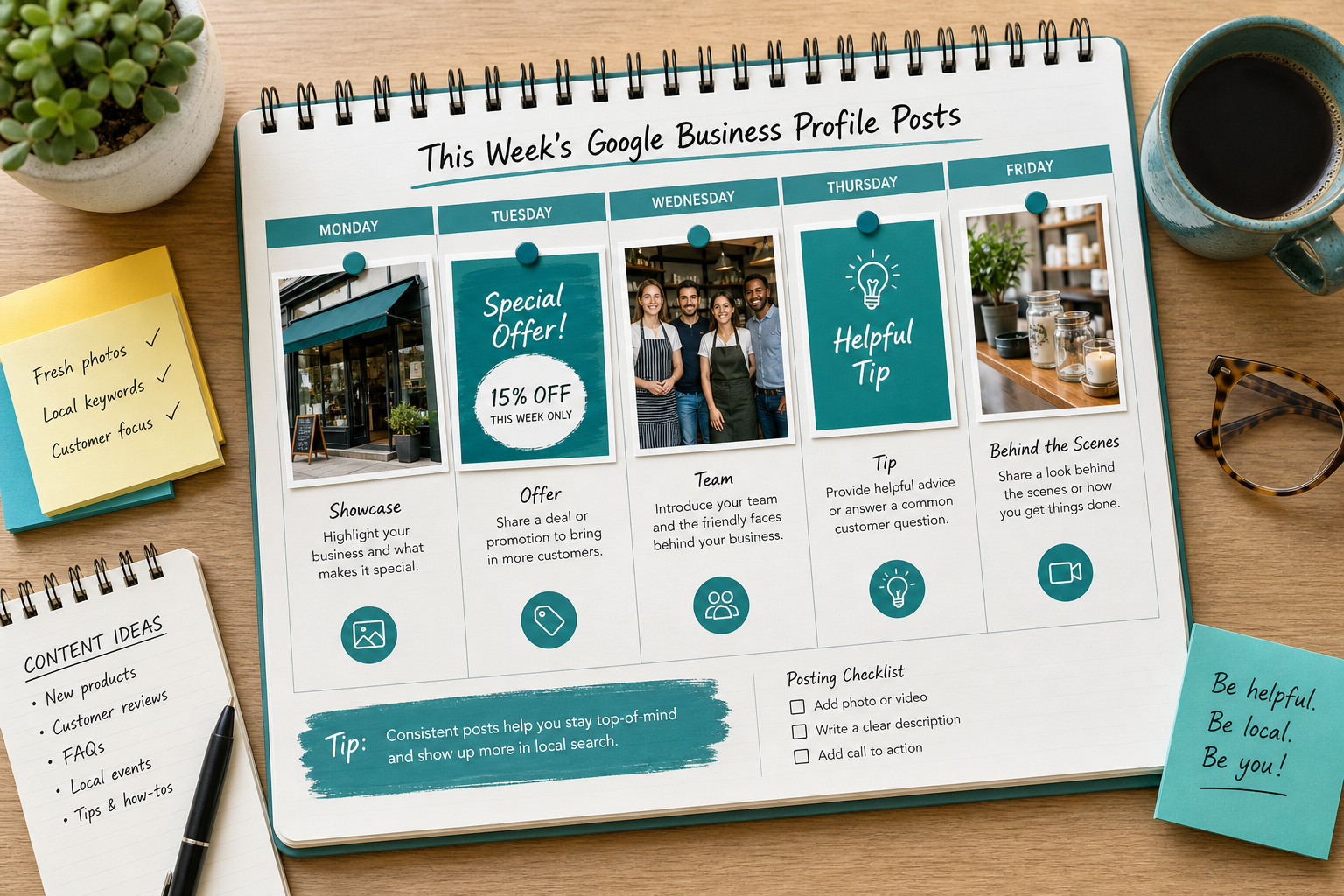
Batch once a month: draft four captions, pick four real photos, schedule publish days, and human-check prices/dates. Multi-location brands should keep a shared calendar with editable local fields (neighborhood, hours, phone) so posts do not feel corporate-generic. For templates and workflows, see our weekly Google post strategy and GBP posts guide .
Write for mobile thumbs first. Lead with the customer outcome in the first line, keep the body scannable, and match the CTA button to the real next step (Call now for emergencies, Book for appointment businesses, Learn more when the landing page carries the details). If the button promises one thing and the destination delivers another, you train Google and customers to distrust your listing.
How to Measure Whether Posts Are Helping
Stop arguing about ranking theory without a measurement frame. Run a simple 30–60 day test: Treat “How to Measure Whether Posts Are Helping” as an operating checklist—not a one-time edit—so rankings compound instead of resetting every month.
- Baseline 2 weeks: Insights for calls, direction requests, website clicks, and photo views
- Baseline ranks: neighborhood grid for 3–5 money keywords (not only HQ)
- Intervention: publish 1–2 quality posts weekly + 3–5 fresh photos weekly
- Hold constants: do not change primary category mid-test unless it is clearly wrong
- Compare: engagement per impression, calls, and grid averages—not vanity screenshots
| Metric | Where to check | What “good” looks like | If it stays flat… |
|---|---|---|---|
| Calls from listing | GBP Insights | Up vs prior 28 days after offers/CTAs | Strengthen CTA + phone UX + offer clarity |
| Direction requests | GBP Insights | Stable/up for storefronts | Fix pin, parking info, hours accuracy |
| Website clicks | GBP Insights | Up when “Learn more” is used | Landing page speed/relevance issues |
| Post views / photo views | Insights / post stats | Healthy view volume on new creatives | Upgrade real photography |
| Grid rank (core keywords) | Local rank tracker | Hold or slight lift over 4–8 weeks | Revisit categories, reviews, citations first |
| Conversion at same rank | Calls ÷ map impressions | Rising even if rank is flat | Keep posting—rank was never the only goal |
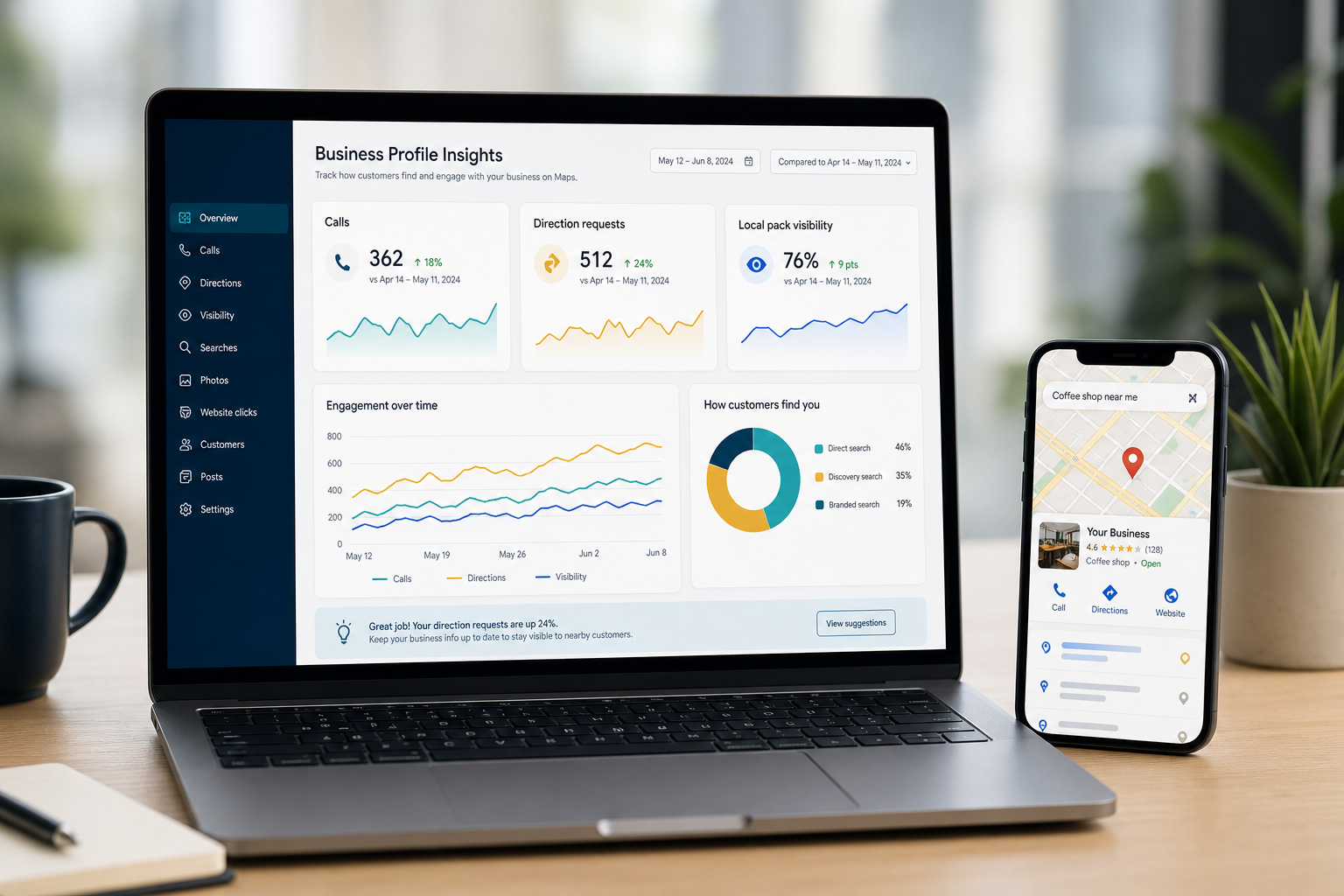
Teams using GBP Local Ranker should pair Insights with neighborhood grids so “rank” is measured where customers actually search—not only from the office. That is how you avoid false positives and false negatives.
When Posts Matter Most (and When They Matter Least)
High leverage situations
- Seasonal demand spikes (festivals, weather, tax season, back-to-school)
- New service launches that reviews have not caught up to yet
- Appointment businesses that need a clear “Call / Book” reason today
- Competitive pack markets where creative differentiation wins the tap
- Multi-location brands coordinating promotions without rebuilding every website page
Lower leverage situations
- Brand-new listings that are not verified or have incomplete categories
- Suspended or restricted profiles (fix the policy issue first)
- Categories where proximity dominates and you are simply too far
- Markets with almost no competitor activity and you already own the pack

A Better Mental Model for 2026
Think of Google Posts like window displays and sidewalk chalkboards—not like backlinks. Window displays do not rewrite the zoning map of the city (proximity), and they do not replace a great reputation (reviews). They do decide whether a passerby stops, reads, and walks in. In Maps, the “passerby” is already looking at three options. Your job is to be the obvious choice.
Agencies should price and report posts that way too. Sell a posting program as part of profile management and conversion optimization—not as a guaranteed #1 ranking package. Clients stay happier when reporting shows calls, direction requests, and creative tests alongside rank grids. That honesty also protects your reputation when Google’s local algorithm shifts again, because your value was never tied to one unverifiable lever.
So the honest 2026 playbook is: Treat “A Better Mental Model for 2026” as an operating checklist—not a one-time edit—so rankings compound instead of resetting every month.
- Fix ranking foundations first: category, NAP, pin, reviews, photos, spam defense
- Publish useful posts on a weekly rhythm for conversion and freshness
- Measure calls and direction requests alongside grid ranks
- Never buy the myth that posts alone are a Map Pack hack
- Never buy the opposite myth that posts are worthless
For deeper tactics on creative angles and SEO-adjacent benefits, continue with Google Posts SEO benefits and the broader Google Maps SEO guide .
Final Takeaway
Do GBP posts actually help rankings anymore in 2026? Not as a proven, primary, direct ranking switch —and anyone selling that story is overselling. Do they still deserve a permanent place in your local SEO system? Yes , because they reliably help engagement, trust, and conversion, and those outcomes are how local businesses win customers even when pack positions move slowly. Post like a careful operator, measure like an analyst, and put your heaviest lift on categories, reviews, and real proximity—then let posts multiply the value of that foundation.
Frequently Asked Questions
Do Google Business Profile posts improve Map Pack rankings in 2026?
There is no strong public evidence that posts are a major direct Map Pack ranking factor in 2026. They are more likely to help indirectly through engagement and freshness, and they clearly help conversion (calls and clicks) when creatives and CTAs are strong.
How often should I post on Google Business Profile for SEO?
Most local businesses should publish one to two high-quality posts per week. Consistency beats bursts of spam. Competitive niches can stay at the higher end; quiet niches can do well with weekly updates plus fresh photos.
Are offers better than update posts for rankings?
Offers usually win on conversion because they create urgency and a clear CTA. Updates win on education and brand trust. Neither is a guaranteed rank booster. Rotate both so your profile stays useful without sounding like a permanent discount banner.
Can posting too much hurt my Google ranking?
Low-quality, repetitive, keyword-stuffed, or misleading posts can hurt trust and may create policy risk. Volume without value is a waste of time and can make the profile look spammy. Quality and honesty matter more than daily posting.
If posts do not strongly rank, why bother?
Because local SEO is not only about position—it is about winning the customer once they see you. Posts improve the creative on your listing, highlight timely services, and drive calls even when you sit at #2 or #3. That revenue effect is often larger than a tiny rank nudge.
What should I fix before investing in a posting calendar?
Verify ownership, correct the primary category, confirm the map pin and NAP, unlock a steady review-request process, and upload real photos. Posts amplify a healthy profile; they rarely rescue a broken one.
How long until I see results from consistent Google Posts?
Engagement changes (views, calls from strong offers) can appear within days to a few weeks. Rank movement—if any—is usually slower and mixed with other factors, so evaluate over 30–60 days with Insights plus neighborhood rank grids.