A local SEO checker for small business should answer one practical question: what is the most useful improvement you can make next? Owner-operated companies rarely need a dense dashboard or a hundred-point audit every morning. They need a repeatable, affordable routine that catches costly errors, shows whether visibility is moving, and connects online activity to calls, bookings, visits, and sales.
This guide provides that routine. It covers Google Business Profile (GBP), local rankings, reviews, website health, name-address-phone (NAP) consistency, local pages, conversions, software selection, and prioritization. No checker can guarantee rankings or revenue. Search results vary by location, query, competition, and Google updates, so use scores as diagnostic signals rather than promises.
What a Useful Local SEO Checker Should Measure
A useful checker combines six views: profile accuracy, geographic visibility, customer reputation, website readiness, off-site consistency, and conversion performance. A perfect profile score means little if the phone number is broken. Measure the complete path from discovery to a qualified inquiry.
- <strong>Accuracy:</strong> Are your business details correct everywhere customers may find them?
- <strong>Visibility:</strong> Where do you appear for valuable searches across the real service area?
- <strong>Trust:</strong> Are recent reviews, responses, photos, and third-party mentions reassuring?
- <strong>Experience:</strong> Can a mobile visitor understand the offer and act quickly?
- <strong>Outcomes:</strong> Are calls, forms, bookings, and qualified leads improving?
- <strong>Priority:</strong> Which fix has the best likely impact relative to cost, time, and risk?
The Affordable Weekly Check: 30 Minutes
Set one weekly appointment and use the same checklist. Spend five minutes reviewing GBP fields and alerts, five on rankings, five on reviews, five on website actions, five on citations or local pages, and five choosing one task. Consistency matters more than running a giant audit once and ignoring it for six months.
Record the date, observation, action, and owner in a simple sheet. Note unusual events such as a closure, redesign, promotion, or tracking failure so you do not attribute every movement to SEO. Try the free local SEO tools first, then pay when automation saves meaningful time.
Check Your Google Business Profile
View the live listing as a customer, not only through the management interface. Confirm the real-world business name, primary category, address or service area, phone, website, regular hours, special hours, services, attributes, and appointment link. Test both the call and website buttons. Watch for unexpected user suggestions, duplicate profiles, ownership changes, or edits made by Google.
Review recent photos and public questions. Add current, original images when they help people recognize the location, team, work, or product. Do not stuff keywords into the business name, select unrelated categories, or create locations that are not eligible. The GBP Audit Center can organize recurring checks, but a person should confirm policy and factual accuracy.
Check Local Rankings Without Fooling Yourself
Searching your own business from one phone is unreliable. Local results change with the searcher's location and query. Track a small group of high-intent phrases, such as a core service plus city, across a geo-grid that reflects where customers actually come from. Keep grid size, pin spacing, device assumptions, and scan schedule consistent so comparisons are meaningful.
Look at top-three coverage, average position, weak neighborhoods, and competitors that repeatedly appear. Review monthly trends instead of reacting to one scan. Add or remove keywords only when the business changes or search intent proves irrelevant. The Local Rank Tracker supports repeatable measurement, while the Keyword Research tool helps identify phrases worth monitoring.
Pair rankings with sessions, GBP interactions, calls, bookings, and lead quality. For the wider framework, read how to rank higher on Google Maps in 2026.
Check Reviews and Customer Trust
Each week, note new reviews, average rating, response status, recurring themes, and suspicious activity. Respond helpfully without sharing private customer information. Ask eligible customers for honest feedback after a genuine transaction, and make the link easy to use. Never buy reviews, gate unhappy customers, require a positive rating, or use incentives that violate platform rules.
Treat repeated criticism as operating data. Complaints about unanswered calls, unclear pricing, delays, or parking may expose conversion problems that SEO software cannot fix. The AI Review Manager can help draft and organize responses, but edit every reply for accuracy, empathy, and brand voice.
Check the Website and Local Pages
Open the site on a phone using mobile data. Confirm that it loads, the main offer is obvious, text is readable, navigation works, and calls or forms can be completed. Check that important service and location pages are indexable, have unique titles and headings, and answer real buying questions. Broken forms and confusing contact details deserve higher priority than minor metadata refinements.
A useful local page should contain genuinely local information: services available there, hours, staff or facility details, directions, parking or accessibility notes, service boundaries, original photos, proof, FAQs, and a clear next step. Avoid dozens of pages that merely swap city names. Thin doorway pages waste crawl attention and give visitors little reason to trust the business.
Check NAP Consistency and Citations
Compare the official business name, address, and primary phone across GBP, the website, Apple Maps, Bing Places, major directories, industry sites, and important local organizations. Focus on material conflicts: an old address, disconnected number, duplicate listing, incorrect map pin, or outdated business name. Differences such as “Street” versus “St.” usually matter less.
Log each listing URL, owner, status, and review date. Fix trusted platforms before paying for mass distribution; accurate, relevant profiles matter more than hundreds of weak submissions. Recheck after a move, rebrand, or phone change.
Check Conversion Before Chasing More Traffic
Run a real test call, form submission, booking, and directions request where appropriate. Confirm the right person receives notifications and follows up. Do not collect more customer data than needed, and follow applicable privacy and call-recording requirements.
Review qualified leads, not just clicks. A plumber may value booked emergency jobs; a clinic may value suitable appointment requests; a retailer may value direction requests and in-store purchases. Write down one primary conversion and two supporting indicators. This keeps the local SEO checker aligned with business economics rather than vanity metrics.
Prioritize Findings with an Impact-Effort-Risk Filter
Give each finding a simple high, medium, or low rating for expected customer impact, effort, and risk. Fix accurate-information and conversion failures first: wrong hours, dead phone numbers, broken forms, duplicate profiles, suspended listings, hacked pages, or misleading addresses. Next address weak service pages, review-response gaps, missing categories, and important citation conflicts.
Schedule experiments such as new page sections, photo routines, and review requests only after the foundation works. Limit the weekly work queue to one meaningful task. Document the change and wait long enough to evaluate it. Simultaneous edits make diagnosis difficult, while constant category or page changes can introduce avoidable risk.
How to Choose Local SEO Checker Software
Start with the workflow, not the feature list. Decide which manual checks consume time, how many locations and keywords you manage, who needs reports, and what decisions the data should support. Then compare total monthly cost, setup time, cancellation terms, export access, scan credits, integrations, location limits, and support.
- <strong>Required:</strong> accurate GBP auditing, geo-specific rank tracking, clear issue explanations, and exportable history.
- <strong>Helpful:</strong> review workflows, citation monitoring, annotations, scheduled reports, and role-based access.
- <strong>Evidence:</strong> transparent methodology, sample reports, current documentation, and a trial or low-risk entry plan.
- <strong>Fit:</strong> pricing that remains sensible as keywords, grid points, users, or locations increase.
Test with one location and five valuable keywords. Compare pricing against the labor replaced and decisions improved; unused features and false alarms provide no value.
Red Flags in Tools, Reports, and Providers
- Guaranteed number-one rankings, guaranteed map-pack placement, or fixed revenue promises.
- A single unexplained score presented as proof that SEO is working.
- Ranking screenshots without query, date, location, grid, or comparison period.
- Recommendations to buy reviews, add keywords to the legal business name, or create fake offices.
- Hundreds of automated directory submissions with no quality or duplicate control.
- Reports that hide conversion tracking, ownership, pricing limits, or data-export options.
Ask how scores are calculated and distinguish confirmed errors from suggestions. Software may not understand a closure, seasonal number, or regulated service. Keep the business in control of profiles, domains, analytics, and logins.
DIY Local SEO Checker vs Hiring Help
DIY is reasonable for one uncomplicated location when the owner can spare 30 minutes weekly and complete occasional fixes. Software can reduce repetitive checking, but someone still needs to interpret findings and coordinate operations. Use a specialist when facing suspension, multi-location complexity, a migration, persistent technical problems, aggressive competition, or work that exceeds available time.
When hiring, request a baseline, scope, access policy, change log, reporting cadence, and cancellation terms. Confirm ownership of pages and accounts. A responsible provider explains uncertainty and reports business outcomes alongside rankings.
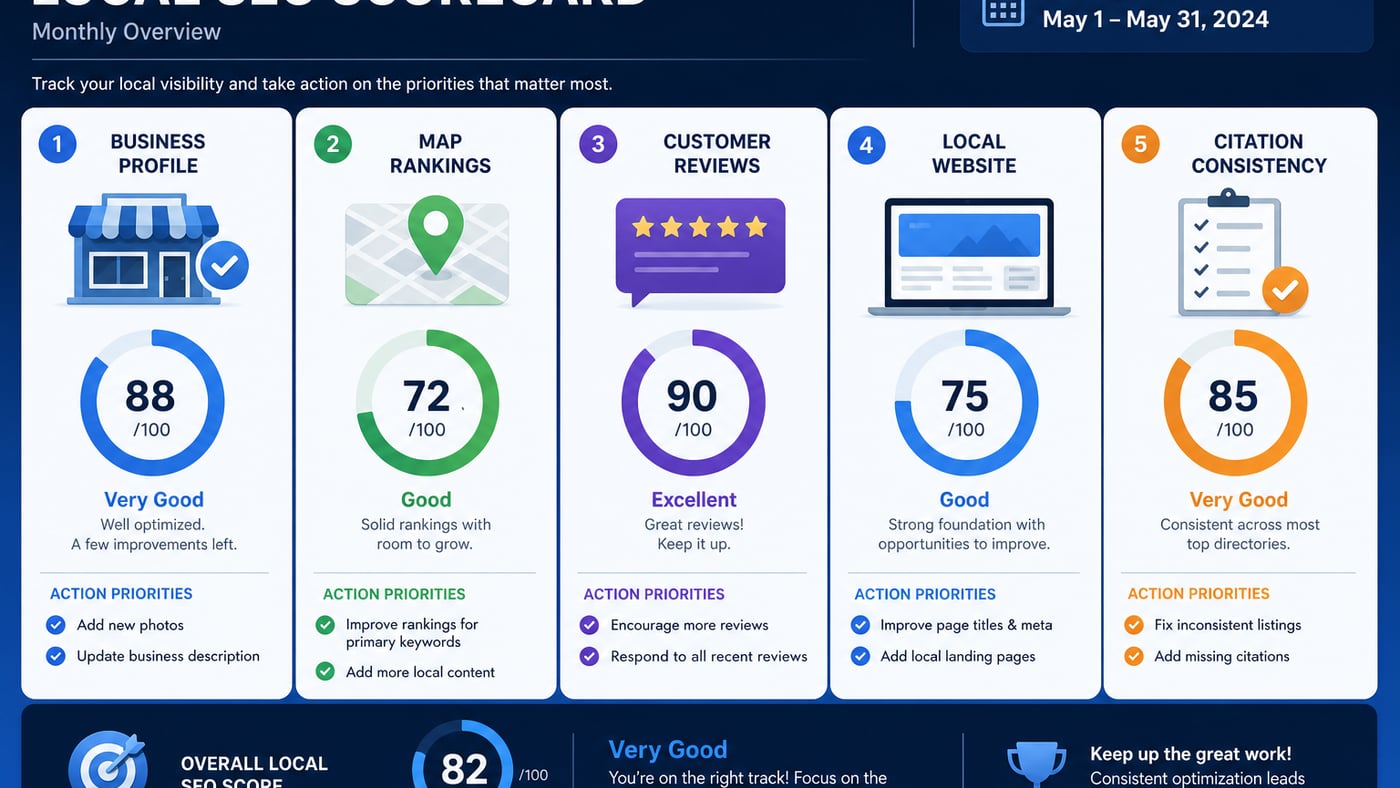
Build a Monthly Local SEO Scorecard
Use the same measures monthly. Score each area zero to two: zero means broken or unknown, one needs attention, and two is accurate and monitored. The total prioritizes work; it is not an industry benchmark. Add a note explaining each score.
- <strong>GBP:</strong> accurate fields, active ownership, correct hours, useful media, no unresolved alerts.
- <strong>Rankings:</strong> consistent grid tracking for five to ten valuable queries with monthly trend notes.
- <strong>Reviews:</strong> ethical request process, current responses, and documented recurring themes.
- <strong>Website:</strong> mobile usability, working conversions, indexable service and local pages.
- <strong>NAP and citations:</strong> no material conflicts on priority platforms.
- <strong>Conversions:</strong> tested tracking plus monthly qualified leads from local search.
List the month's biggest win, unresolved risk, next action, owner, and due date. Save each snapshot. Over time, the scorecard reveals whether execution improves even when rankings fluctuate.
A 30-Day Local SEO Checking Plan
Days 1–7: Establish the Baseline
Verify GBP ownership and every customer-facing field. Choose five to ten commercial keywords and run a consistent grid scan. Test calls, forms, and bookings. Capture current review metrics, major citations, organic sessions, and qualified leads. Create the scorecard and change log before editing anything.
Days 8–14: Repair Accuracy and Access
Correct wrong hours, phone numbers, links, map pins, and high-value citation conflicts. Remove former users from business accounts and assign access through company-controlled credentials. Resolve duplicate or ineligible profiles carefully. Fix broken tracking and conversion paths so later results can be measured.
Days 15–21: Improve Trust and Local Relevance
Respond to unanswered reviews, launch a policy-compliant request routine, and upload helpful original photos. Strengthen the most important service or location page with specific local information, proof, FAQs, and a clear action. Avoid publishing multiple thin pages simply to target nearby towns.
Days 22–30: Review and Choose the Next Cycle
Repeat the weekly checks, but do not expect every metric to move in one month. Confirm that repaired items stayed correct, compare early leading indicators, and record what changed. Select one priority for the next month based on impact, effort, and risk. Continue only the routines the team can sustain.
Final Takeaway
Consistency compounds, spam collapses.