Owners with limited time and budget constantly ask the same question: should the next hour go into the Google Business Profile or the website? The honest answer is that they compete for different search real estate and rarely substitute for each other cleanly. Understanding which one drives which type of customer decision is far more useful than trying to declare an overall winner.
This guide breaks down what each channel actually controls, when one clearly deserves more attention than the other, and how the two reinforce each other when built together instead of in isolation.
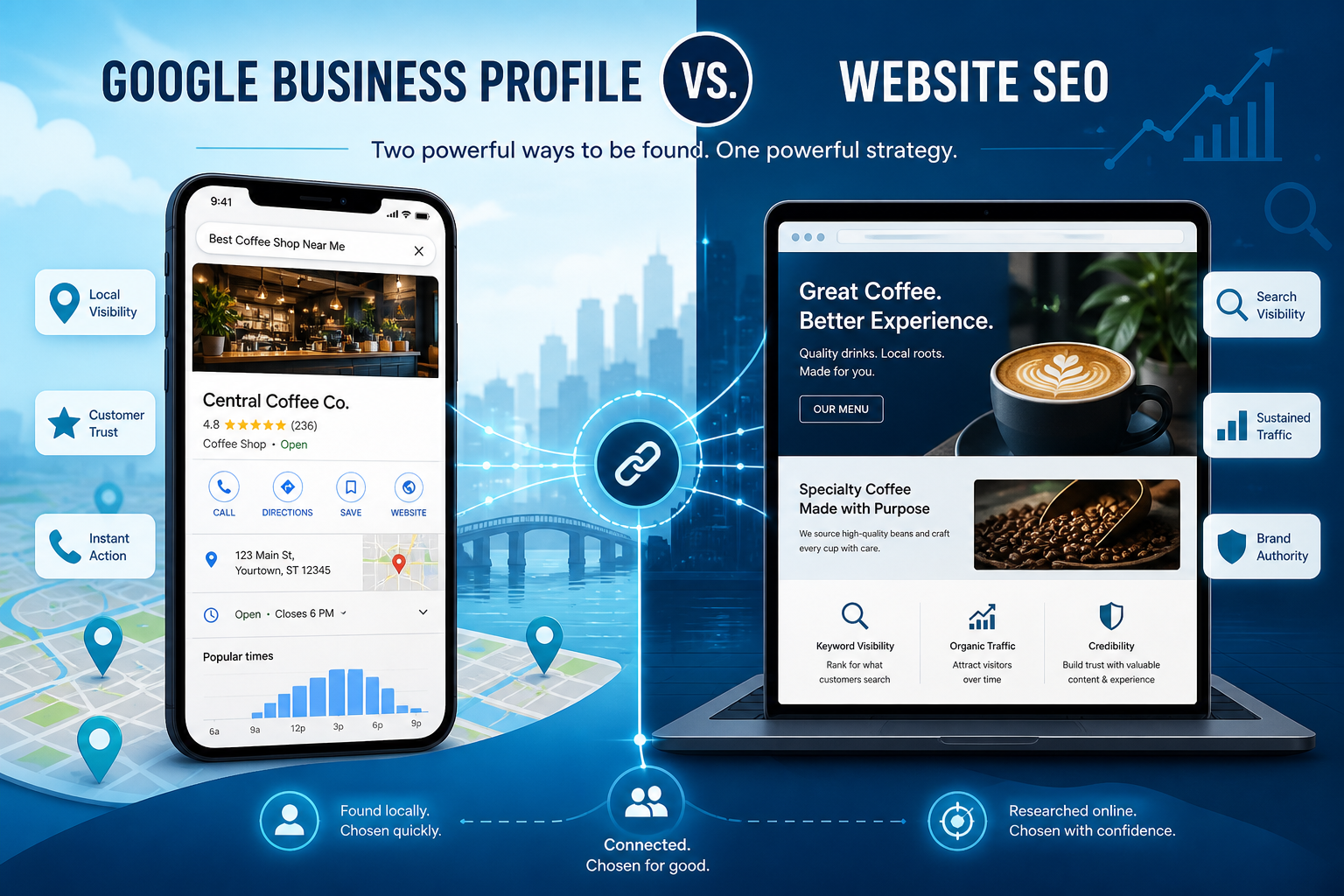
Two Different Battlefields: Map Pack vs Organic Results
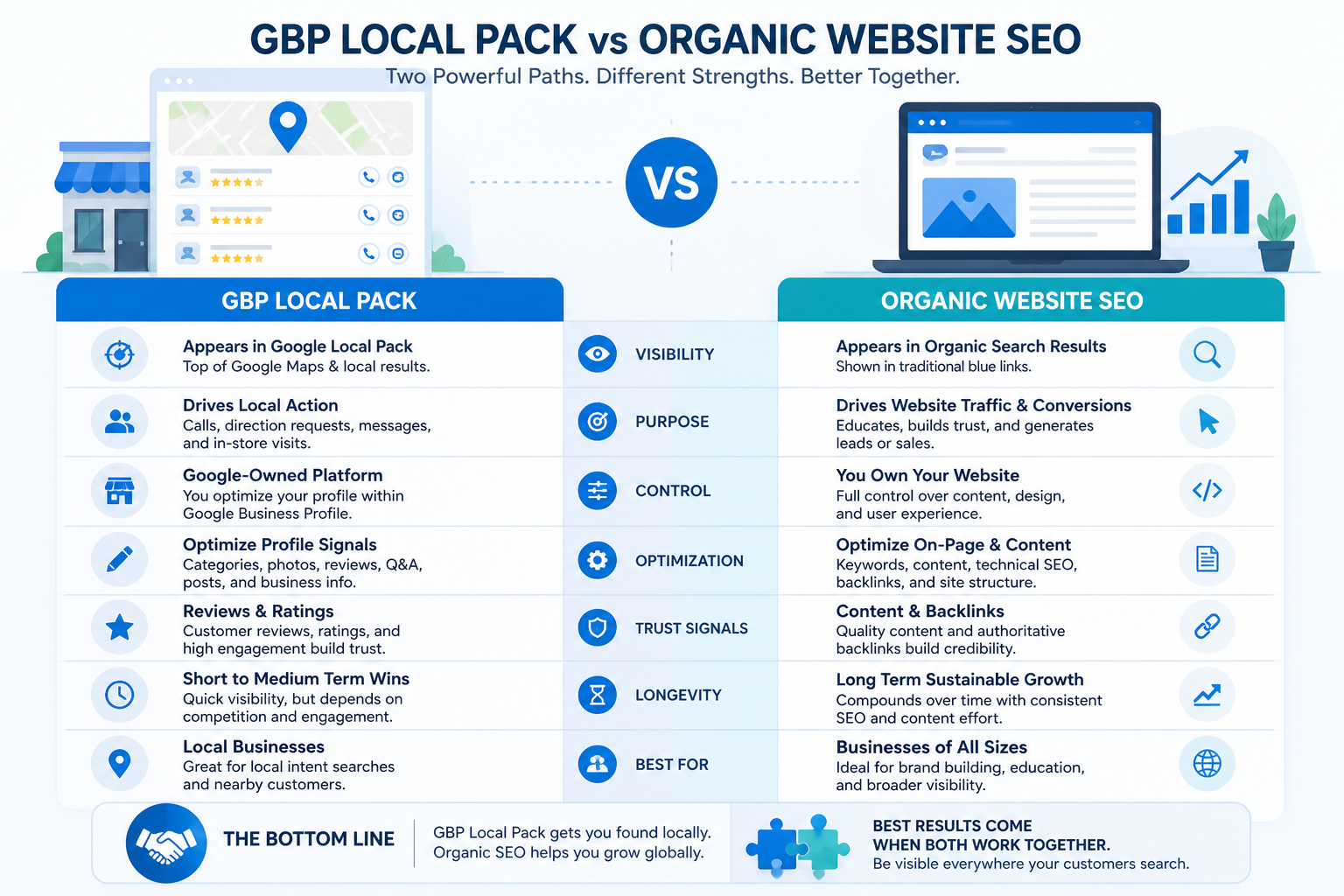
The Map Pack and the organic results below it are technically on the same search page but behave like separate competitions. Map Pack ranking is driven heavily by proximity, category accuracy, and reviews on your profile. Organic ranking is driven by your website's content depth, technical performance, backlink profile, and topical authority. A business can dominate one and barely register in the other, especially in competitive niches with strong national content sites.
What Your Google Business Profile Controls That Your Website Cannot
Your profile owns the map pin, the click-to-call button, the direction request flow, and the review display that appears directly in search and Maps results. For a huge share of local intent searches—"near me," "open now," "call now"—the profile is the entire decision surface, and a searcher may never visit your website at all before calling or driving over.
What Your Website Controls That Your Profile Cannot
Your website owns depth: detailed service explanations, pricing context, case studies, blog content that answers research-stage questions, and the technical infrastructure like page speed and structured data that support broader organic visibility. It is also the only place you fully control design, messaging, and conversion flow without Google's formatting constraints.
| Capability | Google Business Profile | Website |
|---|---|---|
| Map pin and directions | Full control | No influence |
| Detailed service pages | Very limited | Full control |
| Reviews display in search | Full control | No influence |
| Blog / research-stage content | Not possible | Full control |
| Click-to-call in search results | Full control | Indirect only |
| Design and conversion flow | Minimal (templated) | Full control |
When Google Business Profile Matters More
For single-location and multi-location storefront businesses—restaurants, clinics, salons, repair shops—the profile usually drives a larger share of near-term revenue because customers are searching with immediate intent. If your budget only stretches to one channel this quarter, and you have never properly optimized your profile, that is almost always the higher-leverage starting point.
When Website SEO Matters More
Businesses selling higher-consideration services—B2B services, legal work, larger home renovations—often see customers research extensively before ever searching for a specific nearby provider. In these cases, a strong website that ranks for informational and comparison queries can capture demand long before a customer searches with local intent at all. Ecommerce and multi-region service businesses without a meaningful physical storefront also lean more heavily on website SEO by necessity.
| Business type | Primary channel | Reasoning |
|---|---|---|
| Restaurant / salon / clinic | Google Business Profile | High immediate local intent, map-driven decisions |
| Home services (plumber, electrician) | Both, profile first | Urgent local intent plus research for larger jobs |
| B2B / professional services | Website first | Longer research cycle before local search |
| Ecommerce / multi-region | Website | Limited physical proximity relevance |
| Franchise / multi-location retail | Both, tightly coordinated | Local intent per location plus brand-wide content |
A Common Trap: Treating Them as Competing Budgets
Many small businesses unintentionally frame this as a zero-sum budget fight, where every rupee or dollar spent on the website is perceived as a rupee or dollar taken away from Google Business Profile work, and vice versa. This framing leads to underinvestment in whichever channel loses the internal argument, even when both genuinely deserve attention. In practice, foundational profile optimization costs very little beyond time, which means the "competition" for budget mostly applies to ongoing content, advertising, and agency support rather than the core setup work itself.
A more useful framing treats both channels as part of one local visibility budget with different jobs: the profile captures and converts immediate local intent, while the website builds longer-term authority and captures research-stage demand. Once framed this way, the conversation shifts from "which one deserves the budget" to "what does each channel need to do its specific job well," which tends to produce more balanced, less politically charged decisions inside a marketing team.
How They Reinforce Each Other
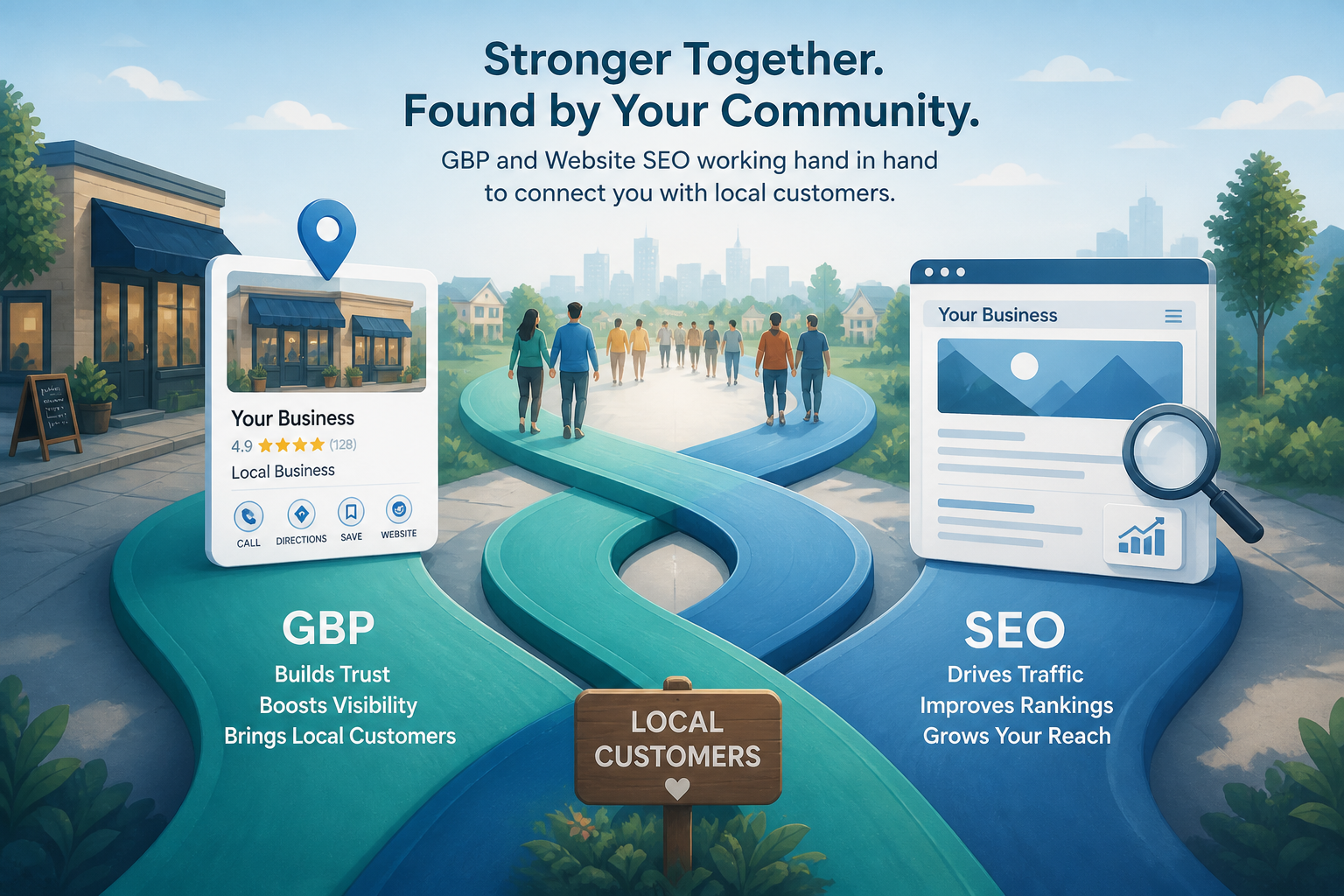
A strong website supports profile prominence through backlinks, brand search volume, and consistent NAP citations. A strong profile sends qualified, ready-to-convert traffic to well-matched local landing pages on the website, improving conversion rates and dwell time that indirectly support broader SEO signals. Treating them as one connected system, as outlined in our local SEO playbook and GMB optimization guide , consistently outperforms optimizing either one in isolation.
A Practical Resource Allocation Framework
Start by identifying whether your typical customer searches with immediate local intent or researches extensively first—that answer alone should guide roughly 60 to 70 percent of your near-term effort. Then commit a smaller, steady portion of time to the other channel so it does not fall completely behind. Use rank tracking through GBP Local Ranker alongside standard website analytics so you can see, with real numbers, which channel is actually producing calls and revenue rather than relying on which one feels more urgent.
Revisit this allocation every quarter rather than setting it once and forgetting it. A business that opens a second location shifts back toward heavier profile work for a period. A business that starts selling nationally through the website shifts the other way. The right split is a moving target tied to how your business actually operates, not a fixed formula you can set in January and ignore for the rest of the year.
What Agencies Should Tell Clients Who Ask This Question
Agencies field this exact question constantly, and the honest answer requires resisting the temptation to just recommend whichever service the agency happens to sell more of. A responsible answer starts with understanding the client's actual customer behavior and current gaps, not with a default pitch. Clients respect this kind of honest diagnosis far more than a one-size-fits-all recommendation, and it tends to produce better long-term retention because the strategy genuinely fits their business instead of fitting the agency's service catalog.
When a client genuinely cannot afford both channels at a meaningful level, it is worth being direct about the trade-off rather than promising strong results from an underfunded effort split thinly across two fronts. A well-executed single-channel strategy usually outperforms two half-hearted efforts running in parallel, at least until the budget grows enough to support both properly.
A Simple Decision Test for Your Next Marketing Hour
When you genuinely cannot decide where to spend the next available hour of marketing time, ask a concrete question: if a customer needed this service in the next hour, would they search "near me" and call the first result, or would they research options over several days before ever mentioning a location? The first pattern points toward the profile; the second points toward the website. Most businesses can answer this honestly within a minute once they picture their actual last few customers rather than an abstract idea of who they serve.
It is also worth asking where you are furthest behind competitors, since catching up on a badly neglected channel often produces faster relative gains than polishing an already-strong one further. A business with an excellent website and a barely-touched profile will likely see more return from an hour spent on the profile than from another hour refining website copy that is already performing reasonably well.
A Note for Businesses Just Starting Out
Brand-new businesses with a genuinely tight budget and no existing presence anywhere often get the most value from starting with the Google Business Profile, simply because it is free to claim and optimize, and it can start producing calls and visibility within weeks rather than the months typically required to build meaningful organic website authority from a completely blank domain. This is not a permanent strategy—the website still deserves investment as the business grows—but it is a sensible, low-risk starting sequence for a founder juggling limited time and money in the earliest months.
Final Takeaway
Neither Google Business Profile nor website SEO wins this debate universally—the right emphasis depends on how your specific customers search and decide. Storefront and urgent-need businesses should generally lean profile-first; research-heavy and less location-bound businesses should lean website-first. The businesses that grow fastest, though, are the ones that eventually build both together instead of treating the question as a permanent either-or choice.
Frequently Asked Questions
Can a strong Google Business Profile compensate for a weak website?
To a degree for immediate local intent searches, yes. But a weak website still hurts conversion once customers click through, and it limits broader organic visibility over time.
Can a strong website compensate for a weak Google Business Profile?
Only partially. The Map Pack occupies prime search real estate that a website simply cannot claim on its own, so a weak profile still costs you visible local visibility.
Which channel should a brand-new local business prioritize first?
For most new local businesses, a fully optimized Google Business Profile produces faster, more measurable early results than building website authority from zero.
Do reviews on my profile affect my website ranking?
Not directly, but strong reviews build brand trust and search volume that can indirectly support broader organic visibility over time.
Should ecommerce businesses bother with a Google Business Profile?
Only if there is a genuine physical location or service area relevant to local search. Purely online, non-local ecommerce sees limited benefit from Maps visibility.
How much budget should go to each channel?
There is no universal ratio—base it on how your customers actually search, then adjust using real performance data rather than a fixed rule of thumb.
Is it a mistake to only invest in one channel long-term?
Usually yes. Even businesses that lean heavily on one channel benefit from at least a baseline investment in the other to avoid leaving visibility and revenue on the table.